


Pet Food Ingredients Market by Source (Plant, Animal, Synthetic) & Pet Type: Forecast to 2036
Pet Food Ingredients Market Conventional Ingredients Lead Nature Demand at 82.0%
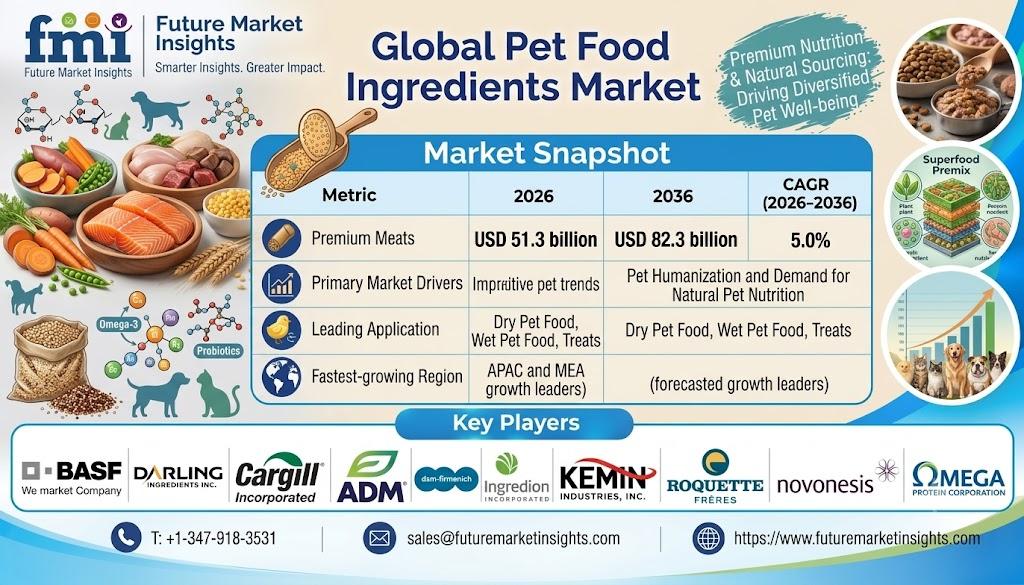
The global pet food ingredients market is forecast to increase from USD 51.3 billion in 2026 to USD 82.3 billion by 2036, expanding at a 5.0% CAGR during the 2026–2036 forecast period, according to Future Market Insights. The market stood at USD 48.9 billion in 2025.
Demand is supported by recurring pet feeding, continued pet ownership, and ongoing reformulation around protein quality, digestive health, palatability, shelf stability, and targeted wellness benefits. Ingredient suppliers are increasingly evaluated on nutritional contribution, process performance, regulatory fit, documentation, and reliable supply for recurring pet food production.
Get detailed market forecasts, competitive benchmarking, and pricing trends: https://www.futuremarketinsights.com/reports/sample/rep-gb-14311
Global Segment Leaders
As this report covers global industry demand, segment insights highlight key ingredient characteristics, ingredient categories, and animal types.
Conventional Ingredients — 82.0% of Nature demand in 2026: Maintain a dominant position because established animal, grain, and plant ingredient streams offer sourcing depth, manufacturing familiarity, and established qualification pathways.
Protein — 24.0% of Ingredient Type demand in 2026: Leads as amino-acid delivery remains central to complete nutrition, while protein ingredients also contribute to texture, palatability, and formulation performance.
Dogs — 59.0% of Animal Type demand in 2026: Represent the largest demand share, supported by substantial ownership populations and consumption across dry food, wet food, treats, and specialized diets.
Market Growth Drivers
The pet food ingredients market is increasingly shaped by manufacturers' requirements for nutritional performance, formulation consistency, safety, and dependable ingredient supply.
Recurring Pet Feeding:
Continuous feeding creates recurring demand for ingredients as manufacturers supply products for established household pet populations.
Nutritional Reformulation:
Pet food producers continue to adjust formulations around protein quality, digestive health, palatability, shelf stability, and targeted wellness benefits.
Process Performance:
Ingredient selection depends not only on nutritional contribution but also on how reliably ingredients perform during manufacturing, storage, and finished-product production.
Regulatory Compliance:
Ingredient changes require safety, legal-use, processing, species-specific, and documentation checks before manufacturers approve commercial-scale reformulation.
Supply Reliability:
Consistent sourcing and dependable ingredient availability remain important as manufacturers seek to maintain uninterrupted production and minimize qualification and procurement risks.
Regional Context
Market growth varies by country as pet populations, manufacturing concentration, ingredient regulations, biosecurity requirements, and documentation standards influence supplier qualification.
The American Pet Products Association reported 95 million U.S. households with pets in 2025, illustrating the scale of the downstream consumer base supporting recurring pet food consumption. In the United Kingdom, UK Pet Food estimated 15.5 million dogs in 2026, highlighting the importance of established companion-animal populations in ingredient demand.
Australia applies tight biosecurity controls to imported animal feed, while several other markets require detailed ingredient or facility documentation. These requirements can influence sourcing decisions, supplier qualification, and the time required to approve ingredient changes.
The broader pet food market also benefits from repeat feeding patterns, keeping nutritional formulation closely connected to household pet ownership and ongoing consumption.
Manufacturers increasingly evaluate ingredients according to nutritional contribution, safety, processing compatibility, species suitability, documentation, and supply reliability. Suppliers capable of combining functional performance with regulatory support can help manufacturers reduce qualification complexity during reformulation.
Competitive Landscape
The pet food ingredients market features established ingredient suppliers competing across nutritional functionality, processing performance, regulatory support, sourcing reliability, documentation, and application expertise.
Key companies include BASF SE, Darling Ingredients Inc., Cargill, Incorporated, ADM, dsm-firmenich, Ingredion Incorporated, Kemin Industries, Inc., Roquette Frères, Novonesis, and Omega Protein Corporation.
Large Ingredient Suppliers: BASF SE, Cargill, Incorporated, ADM, and dsm-firmenich participate through broad ingredient portfolios, technical capabilities, sourcing networks, and support for large-scale food and feed manufacturers.
Functional & Specialty Ingredient Providers: Ingredion Incorporated, Kemin Industries, Inc., Roquette Frères, and Novonesis participate through specialized ingredient and functional solutions addressing nutritional, processing, and formulation requirements.
Animal-Derived & Nutritional Ingredient Suppliers: Darling Ingredients Inc. and Omega Protein Corporation participate through ingredient portfolios serving nutritional and formulation requirements in pet food applications.
Competition centers on nutritional contribution, consistent functionality, reliable sourcing, regulatory fit, documentation, processing performance, and the ability to support reformulation as pet food manufacturers respond to evolving nutritional and wellness requirements.
Analyst Perspective
“Pet food manufacturers are not simply buying protein, starch or functional additives. They are buying an ingredient that must work inside a specific process, remain safe for a specific species and arrive with the documentation needed for repeat production. Suppliers that shorten that qualification burden can defend value even in cost-sensitive formulations.”— Nandini Roy Choudhury, Principal Consultant, Future Market Insights
About Future Market Insights (FMI)
Future Market Insights, Inc. (FMI) is an ESOMAR-certified, ISO 9001:2015 market research and consulting organization, trusted by Fortune 500 clients and global enterprises. With operations in the U.S., UK, India, and Dubai, FMI provides data-backed insights and strategic intelligence across 30+ industries and 1200 markets worldwide.
For Press & Corporate Inquiries
Rahul Singh
AVP - Marketing and Growth Strategy
Future Market Insights, Inc.
+91 8600020075
For Sales: sales@futuremarketinsights.com
For Media: Rahul.singh@futuremarketinsights.com
For Web: https://www.futuremarketinsights.com/

 English
 Arabic
 French
 Spanish
 Portuguese
 Deutsch
 Turkish
 Italiano
 Russian
 Romaian
 Portuguese (Brazil)
 Greek
Greek
