


Generative Design Tools Market to Rise at 14.6% CAGR Through 2036
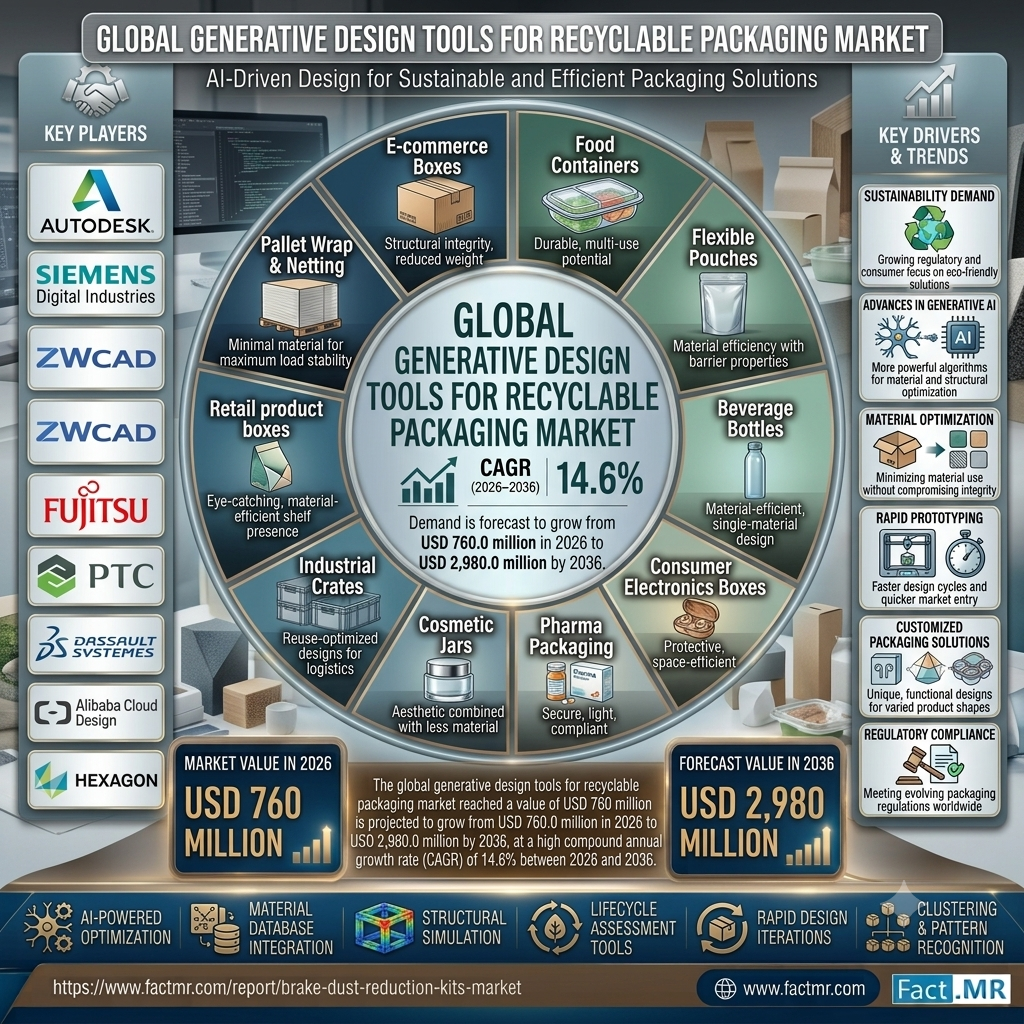
September 7, 2026 — The global generative design tools for recyclable packaging market is projected to reach USD 760 million in 2026 and USD 2,980 million by 2036, expanding at a 14.6% CAGR from 2026 to 2036, according to Fact.MR.
The market is gaining momentum as packaging companies look for better ways to reduce material use while improving recyclability. Generative design tools use algorithm-driven design to create packaging structures that balance weight, strength, cost, and sustainability requirements.
Procurement priorities are also changing. Buyers are expected to focus more closely on tools that support recyclability and reduce material waste. At the same time, risk aversion may favor established suppliers, as changing software can involve training, integration, and operational costs. These factors can encourage longer relationships between packaging companies and technology vendors.
The report's bibliography lists dated sources from 2023 and 2024, including the Organisation for Economic Co-operation and Development (2023), World Economic Forum (2023), European Commission (2023), United Nations Environment Programme (2024), and Journal of Cleaner Production (2024). The supplied report does not state numerical findings from these sources, so no third-party statistics have been added here.
Get detailed market forecasts, competitive benchmarking, and pricing trends: https://www.factmr.com/report/generative-design-tools-for-recyclable-packaging-market
Key Numbers
|
Metric |
Fact.MR Figure |
|
Market value, 2026 |
USD 760 million |
|
Market value, 2036 |
USD 2,980 million |
|
CAGR, 2026–2036 |
14.6% |
|
Leading tool type |
Generative CAD platforms |
|
Generative CAD platforms share |
55% |
|
Leading design focus |
Lightweight & mono-material design |
|
Leading design-focus share |
60% |
|
Fastest country growth |
India |
|
India CAGR, 2026–2036 |
15.6% |
Source: Fact.MR.
Segment Breakdown
Generative CAD platforms lead by tool type. These platforms hold a 55% share of the market. They automate design tasks and allow manufacturers to explore multiple packaging alternatives. This supports the development of packaging solutions designed around material efficiency, cost, and recyclability.
Lightweight and mono-material design leads by design focus. This segment accounts for a 60% share. The approach focuses on reducing material use while maintaining structural integrity. Simpler material structures can also support improved recyclability.
AI-driven topology optimization is a key technology segment. The report identifies it as a leading technology category, while its key takeaways identify a 60% share for the leading technology segment.
The market also covers physics-based simulation combined with AI, cloud-native design tools, and high-fidelity modelling. End-use areas include FMCG and packaging design, sustainable packaging R&D, high-volume packaging, precision packaging, emerging packaging startups, and regional converters.
Country Growth Outlook
|
Country |
CAGR, 2026–2036 |
|
India |
15.6% |
|
China |
15.0% |
|
USA |
13.4% |
|
Germany |
12.8% |
|
Brazil |
11.2% |
|
Japan |
10.8% |
Source: Fact.MR.
India is projected to record the fastest growth among the countries listed. The market is expected to expand at a 15.6% CAGR through 2036 as manufacturers respond to sustainability goals and concerns about packaging waste.
China follows at 15.0% CAGR. Its large manufacturing base and increasing focus on sustainable practices are expected to support adoption of generative design tools.
The U.S. market is forecast to grow at 13.4% CAGR, while Germany is projected to expand at 12.8%. Brazil and Japan are expected to register CAGRs of 11.2% and 10.8%, respectively.
Competitive Landscape
Competition centers on software capabilities, integration with existing design workflows, material optimization, scalability, and sustainability features.
Autodesk and Dassault Systèmes compete through mature design suites that include generative design functions. Their offerings focus on automated geometry creation, lightweight structures, and recyclability criteria.
Siemens Digital Industries and PTC leverage industrial design platforms with simulation and systems integration capabilities. These features appeal to large manufacturers with established engineering workflows.
Fujitsu and Hexagon focus on integrating design with data analytics to support material selection and lifecycle assessment. ZWCAD offers cost-effective CAD capabilities, while Alibaba Cloud Design focuses on cloud-native solutions for distributed teams.
The report identifies Autodesk, Siemens Digital Industries, ZWCAD, Fujitsu, PTC, Dassault Systèmes, Alibaba Cloud Design, and Hexagon as key players. The supplied report does not provide individual company market shares, so no company share percentages are stated.
Analyst Perspective
Ganesh Pai, Principal Consultant at Fact.MR, is identified as the report author.
“Generative design is helping packaging teams evaluate material efficiency and recyclability earlier in the development process. As sustainability requirements increase, these capabilities can become a more important part of packaging design workflows.”
QUOTE STATUS: REQUIRES ANALYST SIGN-OFF. The supplied report does not contain a verbatim quotation from Ganesh Pai. The statement above is an editorially constructed quote based only on the report's published commentary on generative design, recyclability, material efficiency, and procurement priorities.
Frequently Asked Questions
How big is the generative design tools for recyclable packaging market in 2026?
The global market is projected to reach USD 760 million in 2026, according to Fact.MR.
What will the generative design tools for recyclable packaging market be worth in 2036?
The market is forecast to reach USD 2,980 million by 2036.
What is the CAGR of the generative design tools for recyclable packaging market?
The market is projected to grow at a 14.6% CAGR from 2026 to 2036.
Which tool type leads the market?
Generative CAD platforms lead the market with a 55% share.
Which country has the highest projected CAGR?
India has the highest CAGR among the countries listed, at 15.6% from 2026 to 2036.
Top Reports:
https://adamaamresearch.blogspot.com/2026/09/dynamic-signal-analyzer-market-growth.html
https://social.mytamam.com/blogs/37390/Dynamic-Signal-Analyzer-Market-to-Reach-1-79-Billion-by
https://zeuspage.org/blogs/49429/Dynamic-Signal-Analyzer-Market-Set-to-Hit-1-79-Billion
https://kaamkaaziclub.com/read-blog/46537
About the Report
The Generative Design Tools for Recyclable Packaging Market report by Fact.MR analyzes the market by end-use, tool type, design focus, technology, and region. Regions covered include North America, Europe, Asia Pacific, Latin America, and the Middle East & Africa.
The report examines generative CAD platforms, design optimization software, AI-assisted CAD tools, advanced CAD/CAE, lightweight and mono-material design, recyclability-first geometry, cost and material reduction, structural optimisation, AI-driven topology optimization, physics-based simulation with AI, cloud-native design tools, and high-fidelity modelling.
About Fact.MR
Fact.MR is a market research and consulting company providing market intelligence and industry analysis. Its editorial process states that content is researched, fact-checked, reviewed, and updated for accuracy and reliability.

 English
 Arabic
 French
 Spanish
 Deutsch
 Turkish
 Dutch
Dutch
 Italiano
 Russian
 Romaian
 Portuguese (Brazil)
 Greek
Greek
