


Thermoplastic Vulcanizate Market Projected at USD 3.39 Billion by 2036; France Expands at 4.5%
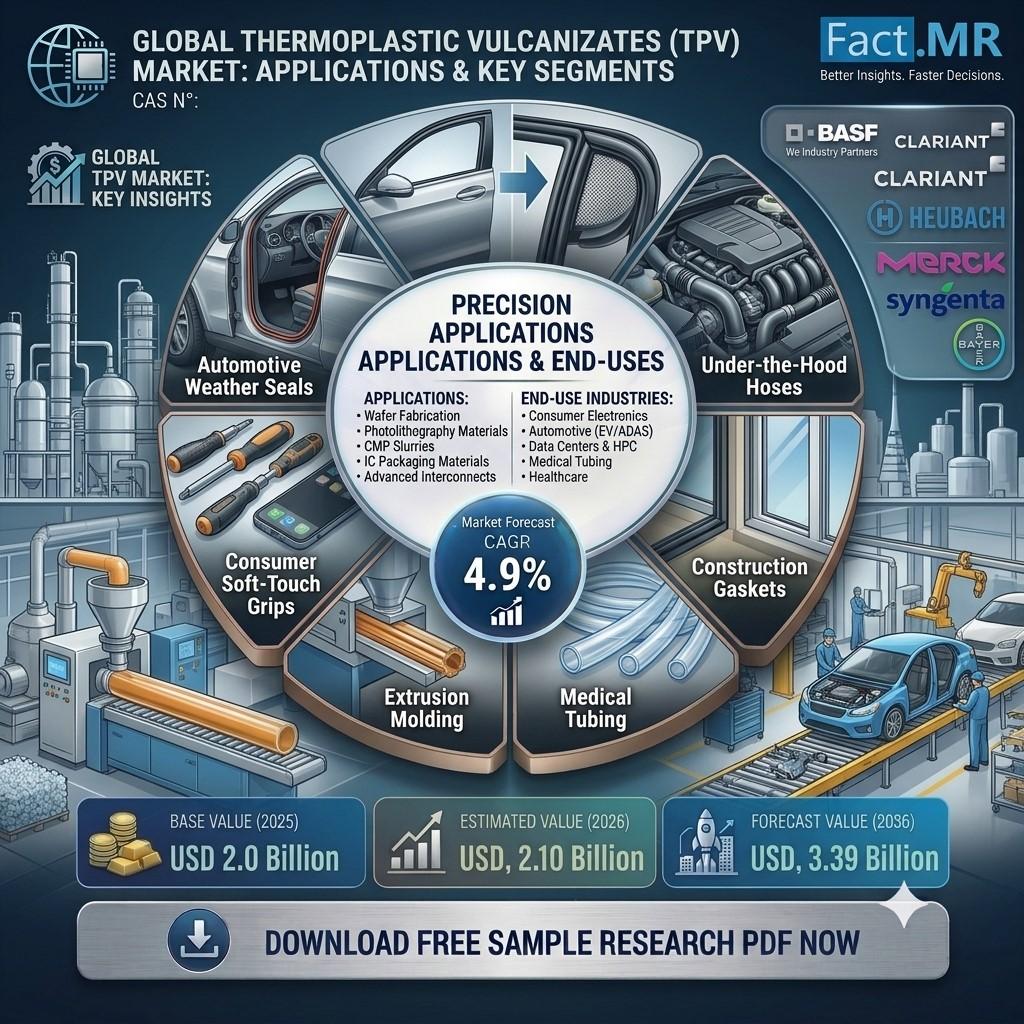
The global thermoplastic vulcanizate (TPV) market is expected to increase from USD 2.10 billion in 2026 to USD 3.39 billion by 2036, registering a 4.9% CAGR during the forecast period. According to Fact.MR, the market was valued at USD 2.0 billion in 2025 and is expected to generate an absolute dollar opportunity of USD 1.29 billion between 2026 and 2036. Demand is being supported by automotive lightweighting requirements, growing preference for recyclable elastomer materials, and the replacement of conventional thermoset rubber in automotive and construction applications.
Thermoplastic vulcanizates combine rubber-like elasticity with the processing advantages of thermoplastics. Their ability to support injection molding, material recycling, and consistent component performance makes them suitable for automotive weatherseals, underhood components, construction gaskets, and consumer products. Fact.MR highlights that TPV injection molding can deliver cycle times 30% to 40% shorter than compression molding for thermoset rubber, encouraging automotive component manufacturers to adopt more efficient production methods.
Get detailed market forecasts, competitive benchmarking, and pricing trends:
https://www.factmr.com/connectus/sample?flag=S&rep_id=3478
PP-Based TPV Retains Dominant Market Position
By base polymer, PP-based TPV is expected to account for 52.0% of the thermoplastic vulcanizate market in 2026. Its leading position is supported by cost efficiency, flexibility, processing compatibility, and established use across automotive manufacturing. Polypropylene-based formulations offer manufacturers the ability to produce durable elastomer components while maintaining compatibility with existing molding and processing equipment.
TPO-based materials and other specialty blends each represent 24% of the market. These materials serve applications requiring specific flexibility, durability, and processing characteristics. Demand for specialized formulations is being supported by manufacturers seeking improved material performance without substantially increasing production complexity.
Automotive seals and soft-touch applications account for 46% of market demand, making automotive the leading application segment. TPV materials are increasingly used in door seals, window encapsulation, interior components, and underhood applications where flexibility and durability remain important purchasing considerations.
Construction and hose applications represent another 30% of the market. TPV materials are used in window gaskets, roofing profiles, pipe seals, and other components requiring weather resistance and long-term flexibility. Consumer goods account for the remaining 24%, supported by applications in household products, sports equipment, and specialty molded components.
Virgin TPV holds a 61% share by formulation in 2026, reflecting manufacturer preference for consistent mechanical properties and reliable performance in demanding applications. Recycled and blended TPV formulations account for 39%, with growing interest in material circularity and sustainable manufacturing practices creating additional opportunities.
USA, Germany, and France Show Strong Growth Potential
The United States is projected to register a 5.4% CAGR from 2026 to 2036, making it the fastest-growing country among those specifically assessed in the report. Automotive lightweighting programs, domestic manufacturing investment, and increasing adoption of recyclable materials are supporting demand. Manufacturing centers in Michigan, Texas, and Ohio are contributing to the adoption of TPV materials across automotive components and industrial applications.
Germany is expected to advance at a 4.6% CAGR through 2036. Its established automotive manufacturing base, engineering capabilities, and focus on high-performance materials support demand for advanced TPV formulations. Automotive production centers in Bavaria, Baden-Württemberg, and North Rhine-Westphalia are important markets for materials used in weatherseals, interior components, and underhood applications. Sustainability requirements and automotive material specifications are also influencing product development.
France is forecast to expand at a 4.5% CAGR during the same period. Construction modernization and demand for durable building materials are supporting the adoption of TPV products. Applications in construction seals, flexible profiles, and related building components are creating opportunities for manufacturers supplying weather-resistant elastomer solutions.
Mexico is projected to record a 5.0% CAGR, supported by automotive manufacturing expansion and nearshoring activity. The United Kingdom is expected to grow at 4.2%, while South Korea and Japan are forecast to register CAGRs of 4.1% and 4.0%, respectively.
Competitive Landscape
Competition in the thermoplastic vulcanizate market includes established chemical manufacturers and specialty polymer suppliers with expertise in elastomer formulation, processing technology, and automotive material qualification. Key companies profiled by Fact.MR include ExxonMobil Chemical Company, Avient Corporation, Kraiburg TPE GmbH & Co. KG, LG Chem Ltd., Teknor Apex Company, Kuraray Co. Ltd., Zeon Corporation, Sumitomo Chemical Co. Ltd., Sinopec, and Celanese Corporation.
Manufacturers are competing through product performance, technical support, material consistency, and application-specific development. Automotive OEM relationships and proximity to major manufacturing clusters are important competitive factors. Suppliers offering specialized grades for demanding applications may also benefit from the growing focus on recyclable materials and efficient processing.
Technology and Sustainability Developments Shape the Market
Automotive electrification and changing vehicle design requirements are creating opportunities for TPV materials in battery sealing, thermal management, and lightweight components. Manufacturers are developing specialized formulations to address evolving requirements for flexibility, durability, and compatibility with automated production processes.
Sustainability is also influencing material selection. Recycled-content formulations and bio-based alternatives are gaining attention as automotive manufacturers and industrial buyers seek to reduce material waste and improve product recyclability. TPV materials offer the advantage of thermoplastic processing while retaining rubber-like performance, supporting their use as alternatives to conventional thermoset elastomers.
However, polypropylene and EPDM rubber price fluctuations remain important considerations for manufacturers. Processing complexity and technical qualification requirements can also affect adoption, particularly among cost-sensitive producers.
As automotive manufacturers pursue lightweight components and recyclable materials, thermoplastic vulcanizates are expected to gain further importance across transportation and industrial applications. Fact.MR's full report provides detailed market forecasts, segment analysis, country-level growth opportunities, and competitive insights through 2036.
Top Reports:
https://adamaamresearch.blogspot.com/2026/11/maternal-nutrition-product-market-to.html
https://net-pals.com/blogs/68491/Global-Maternal-Nutrition-Product-Market-Forecast-at-USD-38-66
https://acmingle.com/blogs/36545/Global-Maternal-Nutrition-Product-Market-Outlook-USD-38-66-Billion
About Fact.MR
Fact.MR is a market research and consulting company providing market intelligence, competitive analysis, and forecasting across global industries. Its research supports businesses with data-driven insights into emerging markets, technology trends, competitive dynamics, regional opportunities, and changing demand patterns.

 English
 Arabic
 French
 Spanish
 Portuguese
 Turkish
 Dutch
 Italiano
 Russian
 Romaian
 Portuguese (Brazil)
 Greek
