


Seaweed Protein Market to Expand as Protein Isolate Technology Advances
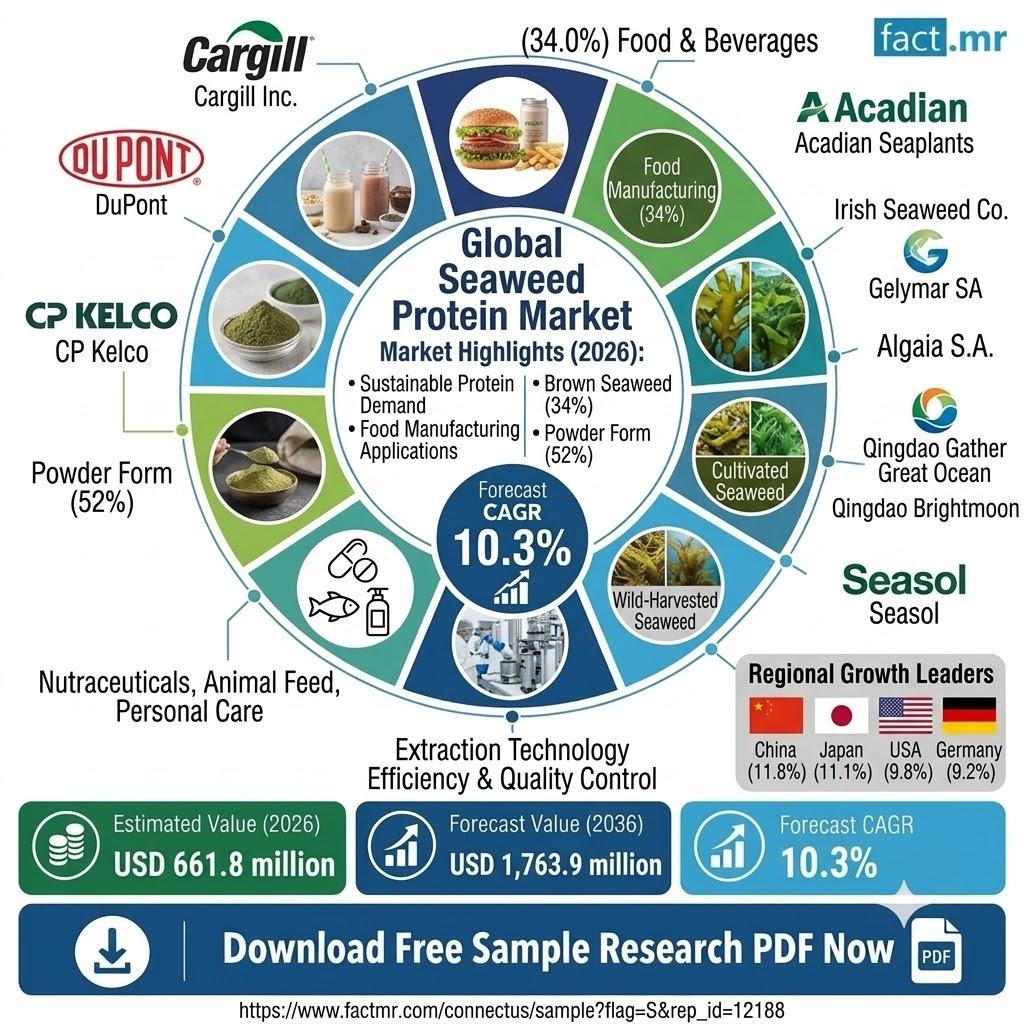
The global seaweed protein market is projected to grow at a 10.3% CAGR through 2036, driven by sustainable protein demand and food manufacturing applications.
October 13, 2026 — The global seaweed protein market is projected to increase from USD 661.8 million in 2026 to USD 1,763.9 million by 2036, expanding at a compound annual growth rate (CAGR) of 10.3%, according to Fact.MR. The forecast represents an absolute dollar opportunity of USD 1,102.1 million over the decade. Demand for marine-derived protein ingredients is gaining attention as food manufacturers explore alternative protein sources and seek ingredients that can support sustainability objectives without compromising product functionality.
Seaweed protein includes protein isolates, concentrates, and extracts obtained from brown, red, and green seaweed. These ingredients serve food and beverage manufacturers, nutraceutical producers, animal feed suppliers, and personal care companies. However, wider adoption will depend on improving extraction efficiency, controlling production costs, and delivering the taste, color, texture, and solubility required for commercial formulations.
Get detailed market forecasts, competitive benchmarking, and pricing trends: https://www.factmr.com/connectus/sample?flag=S&rep_id=12188
Seaweed Protein Market Growth Driven by Food Manufacturing Demand
Food and beverages account for 34% of the seaweed protein market's application segment in 2026, according to Fact.MR. Manufacturers use seaweed-derived ingredients in plant-based foods, functional beverages, and protein-enriched products. The segment's position reflects an expanding search for protein ingredients that can serve established food categories while offering a marine-derived alternative.
Brown seaweed protein holds 34% of the product segment in 2026. Its position is supported by established cultivation and processing infrastructure, including supply chains built around kelp and wakame. One important commercial detail is the potential to recover protein alongside alginate, a seaweed-derived hydrocolloid. This dual-use approach can improve the economics of protein recovery by creating additional value from existing processing operations.
Powder is the leading form, representing 52% of the market's form segment. Its versatility supports use in food manufacturing, dietary supplements, and cosmetic formulations. High-concentration protein isolates are also attracting attention as extraction technologies advance. Better yield and purity could help manufacturers incorporate seaweed protein into meat alternatives, dairy substitutes, and sports nutrition products at functional concentrations.
Cultivation Capacity and Extraction Technology Shape Market Opportunities
Supply availability remains a central issue. Wild-harvested seaweed accounts for 42% of the source segment in 2026, reflecting continued dependence on ocean harvesting in established production regions. However, natural harvesting can expose processors to yield variability and sustainability constraints.
Cultivated seaweed offers another route. Expanding aquaculture infrastructure can provide more predictable raw material supply, improve quality control, and support sustainability certification. Opportunities for cultivation growth extend beyond East Asia to Europe, Latin America, and Africa, where new production capacity could help diversify supply chains.
Extraction remains a technical challenge. Protein recovery from seaweed biomass can be less efficient than extraction from conventional plant protein sources, affecting cost competitiveness. Seaweed's natural taste, color, and texture may also require additional processing before the ingredients can meet mainstream food manufacturers' specifications.
These constraints help explain why extraction technology is becoming a competitive priority. Improved filtration, enzymatic extraction, and purification methods could raise protein yield and improve functional performance. For manufacturers, the commercial test is straightforward: ingredients must work reliably in finished products at a cost that supports market adoption.
China and Japan Lead Country Growth Forecasts
Fact.MR identifies China as the fastest-growing country market, with a projected CAGR of 11.8% through 2036. The country's established seaweed cultivation and processing industry provides a substantial raw material base, while expanding protein processing capacity could support new applications for marine ingredients.
Japan follows with a projected CAGR of 11.1%. Established seaweed consumption habits and advanced processing capabilities support demand for higher-value ingredients. South Korea is forecast to grow at 10.3%, supported by domestic seaweed consumption and interest in nutraceutical and cosmetic applications.
Growth is also expected in Western markets. The United States is projected to expand at a CAGR of 9.8%, while Germany is forecast to grow at 9.2%. Demand for sustainable protein ingredients, plant-based food development, and nutraceutical formulations supports the outlook in both countries.
The geographic pattern highlights a distinction between production capability and emerging demand. East Asia retains an established cultivation and processing base, while North America and Europe offer opportunities for broader commercial adoption and supply diversification.
Seaweed Protein Market Competitive Landscape
The competitive landscape includes ingredient manufacturers, seaweed processors, and cultivation specialists. Fact.MR identifies Cargill Inc., DuPont Nutrition and Biosciences, CP Kelco, Acadian Seaplants, Irish Seaweed Company, Gelymar SA, Algaia S.A., Qingdao Gather Great Ocean Algae Group, Qingdao Brightmoon Seaweed Co., and Seasol among the market participants.
Cargill Inc. is reported to hold approximately 13% market share, supported by seaweed ingredient processing capabilities and global distribution infrastructure. CP Kelco and DuPont Nutrition and Biosciences bring established ingredient-processing expertise, while Acadian Seaplants and Irish Seaweed Company are associated with cultivation and integrated harvesting operations.
Asian processors, including Qingdao Gather Great Ocean Algae Group and Qingdao Brightmoon Seaweed Co., contribute regional production capacity. Across the market, ingredient consistency and processing performance remain important competitive considerations for buyers evaluating new protein sources.
The next phase of development will depend on whether producers can scale cultivation and improve extraction while meeting food-grade requirements. Better functional properties could help move seaweed protein beyond specialist applications into broader food manufacturing.
View Related Reports :
https://ayushjadhavblogs.blogspot.com/2026/10/suppositories-market-to-reach-usd-33.html
https://www.pikumil.com/blogs/214434/Adaptive-Clothing-Market-to-Expand-at-7-8-CAGR-From
https://social.art-inpa.com/blogs/35874/Washer-Pumps-and-Spray-Nozzles-Market-Forecast-to-Reach-USD
About Fact.MR
Fact.MR is a market research and consulting firm that provides market intelligence, industry forecasts, competitive assessments, and strategic insights for businesses across sectors. Its research combines industry analysis, primary interviews, and quantitative forecasting to help organizations evaluate market opportunities and business conditions.

 English
 Arabic
 French
 Portuguese
 Deutsch
 Turkish
 Dutch
Dutch
 Italiano
 Russian
 Romaian
 Portuguese (Brazil)
 Greek
Greek
