A butterfly ball valve is a flow-control component used in piping systems to regulate or shut off the movement of liquids and gases. The term is sometimes used to describe valve solutions that combine quarter-turn operation with compact flow-control characteristics, although technically butterfly valves and ball valves are two different valve designs. Butterfly valves use a rotating disc, while ball valves use a rotating ball with a passage through it. Both are quarter-turn valves designed for quick operation.
Butterfly valve designs are widely used because they provide a compact structure, relatively low weight, quick operation, and good flow capacity. They are commonly found in water treatment, HVAC systems, chemical processing, power plants, industrial utilities, and other piping applications where reliable flow isolation or control is required.
What Is a Butterfly Ball Valve
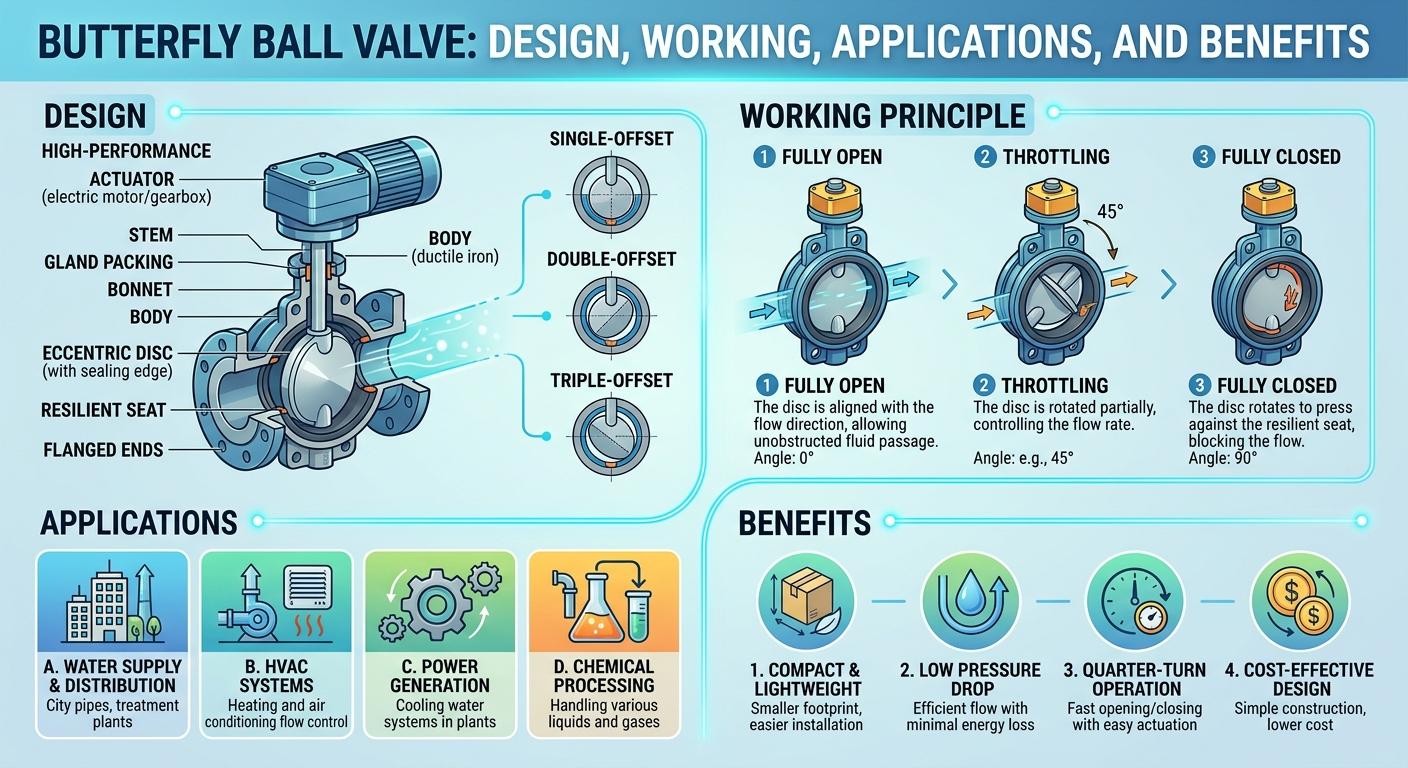
A butterfly valve has a circular disc positioned inside the pipeline. The disc is connected to a stem or shaft, which allows an operator or actuator to rotate it. When the disc is aligned with the direction of flow, the valve is open and fluid can pass through. When the disc rotates across the pipeline, it blocks the passage and stops the flow.
This operating principle allows the valve to move between open and closed positions with approximately a 90-degree rotation. Depending on the design, the valve can also be positioned between fully open and fully closed to provide flow regulation.
The compact construction makes butterfly valves particularly useful for large-diameter pipelines where installation space, weight, and operating speed are important considerations.
How Butterfly Ball Valves Work
The basic working principle is based on rotational movement. A handle, gearbox, pneumatic actuator, or electric actuator turns the valve shaft. The shaft then rotates the disc inside the valve body.
When the valve is fully open, the disc is positioned to allow fluid to move through the pipeline with relatively little obstruction. As the disc rotates, the available flow area decreases. In the closed position, the disc sits across the flow passage and works with the seat to restrict or stop fluid movement.
For automated systems, pneumatic and electric actuators can operate the valve remotely. Pneumatic butterfly valves are especially useful where rapid switching and integration with industrial control systems are required.
Main Components
Several important components work together to provide reliable operation. The valve body houses the internal mechanism and connects to the piping system. The disc controls the flow by rotating inside the body, while the stem transfers movement from the actuator or handle to the disc.
The seat provides the sealing surface between the disc and valve body. Seat materials can vary according to the pressure, temperature, and type of media being handled. The valve may also include a manual lever, gearbox, pneumatic actuator, or electric actuator depending on the operating requirements.
Material selection is important because the valve needs to withstand the conditions of the particular application. Pressure, temperature, fluid type, corrosion risk, and operating frequency should all be considered before selecting a valve.
Types of Butterfly Valves
Butterfly valves are available in several designs for different industrial requirements. Concentric butterfly valves are commonly used for general-purpose services such as water, HVAC, and utility systems. They generally provide a simple and economical solution.
Double-offset butterfly valves move the disc away from the centerline to reduce contact between the disc and seat during operation. This design can be suitable for higher-performance applications.
Triple-offset butterfly valves use additional geometric offsets and are commonly selected for demanding services where metal seating and high-temperature performance are required.
Connection styles also vary. Wafer, lug, and flanged configurations can be selected according to the piping arrangement and installation requirements.
Applications of Butterfly Ball Valves
Butterfly valves are used across many industries because of their compact design and quick operation. Water and wastewater treatment plants use them for controlling and isolating pipelines. HVAC systems also use butterfly valves for water circulation and other utility services.
In industrial facilities, these valves can be found in chemical processing, power generation, petrochemical operations, mining, and general utility systems. Their ability to handle large pipe sizes without the bulk of some other valve designs makes them useful where space and weight are important considerations.
They can be used for on-off isolation and, when properly selected and sized, for throttling or flow-control applications. However, not every butterfly valve is suitable for continuous throttling, so the valve design and operating conditions should be evaluated before installation.
Benefits of Using Butterfly Valves
One of the main advantages is their compact construction. Compared with many traditional valve designs, butterfly valves can require less installation space and can be easier to handle, particularly in larger pipeline sizes.
Another benefit is quick operation. A quarter-turn movement can move the valve from open to closed, making it suitable for applications that require rapid isolation. Butterfly valves can also provide relatively low pressure loss and high flow capacity, depending on the valve design and operating conditions.
Their simple construction can also help reduce maintenance requirements. Manual and automated operating options provide flexibility for different industrial systems.
Choosing the Right Butterfly Valve
Selecting a suitable valve requires more than simply matching the pipe diameter. Engineers should consider the type of fluid, operating pressure, temperature, flow requirements, pressure drop, corrosion conditions, and whether the valve will primarily be used for isolation or throttling.
The body, disc, stem, and seat materials should be compatible with the process media. Actuator selection is also important for automated systems because the actuator must provide sufficient torque to operate the valve reliably.
Conclusion
A butterfly ball valve is often used as a general term for compact quarter-turn flow-control solutions, but butterfly and ball valves have different internal designs. Butterfly valves use a rotating disc, while ball valves use a rotating ball. Understanding this difference helps engineers and buyers select the appropriate valve for their piping system.
With compact construction, quick operation, flexible actuation options, and applications across water, HVAC, chemical, power, and industrial systems, butterfly valves remain an important choice for modern flow-control applications. Proper selection based on pressure, temperature, media, materials, and operating requirements can help ensure dependable performance and longer service life.




 English
 Arabic
 French
 Portuguese
 Deutsch
 Turkish
 Dutch
Dutch
 Italiano
 Russian
 Romaian
 Portuguese (Brazil)
 Greek
Greek
