


Benzoic Acid Market Worth USD 2.0 Billion by 2036, India - CAGR 7.2%, China - CAGR 6.8%, Germany - CAGR 4.6%
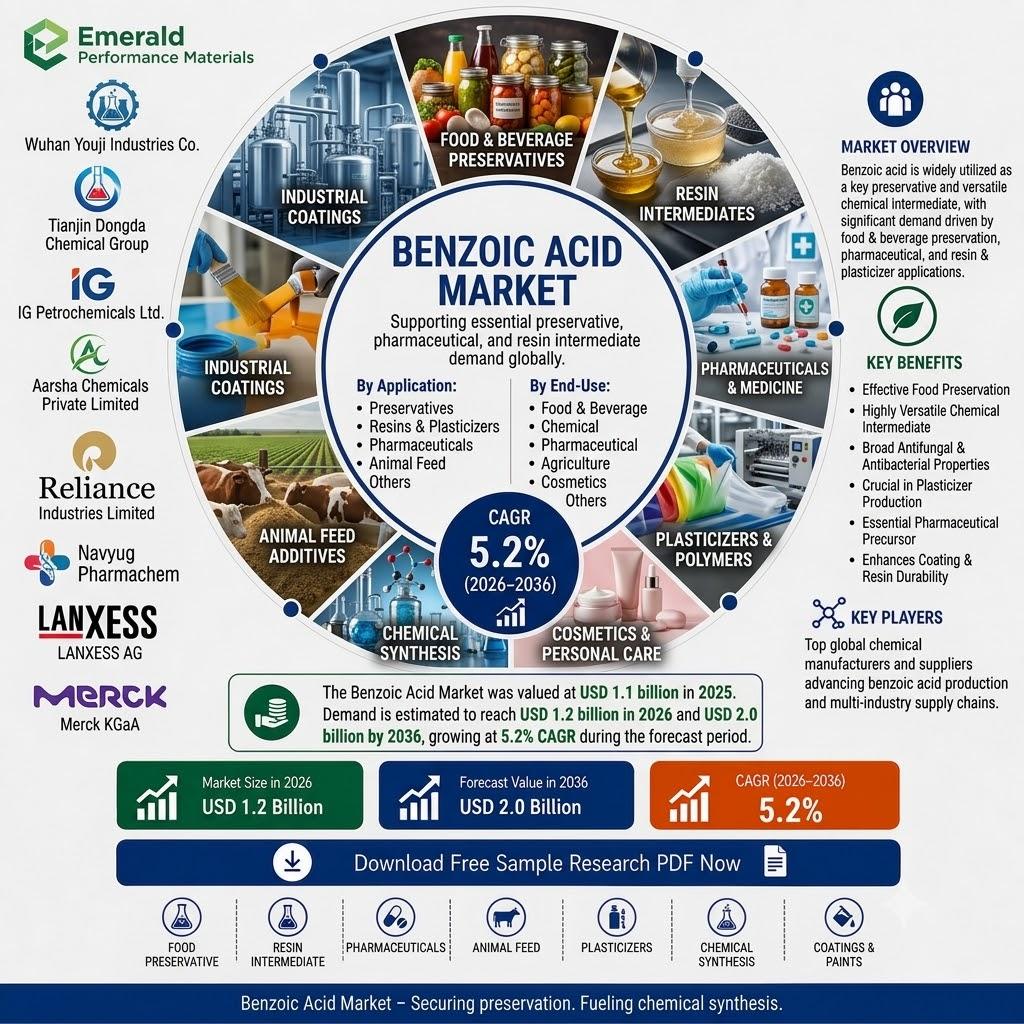
Demand for benzoic acid is estimated at USD 1.2 billion in 2026 and is projected to reach USD 2.0 billion by 2036, advancing at a 5.2% CAGR over the forecast period. The market is being supported by continued use of benzoic acid in food preservation, chemical intermediates, and high-purity formulations. Food processors rely on benzoic acid and benzoate routes for acidic packaged products, while chemical manufacturers use the material in resin and specialty chemistry applications.
Food preservation remains a key demand driver. Benzoic acid and benzoate systems are suited to lower-pH food and beverage products, where antimicrobial performance helps support shelf-life requirements. Demand is also coming from resin producers using benzoic acid in alkyd systems, as well as pharmaceutical and personal care formulators that require documented purity and consistent material quality.
Get detailed market forecasts, competitive benchmarking, and pricing trends: https://www.factmr.com/connectus/sample?flag=S&rep_id=7927
Benzoates Account for 42% Market Share
Among applications, benzoates are projected to account for 42.0% of the market in 2026, making them the leading application segment. Food and beverage processors use benzoate salts as established preservative systems, creating a strong conversion-based demand stream for benzoic acid. Benzoyl chloride, alkyd resins, benzoate plasticizers, and animal feed additives represent additional application areas.
Food & Beverages lead the end-use landscape with a 40.0% share, reflecting the importance of shelf-life protection in packaged acidic products. By grade, Food Grade holds 45.0% share in 2026, as food processors require documented additive purity and specification control. Powder and crystals represent 52.0% share, while direct sales account for 60.0%, reflecting the needs of large processors for contract supply and quality control.
India Leads Country-Level Growth
India is forecast to register the fastest growth among the countries assessed, advancing at a 7.2% CAGR from 2026 to 2036. Packaged food processing and domestic chemical production are supporting demand for both food-grade and technical-grade benzoic acid. Local supply capabilities can also help regional processors reduce lead times and maintain steady material availability.
China follows with a 6.8% CAGR through 2036. Domestic chemical manufacturing supports benzoic acid consumption across preservative and resin applications, while established chemical distribution networks help supply food processors and industrial users. The country's chemical integration also supports demand for benzoic acid as an input for downstream intermediates.
Germany is projected to grow at a 4.6% CAGR through 2036. Resin and coating applications provide an established industrial demand base, while food processors continue to use preservative ingredients within European additive controls. The United Kingdom is expected to expand at 4.5%, while the United States records a 5.4% CAGR during the same period.
Grade Control and Supply Reliability Remain Important
As regulated applications account for a substantial portion of consumption, suppliers increasingly compete on purity documentation, impurity records, and consistent batch quality. Food and pharmaceutical users require clear certificates before approving materials, making documentation an important part of supplier qualification. High-purity grades therefore provide an additional opportunity as formulators seek dependable inputs for sensitive applications.
Supply reliability is another consideration for chemical processors. Feedstock exposure can affect cost planning and availability, particularly where production is connected with petrochemical routes and coproduct recovery. Regional sourcing in India and China can help reduce delivery delays, while liquid formulations offer opportunities for personal care and specialty manufacturers seeking easier dosing and handling.
Competitive Landscape
The competitive environment includes integrated producers, specialty chemical suppliers, and regional distributors. LANXESS AG, IG Petrochemicals Ltd., Wuhan Youji Industries Co., Tianjin Dongda Chemical Group, Merck KGaA, Emerald Performance Materials, and Reliance Industries Limited are among the companies profiled in the report. Competition is shaped by grade consistency, purity control, supply reliability, application suitability, and regional delivery capabilities.
Shambhu Nath Jha, Senior Analyst at Fact.MR, highlights the importance of grade control and application reliability, noting that food processors require preservative performance backed by compliance records while chemical producers depend on steady intermediate supply.
Market Outlook
The benzoic acid market is expected to rise from USD 1.2 billion in 2026 to USD 2.0 billion by 2036. Continued preservative demand, resin and specialty chemical applications, and requirements for documented high-purity material are expected to shape market development through the forecast period.
To View Related Reports
https://afgbfh.blogspot.com/2026/09/blood-glucose-monitoring-devices-market.html
https://sportgalax.com/read-blog/24067
About Fact.MR
Fact.MR is a market research and consulting company providing market intelligence, competitive analysis, and forecasting across global industries. Its research covers emerging technologies, evolving consumer trends, industrial developments, and changing business environments. Fact.MR delivers data-driven insights designed to support strategic planning, investment decisions, and market-entry initiatives.

 English
 Arabic
 Spanish
 Portuguese
 Deutsch
 Turkish
 Dutch
Dutch
 Italiano
 Russian
 Romaian
 Portuguese (Brazil)
 Greek
Greek
