


Metal Casting Market Growth Supported by EV and Industrial Demand
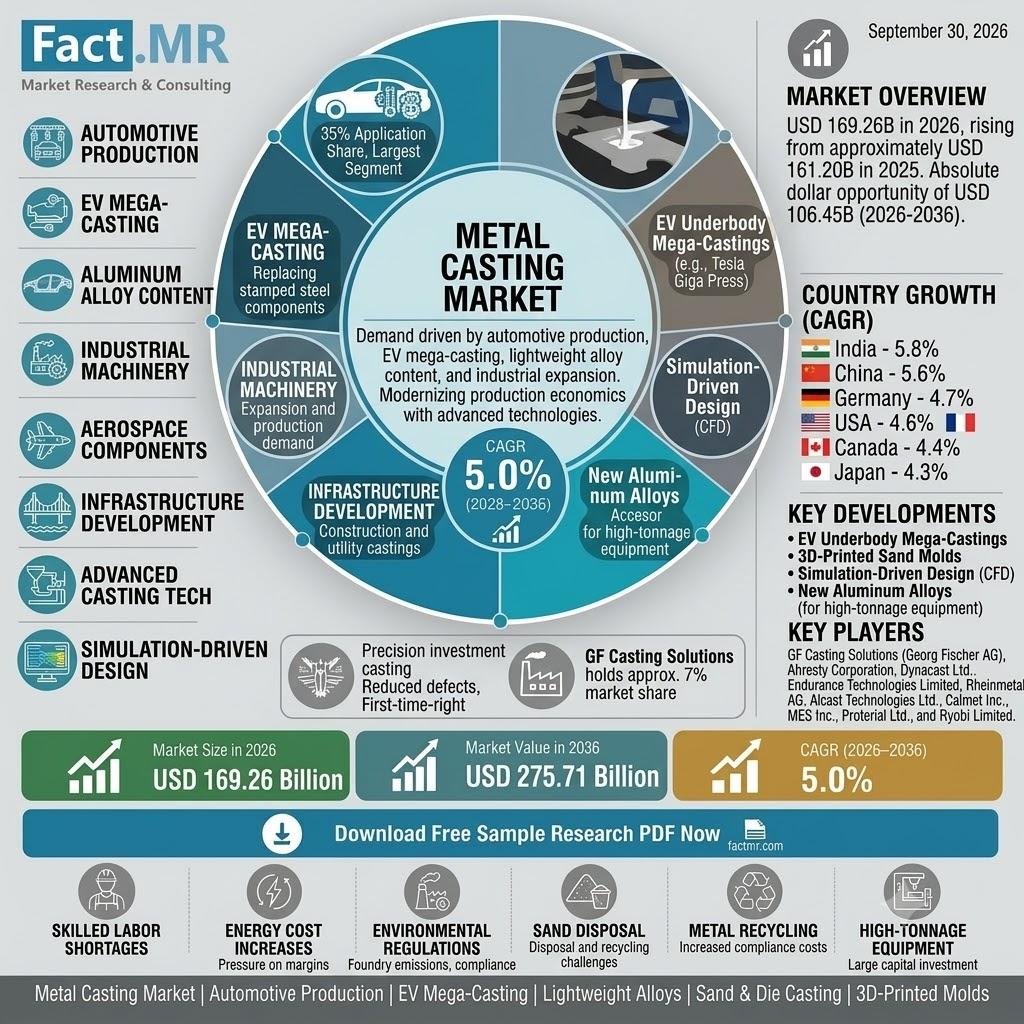
Metal Casting Market to Reach USD 275.71 Billion by 2036
The Metal Casting Market is projected to grow from USD 169.26 billion in 2026 to USD 275.71 billion by 2036 at a 5.0% CAGR, driven by automotive production and EV mega-casting.
September 30, 2026 — The global Metal Casting Market is estimated at USD 169.26 billion in 2026 and is forecast to reach USD 275.71 billion by 2036, expanding at a CAGR of 5.0%, according to Fact.MR analysis. The market was valued at approximately USD 161.20 billion in 2025 and is expected to create an absolute dollar opportunity of USD 106.45 billion between 2026 and 2036.
The growth outlook is closely tied to automotive manufacturing, increasing aluminum content per vehicle, electric vehicle structural mega-casting, industrial machinery expansion, aerospace component demand, and infrastructure development. Advanced casting technologies are also changing production economics, particularly through high-pressure die casting, 3D-printed sand molds, and simulation-driven casting design.
Get detailed market forecasts, competitive benchmarking, and pricing trends: https://www.factmr.com/connectus/sample?flag=S&rep_id=12367
Metal Casting Market Growth Tracks Automotive and EV Manufacturing
Automotive applications account for 35% of the application segment in 2026. Traditional cast components include engine blocks, cylinder heads, transmission housings, and brake components, while EV platforms are creating demand for structural castings, battery trays, motor housings, and large underbody components.
The average vehicle contains 100 to 200 kg of castings, according to the Fact.MR analysis. Rising aluminum and lightweight alloy content per vehicle is supporting die casting and sand casting demand across conventional and electric vehicle platforms.
EV mega-casting is also creating demand for 6,000 to 9,000 tonne die casting machines. The technology can replace 70 to 100 stamped and welded steel components with a single aluminum die casting for vehicle underbody and structural applications.
Shambhu Nath Jha, Principal Consultant at Fact.MR, said, “The metal casting market is being transformed by the EV mega-casting revolution, where single-piece aluminum die castings replace dozens of stamped and welded steel components in vehicle underbody and structural applications.”
Tesla's Giga Press approach has been followed by multiple OEMs, including Toyota, Hyundai, Volvo, and Chinese manufacturers, according to the Fact.MR analysis. This shift is increasing demand for large-tonnage equipment, new aluminum alloy development, and specialized mega-casting expertise.
Sand Casting Remains a Major Process Segment
Sand casting accounts for 35% of the process type segment in 2026. Green sand and resin sand processes provide design flexibility and broad material compatibility, with applications spanning automotive engine blocks, machinery housings, pipe fittings, and industrial equipment components.
Die casting represents the second-largest and fastest-growing process, supported by aluminum automotive components and EV mega-casting. Investment casting serves high-precision applications, including aerospace turbine blades and medical implants.
Ferrous metals account for 55% of the material type segment in 2026. Gray iron is used in engine blocks, brake drums, and machine bases, while ductile iron supports applications such as pipes, heavy equipment, and wind turbine components.
Mass production holds 65% of the production type segment, reflecting demand from automotive, consumer products, and industrial component manufacturing.
Technology Opens New Casting Applications
3D-printed sand molds are another technology area covered in the Metal Casting Market analysis. Binder jetting can eliminate traditional pattern tooling investment for prototypes and low-volume production while supporting complex geometries.
The Fact.MR analysis states that this approach can reduce prototype lead times from weeks to days. It also supports casting applications where tooling amortization previously favored fabrication.
Simulation-driven casting design is another opportunity area. Computational fluid dynamics can be used to reduce defect rates and improve first-time-right casting quality.
Shambhu Nath Jha, Principal Consultant at Fact.MR, added, “GF Casting Solutions' 7% market share reflects the value of precision casting technology across automotive and industrial segments.”
The market also faces constraints. Energy cost increases can pressure foundry margins, particularly in electric melting operations. Environmental regulations covering foundry emissions, sand disposal, and metal recycling can increase compliance costs, while skilled labor shortages in developed markets can limit production capacity expansion.
India and China Show Strong Regional Growth
India is projected to grow at a CAGR of 5.8% through 2036, while China is forecast to expand at 5.6%. Germany is projected at 4.7%, the United States at 4.6%, France at 4.5%, Canada at 4.4%, and Japan at 4.3%.
China accounts for more than 50% of global casting output, according to the Fact.MR analysis, supported by automotive, machinery, and infrastructure demand. India has the world's second-largest casting production base and is seeing demand from automotive manufacturing, infrastructure development, and export activity.
Europe continues to see demand through Germany and France, particularly in automotive precision casting, aerospace components, and industrial machinery. North America maintains demand through automotive, aerospace, energy, and defense applications.
Competitive Landscape Remains Fragmented
GF Casting Solutions (Georg Fischer AG), Ahresty Corporation, Dynacast Ltd., Endurance Technologies Limited, Rheinmetall AG, Alcast Technologies Ltd., Calmet Inc., MES Inc., Proterial Ltd., and Ryobi Limited are among the companies covered in the competitive assessment.
GF Casting Solutions holds approximately 7% market share, according to Fact.MR analysis. Its portfolio includes precision iron and aluminum casting and lightweight automotive components across automotive, industrial, and energy applications.
The Fact.MR methodology combines secondary research, primary interviews, and forecast modelling. The study draws on more than 70 secondary sources, benchmarks 25+ foundry production capacities, and covers 25+ countries through a demand-side model. Primary validation includes more than 20 interviews across foundries, automotive OEMs, machinery manufacturers, and aerospace contractors.
View Related Reports :
https://social.mytamam.com/blogs/43900/Hemodialysis-Catheters-Market-to-Reach-US-3-77-Billion-by
https://ayushjadhavblogs.blogspot.com/2026/09/in-circuit-test-market-set-to-grow-at.html
https://1nigeria.radiobenue.be.gov.ng/read-blog/34408
https://uddokta64.com/blogs/9732/Long-Wear-Cosmetic-Pigment-Market-to-Reach-3-24B-by
About Fact.MR
Fact.MR is a market research and consulting firm providing market intelligence, forecasts, and strategic analysis across industries and geographic markets. Its research combines secondary sources, primary interviews, market modelling, and validation to assess market size, growth trends, competitive positioning, and emerging opportunities.

 English
 Arabic
 French
 Spanish
 Portuguese
 Deutsch
 Turkish
 Dutch
Dutch
 Italiano
 Russian
 Romaian
 Greek
Greek
