


How to Choose the Right Mylar Bag Size for Bulk Food Storage
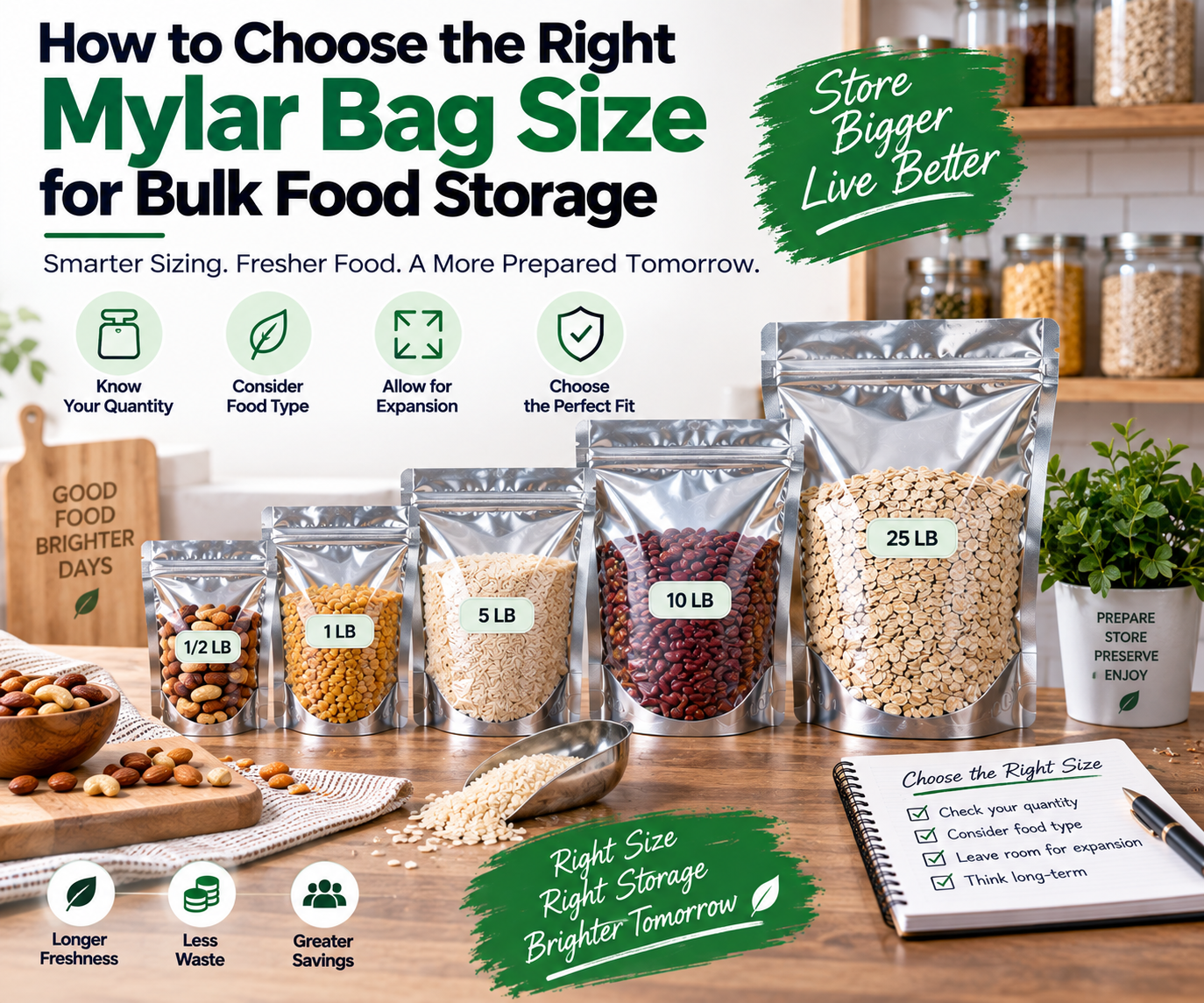
Buying too small a bag wastes trips back to the sealer. Buying too large wastes space and oxygen absorber capacity on empty air. Getting bag size right the first time saves both money and hassle across a large storage project. Suppliers like premium mylar bags carry a range of sizes precisely because bulk storage needs vary so much by household size and food type. Matching volume to actual need takes a bit more than guessing.
Standard Mylar Bag Sizes and What They Hold
Bag sizes follow a fairly consistent naming pattern across the industry. The names tie to gallon capacity rather than exact dimensions alone.
| Size | Typical Dimensions | Approximate Dry Food Capacity |
|---|---|---|
| Quart | 8" x 12" | 1–1.5 lbs |
| Half-Gallon | 8" x 14" | 2–3 lbs |
| 1 Gallon | 10" x 14" | 5–6 lbs |
| 2 Gallon | 12" x 16" | 10–12 lbs |
| 5 Gallon | 14" x 20"+ | 30–35 lbs |
These numbers assume standard dry goods like rice, beans, or wheat berries. Lighter items like puffed cereals or dehydrated vegetables fill a bag by volume faster than by weight. A size that fits 5 pounds of rice might only hold half that much in a lighter product.
Why Weight and Volume Don't Always Match
Density varies significantly between foods, and this is where a lot of first-time buyers miscalculate. A gallon of dense wheat berries weighs far more than a gallon of light, airy freeze-dried fruit, even though both fill the same physical space. Checking a food's density first avoids ordering the wrong quantity of bags for a project.
Matching Bag Size to Household Needs
Family size and how the food gets used day to day both factor into which size makes the most sense.
- Individuals or couples often do better with 1-gallon or smaller bags, since smaller portions get used up before staleness becomes a concern
- Families of four to six typically benefit from 2-gallon bags for staples used regularly, balancing bulk savings against reasonable portion control
- Long-term emergency reserves for a full household often make the most sense in 5-gallon bags lined inside food-grade buckets, prioritizing storage density over frequent access
- Mixed approaches work well too. Use smaller bags for frequently opened staples and larger bags for items meant to stay sealed for years
Leaving Room for Oxygen Absorbers and Headspace
Bag size isn't just about the food itself. Room for an oxygen absorber and a clean seal both take up space that needs planning for upfront.
- Leave 1 to 2 inches of headspace above the fill line for a clean, reliable heat seal
- Match oxygen absorber size to the bag's total volume, not just the food's weight, generally around 300cc per gallon of capacity
- Overfilling a bag to save on bag count often weakens the seal and squeezes the absorber out of place near the sealed edge
- A slightly larger bag than the bare minimum needed usually seals more reliably than one filled to its absolute limit
Common Sizing Mistakes in Bulk Storage
A handful of recurring errors show up across large storage projects. Most of them are avoidable with a bit of upfront planning.
- Buying one size for an entire pantry project regardless of what each food actually requires
- Underestimating how much headspace a proper seal needs, leading to rushed or weak seams
- Overstacking large gallon bags on top of each other, which can crush lower bags under excessive weight
- Failing to account for different food densities when converting a recipe's weight into bag volume
- Ordering bags before checking whether a 5-gallon bucket liner size matches the actual bucket being used
Sizing for Specific Storage Setups
Different storage containers call for different bag proportions. Matching the two upfront avoids a bag that doesn't fit its intended container.
- Bucket liners need a 5-gallon or comparable large bag sized specifically to fit standard food-grade bucket dimensions
- Shelf storage works well with 1 or 2-gallon bags that stack neatly without excessive bulk
- Rotating pantry stock benefits from smaller, more frequently opened sizes rather than one large bag that stays open for weeks at a time
- Mixed staple storage, where several food types get packed at once, often needs a range of sizes rather than a single standard
Choosing the Right Size From the Start
Reviewing a full range like mylar bags by size before placing a bulk order helps match specific dimensions to the containers, quantities, and food types involved in a given project. This beats settling for whatever size happens to be most commonly advertised.
When Extra-Large Sizes Make Sense
Some bulk projects go beyond standard 5-gallon capacity, especially for households or small operations storing multiple months of staples at once. In these cases, large mylar bags handle bigger batches without splitting a single food type across several smaller bags. This cuts down on the number of separate seals and oxygen absorbers a project ultimately needs.
Adjusting Thickness Alongside Size
Larger bags carry more weight, which shifts the thickness recommendation upward compared to smaller, lighter-duty sizes.
- Small bags under 1 gallon generally perform fine at 3.5–4 mil for shorter-term storage
- 1 to 2-gallon bags benefit from 4.5–5 mil for a reasonable multi-year storage window
- 5-gallon and larger bags should use 5.5 mil or thicker, since the added weight puts more stress on the seams and film
- Bags meant for repeated handling or transport should size up in thickness regardless of volume, since movement adds physical stress a shelf-bound bag never experiences
Pairing size and thickness correctly matters more as bag volume increases. A large bag holding significant weight gives a weak seam or puncture far more room to cause a total loss than a small bag holding a pound or two.
Signs You Chose the Wrong Bag Size
A few warning signs show up quickly once a bag turns out to be the wrong fit for its contents.
- A seal that puckers or wrinkles because the bag was overfilled beyond a comfortable fill line
- An oxygen absorber that gets crushed against the food rather than sitting freely near the headspace
- A bag that looks mostly empty with excess unused material bunched at the top, wasting shelf space
- Difficulty fitting a filled bag into its intended bucket or storage container due to a size mismatch
Catching these signs on the first few bags of a large project makes it easy to switch sizes before packing the rest of a bulk order the same way.
Planning Bag Counts for a Full Pantry Project
Working out quantities ahead of time prevents a mid-project scramble for more bags or a leftover pile of unused ones.
- List out every food type planned for storage along with the total weight or volume needed
- Match each food's density to the closest size on a standard chart rather than assuming one size fits all
- Calculate how many bags each food requires based on its typical capacity per bag
- Add a small buffer, generally 10 to 15 percent extra bags, to account for resealing mistakes or size miscalculations
- Order oxygen absorbers in matching quantities and CC ratings alongside the bags themselves, rather than as a separate afterthought
Planning this way before a single bag gets filled turns a large, multi-food storage project into a straightforward checklist rather than a series of individual guesses. Keeping a written record of what size worked for each food also saves time on the next round of restocking, since the guesswork only needs to happen once.
Getting the Sizing Decision Right
Bag size affects far more than how much food fits inside. It shapes seal quality, oxygen absorber effectiveness, and how efficiently a bulk storage project uses both shelf space and budget. Matching size to actual food density, household consumption patterns, and storage container dimensions heads off the two most common outcomes of guessing: bags too small to seal properly, and bags so oversized that they waste material and absorber capacity on empty air.

 English
 Arabic
 French
 Spanish
 Portuguese
 Deutsch
 Turkish
 Dutch
Dutch
 Italiano
 Russian
 Romaian
 Portuguese (Brazil)
