


Polyelectrolyte Coated SPION: Uses and Benefits
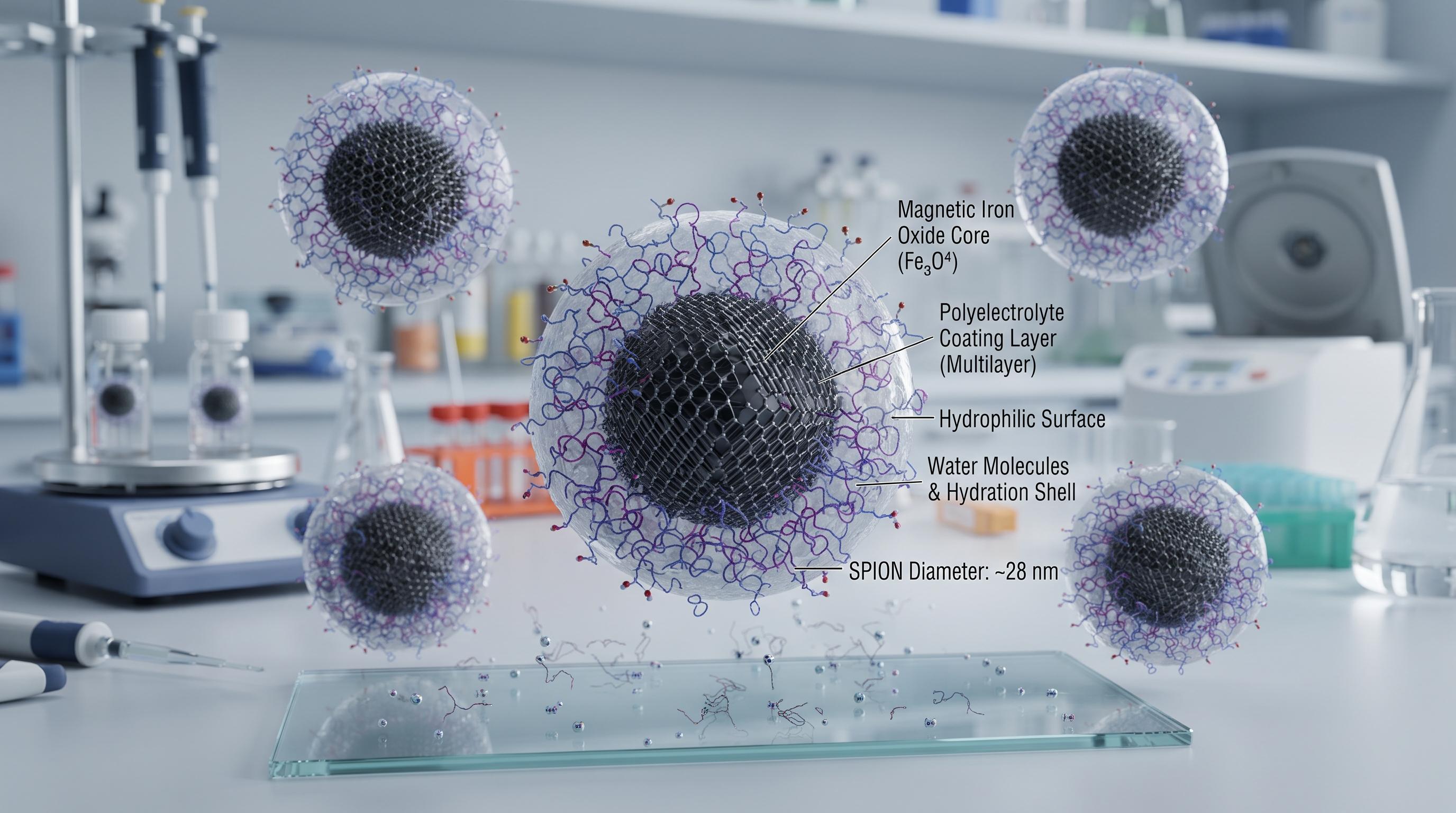
Polyelectrolyte coated nanoparticle SPION refers to superparamagnetic iron oxide nanoparticles that have been modified with a layer of polyelectrolyte material on their surface. SPIONs are widely studied because of their magnetic properties, small size, surface chemistry, and potential usefulness in biomedical research, environmental applications, imaging, sensing, and targeted delivery systems. Applying a polyelectrolyte coating can change the surface characteristics of these nanoparticles and improve their interaction with surrounding liquids, biological molecules, and other materials. Understanding the structure, properties, preparation, stability, and applications of polyelectrolyte coated SPIONs helps researchers determine where these advanced nanomaterials may be useful.
What Is a SPION?
SPION stands for superparamagnetic iron oxide nanoparticle, a type of magnetic nanoparticle commonly investigated for scientific and biomedical applications. These particles generally contain iron oxide and exhibit magnetic behavior that is especially useful when an external magnetic field is applied. Their nanoscale dimensions provide a large surface area relative to their volume, which allows researchers to modify their surfaces with different molecules, polymers, or functional materials. SPIONs are particularly interesting because their magnetic response can be controlled externally while their surface can be engineered for interaction with specific environments.
What Is a Polyelectrolyte Coating?
A polyelectrolyte coating is a layer made from a polymer containing ionizable or charged groups. When placed around a nanoparticle, this polymer layer can alter the surface charge, hydrophilicity, stability, and interaction behavior of the particle. Polyelectrolytes can carry positive, negative, or charge-responsive characteristics depending on their chemical structure and surrounding conditions. When applied to SPIONs, the coating can provide a functional surface that is different from the original iron oxide surface and may make the nanoparticles easier to disperse or modify for a particular application.
What Is a Polyelectrolyte Coated Nanoparticle SPION?
A polyelectrolyte coated nanoparticle SPION is a superparamagnetic iron oxide nanoparticle surrounded by a polymer layer containing charged functional groups. The coating can help control how the magnetic nanoparticle behaves in a liquid environment and how it interacts with other particles, molecules, cells, or surfaces. Researchers can select different polyelectrolyte materials depending on the desired surface properties and intended application. The combination of magnetic behavior from the SPION core and adjustable surface chemistry from the polymer coating makes this type of nanomaterial valuable for advanced research.
Why Coat SPION Nanoparticles With Polyelectrolytes?
Bare magnetic nanoparticles can have a strong tendency to aggregate because of magnetic attraction and surface interactions. A suitable coating can create a protective and stabilizing layer around the particles, helping them remain dispersed under appropriate conditions. Polyelectrolyte coatings can also provide charged functional groups that make further surface modification possible. This means researchers can design the outer surface according to the needs of a particular application while retaining the magnetic properties of the underlying SPION core.
Surface Charge and Stability
Surface charge plays an important role in the behavior of nanoparticles suspended in liquids. Particles with suitable surface charges can experience electrostatic interactions that influence their dispersion and aggregation behavior. A polyelectrolyte coating can modify the surface charge of a SPION and provide greater control over its interaction with the surrounding medium. The actual stability depends on the polymer, solution chemistry, pH, ionic strength, temperature, particle concentration, and other environmental conditions. Because of this, coating selection and characterization are important when designing stable polyelectrolyte coated SPION systems.
How Does Polyelectrolyte Coating Improve SPIONs?
Polyelectrolyte coating can provide several changes to the surface of SPION nanoparticles. The coating can improve colloidal stability, introduce functional groups, modify surface charge, and influence how the particle interacts with biological or chemical environments. It may also provide a platform for attaching additional molecules or materials to the nanoparticle surface. These properties can make coated SPIONs more adaptable than unmodified particles for certain research applications. The effectiveness of the coating depends on how uniformly it covers the particle and whether it remains stable under the intended conditions.
Common Polyelectrolyte Materials
Researchers can use different types of polyelectrolytes to modify nanoparticle surfaces. The choice depends on whether a positively charged, negatively charged, hydrophilic, biodegradable, or otherwise functional surface is required. Some polymer systems can provide strong electrostatic interactions, while others can be selected for compatibility with biological environments or additional surface modification. The chemical structure of the polyelectrolyte determines how it behaves in solution and how it interacts with the SPION surface. Selecting an appropriate polymer is therefore an important part of nanoparticle design.
Preparation of Polyelectrolyte Coated SPIONs
The preparation of polyelectrolyte coated SPIONs involves forming an appropriate polymer layer around the magnetic nanoparticle surface. Depending on the selected coating system, researchers may use adsorption, electrostatic assembly, layer-by-layer approaches, covalent attachment, or other surface modification strategies. The preparation conditions influence coating thickness, surface charge, dispersion, magnetic behavior, and stability. Careful control of the preparation process is important because an uneven or unstable coating may reduce the intended benefits of surface modification.
Layer-by-Layer Coating Approach
Layer-by-layer assembly is a commonly studied approach for creating controlled polymer coatings on nanoparticles. In this type of process, polymers with complementary charges can be deposited sequentially onto a particle surface. The interaction between oppositely charged materials allows researchers to build a structured coating around the SPION. This approach can provide control over surface composition and functionality and may allow different layers to be incorporated for specific purposes. The final characteristics depend on the polymers selected and the conditions used during the coating process.
Magnetic Properties of Coated SPIONs
The magnetic behavior of SPIONs is one of their most important characteristics, and coating modification is generally intended to improve surface functionality without eliminating the useful magnetic response of the core. A suitable polymer coating surrounds the magnetic material while allowing the nanoparticle to respond to an external magnetic field. The thickness and nature of the coating can influence the overall magnetic response observed in measurements. Researchers therefore evaluate both surface properties and magnetic properties when developing polyelectrolyte coated SPIONs.
Biomedical Applications
Polyelectrolyte coated SPIONs have attracted interest in biomedical research because their magnetic properties and modifiable surfaces can be combined in a single nanoscale system. Potential research areas include magnetic separation, imaging, drug delivery, biosensing, and other nanomedicine applications. The polymer coating can help control interactions with biological environments and provide sites for attaching functional molecules. However, suitability for a specific biomedical application depends on factors such as particle composition, surface chemistry, stability, biological compatibility, and the intended route of use.
Drug Delivery Research
Magnetic nanoparticles are being investigated as carriers for controlled delivery systems, and surface coatings can play an important role in how these particles interact with their surroundings. A polyelectrolyte coating can provide functional groups for binding or incorporating therapeutic compounds and may influence particle stability and release behavior. Magnetic properties can also provide an opportunity for external manipulation in certain research systems. The performance of a coated SPION drug delivery system depends on the nanoparticle core, coating chemistry, drug interaction, biological environment, and desired release mechanism.
Magnetic Separation
Magnetic separation is another important application area for SPION-based materials. Because SPIONs respond to an external magnetic field, they can potentially be separated from a liquid without requiring conventional filtration methods. A polyelectrolyte coating can provide functional groups that allow target molecules, biomolecules, or other materials to interact with the particle surface. This can make coated SPIONs useful in research involving sample preparation, purification, biomolecule separation, and analytical processes.
Biosensing Applications
The combination of magnetic properties and customizable surface chemistry makes coated SPIONs interesting for biosensor development. A polyelectrolyte layer can provide a surface where recognition molecules or other functional components may be attached. When the target substance interacts with the modified nanoparticle, changes in the system can potentially be detected through an appropriate sensing method. The exact sensing mechanism depends on the nanoparticle design, target analyte, recognition chemistry, and detection technology.
Environmental Applications
Polyelectrolyte coated SPIONs can also be investigated for environmental applications because magnetic nanoparticles can potentially help remove or separate contaminants from liquid systems. Surface modification can change the interaction between the nanoparticle and pollutants, metals, dyes, or other substances. Once the target material interacts with the nanoparticle, an external magnetic field may assist with separation. The effectiveness of this approach depends on the surface chemistry, contaminant type, water composition, particle stability, and recovery process.
Factors Affecting SPION Stability
Several environmental factors can influence the stability of polyelectrolyte coated SPIONs. The pH of the surrounding solution can affect the charge state of the polymer and change particle interactions. Ionic strength can also influence electrostatic repulsion and may cause particles to aggregate under certain conditions. Temperature, polymer composition, coating density, particle concentration, and surface chemistry can further affect dispersion. Researchers therefore need to evaluate coated nanoparticles under conditions that closely represent their intended application.
Characterization of Polyelectrolyte Coated SPIONs
Characterization is an important part of developing a reliable nanoparticle system because researchers need to understand both the magnetic core and the polymer coating. Techniques can be used to investigate particle size, surface charge, morphology, magnetic behavior, coating composition, dispersion, and stability. Studying these properties helps determine whether the coating has been successfully applied and whether the resulting material has the characteristics required for its intended use. Proper characterization can also reveal aggregation or coating instability that may not be obvious from visual inspection.
Advantages of Polyelectrolyte Coated SPIONs
Polyelectrolyte coated SPIONs can offer a combination of magnetic functionality and adjustable surface chemistry. The coating can improve dispersion, introduce charged groups, provide sites for further functionalization, and influence interactions with biological or environmental materials. At the same time, the magnetic core allows the particles to respond to an external magnetic field. This combination can make coated SPIONs useful for designing multifunctional nanomaterials in research and advanced technological applications.
Limitations and Challenges
Despite their potential benefits, polyelectrolyte coated SPIONs also present challenges. Maintaining a stable coating under changing chemical conditions can be difficult, particularly when pH or ionic strength changes significantly. Aggregation may occur if the surface protection is insufficient or if environmental conditions reduce electrostatic stabilization. Reproducible coating thickness and surface chemistry can also require careful control during preparation. For biomedical applications, additional concerns such as biological compatibility, long-term stability, particle fate, and safety must be thoroughly investigated before practical use.
Future Potential of Polyelectrolyte Coated SPIONs
Research into coated magnetic nanoparticles continues to explore ways to improve surface functionality, stability, selectivity, and application-specific performance. Polyelectrolyte coatings provide researchers with a flexible platform for designing surfaces with different charges and functional groups. Future developments may involve smarter coatings that respond to environmental conditions, improved targeting systems, multifunctional sensors, advanced separation technologies, and more controlled interactions with biological materials. Continued research and careful characterization will be important for translating laboratory concepts into dependable applications.
Frequently Asked Questions About Polyelectrolyte Coated Nanoparticle SPION
What is a polyelectrolyte coated nanoparticle SPION?
A polyelectrolyte coated nanoparticle SPION is a superparamagnetic iron oxide nanoparticle covered with a polymer layer containing charged or ionizable groups. The coating changes the surface properties of the magnetic nanoparticle and can improve its stability and functionality.
Why are SPIONs coated with polyelectrolytes?
SPIONs can be coated with polyelectrolytes to improve dispersion, modify surface charge, reduce unwanted aggregation, and introduce functional groups for additional surface modification. The coating can also influence how the nanoparticles interact with biological, chemical, or environmental systems.
What are SPION nanoparticles used for?
SPION nanoparticles are studied for applications involving magnetic separation, imaging, sensing, drug delivery research, environmental treatment, and other areas where magnetic behavior at the nanoscale can be useful.
How does a polyelectrolyte coating affect nanoparticle stability?
A suitable polyelectrolyte coating can provide surface charge and steric or electrostatic effects that help particles remain dispersed. However, stability depends on factors such as polymer chemistry, solution conditions, pH, ionic strength, and temperature.
Can polyelectrolyte coated SPIONs be used in biomedical research?
Yes, these materials are investigated for various biomedical research applications because they combine magnetic properties with a modifiable surface. Their suitability depends on factors such as surface chemistry, particle composition, biological compatibility, and the specific intended application.
What is the role of surface charge in coated SPIONs?
Surface charge influences how nanoparticles interact with one another and with materials in their surrounding environment. A polyelectrolyte coating can modify this charge and provide greater control over particle interactions and dispersion.
Are polyelectrolyte coated SPIONs useful for magnetic separation?
They can be useful for magnetic separation research because the SPION core responds to an external magnetic field, while the coating can provide functional groups for interacting with target substances.
What factors can cause coated SPIONs to aggregate?
Aggregation can be influenced by changes in pH, ionic strength, temperature, surface charge, polymer stability, particle concentration, and coating quality. Selecting suitable coating chemistry and maintaining appropriate environmental conditions can help control aggregation.
Conclusion
Polyelectrolyte coated nanoparticle SPION represents a versatile class of engineered nanomaterials that combines the magnetic properties of superparamagnetic iron oxide with the adjustable surface chemistry of polyelectrolytes. The coating can influence dispersion, surface charge, stability, functionalization, and interactions with surrounding materials. These properties have made coated SPIONs an important subject of research in biomedical science, chemical analysis, magnetic separation, sensing, environmental applications, and advanced materials development. Although challenges such as aggregation, coating stability, reproducibility, and application-specific safety remain important, careful surface engineering and characterization can help researchers develop SPION systems with properties suited to specific needs. Understanding the relationship between the magnetic core and polyelectrolyte surface is therefore essential for exploring the full potential of these multifunctional nanoparticles.

 English
 Arabic
 French
 Spanish
 Portuguese
 Turkish
 Dutch
Dutch
 Italiano
 Russian
 Romaian
 Portuguese (Brazil)
 Greek
Greek
