


FMCG Logistics Market Set to Hit USD 190.5 Billion by 2036, India - CAGR 9.1%, Germany - CAGR 5.2%, United States - CAGR 4.5%
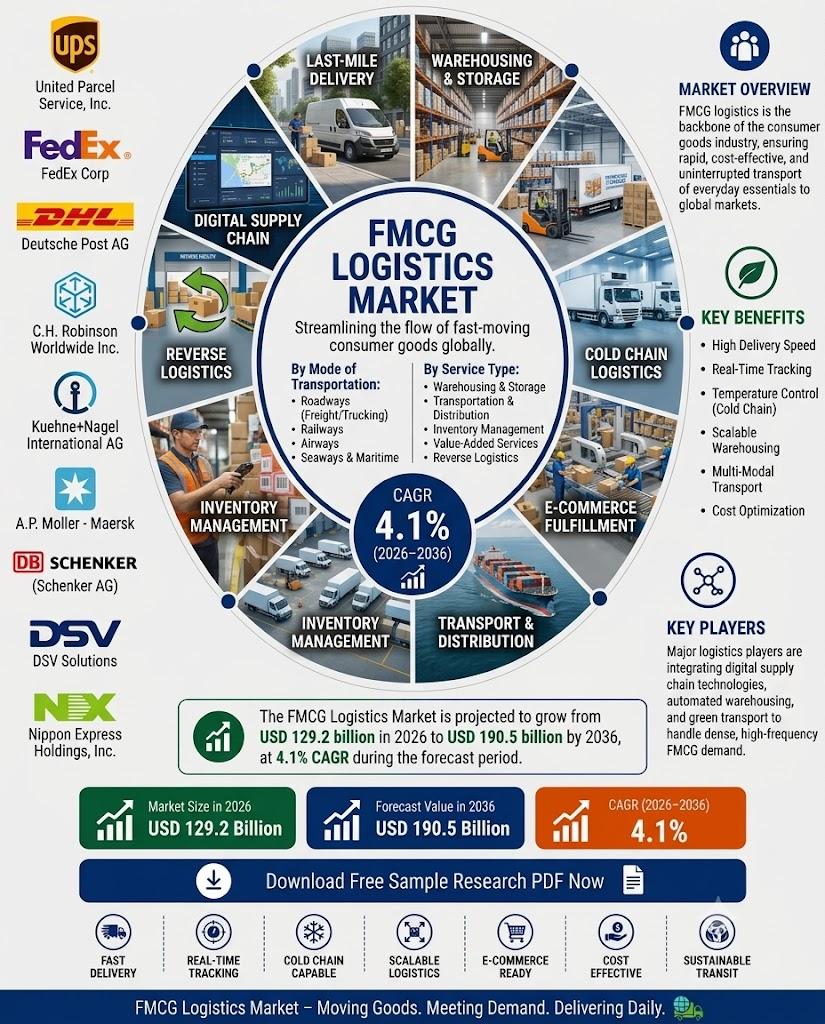
The global FMCG logistics market is projected to expand from USD 129.2 billion in 2026 to USD 190.5 billion by 2036, advancing at a 4.1% CAGR during the forecast period. Rising quick-commerce activity, expanding modern retail networks, e-commerce grocery fulfillment, and investments in freight infrastructure are reshaping how fast-moving consumer goods move from manufacturers to stores and consumers.
Get detailed market forecasts, competitive benchmarking, and pricing trends: https://www.factmr.com/connectus/sample?flag=S&rep_id=14328
Quick Commerce and Infrastructure Reshape FMCG Distribution
A major source of new logistics demand is the rapid development of quick-commerce platforms and more organized retail distribution. Platforms such as Blinkit, Zepto, Swiggy Instamart, Meituan, and JD Daojia are increasing the need for smaller and more frequent deliveries, dark-store fulfillment, and real-time inventory visibility. At the same time, infrastructure programs and freight corridors are improving distribution efficiency in emerging markets, supporting greater adoption of organized third-party logistics services.
European logistics networks face a different but related shift. Decarbonization requirements are influencing fleet investment, route planning, and transportation-mode selection. Rising road freight compliance costs are also strengthening the case for rail and intermodal services on suitable medium- and long-distance FMCG routes. These changes are encouraging logistics providers to balance delivery speed with cost, capacity, and environmental requirements.
Railways Maintain a Major Share of Transportation Demand
Railways are expected to account for 43.1% of the FMCG logistics market by transportation mode in 2026. Their cost advantage for long-haul, high-volume movements makes rail particularly relevant across large FMCG markets, while dedicated freight corridors and intermodal connections support more predictable replenishment schedules.
Food and beverages represent another major area of demand, accounting for 44.7% of the market by product type in 2026. Frequent replenishment requirements and the need for temperature-controlled transportation contribute to the segment's substantial logistics requirements. Cold-chain expansion is therefore becoming increasingly relevant as FMCG distribution networks serve both traditional retail channels and digitally enabled delivery models.
India Leads Growth While Germany Strengthens Europe's Position
India is expected to record the fastest country-level growth among the markets covered in the report, with FMCG logistics demand rising at a 9.1% CAGR through 2036. The country's growth is associated with the Gati Shakti infrastructure program, quick-commerce expansion, tax reforms, and new freight corridors. Together, these developments are supporting more efficient distribution networks and encouraging consolidation among logistics providers.
Germany is projected to advance at a 5.2% CAGR. Its position as a central European distribution hub connects production centers with retail markets across Western, Eastern, and Nordic Europe. Strong rail infrastructure and environmental regulations are contributing to changes in modal selection, while electric delivery vehicles are becoming more relevant for urban FMCG distribution.
The United States is forecast to register a 4.5% CAGR through 2036. E-commerce grocery, personal-care deliveries, health-product distribution, expanding last-mile networks, and fulfillment automation are supporting demand. At the same time, electronic logging requirements, labor constraints, and urban delivery regulations continue to influence transportation capacity and operating models.
Logistics Providers Compete Through Network Depth and Technology
Competition in FMCG logistics spans global third-party logistics companies, freight carriers, contract logistics specialists, and technology-enabled fulfillment providers. Key companies profiled by Fact.MR include United Parcel Service, Inc., FedEx Corp, Deutsche Post AG, C.H. Robinson Worldwide Inc., Kuehne+Nagel International AG, A.P. Moller - Maersk, Schenker AG, DSV Solutions, Nippon Express Holdings, Inc., and Landstar System Holdings, Inc.
Competitive positioning increasingly depends on network coverage, cold-chain infrastructure, digital freight management, automation, and the ability to integrate transportation with inventory and fulfillment systems. Providers are also adapting their service portfolios as FMCG manufacturers move between conventional pallet-based replenishment and smaller, more frequent e-commerce and quick-commerce shipments.
Market Outlook
The shift toward faster fulfillment, organized retail, cold-chain distribution, and technology-enabled supply chains is expected to remain central to FMCG logistics development through 2036. Asia Pacific is identified as a major source of incremental growth, while European sustainability requirements and North American e-commerce fulfillment continue to influence network design and transportation strategies.
Fact.MR's FMCG Logistics Market report provides forecasts from 2026 to 2036, covering transportation modes, product categories, regional markets, competitive positioning, infrastructure developments, and logistics technology adoption. The study uses top-down and bottom-up market modeling supported by primary interviews and industry data to assess changing FMCG distribution requirements.
To View Top Reports
https://afgbfh.blogspot.com/2026/09/3d-4d-technology-market-forecast-to-usd.html
https://social.art-inpa.com/blogs/29589/3D-4D-Technology-Market-to-Reach-USD-1-379-5
https://sportgalax.com/read-blog/23756
About Fact.MR
Fact.MR is a market research and consulting company providing market intelligence, competitive analysis, and forecasting across global industries. Its research combines primary interviews, secondary research, company disclosures, industry statistics, and proprietary market modeling to help businesses understand market developments and emerging opportunities.
Countries chosen: India was selected for its highest reported CAGR of 9.1%, Germany provides the required European growth perspective at 5.2%, and the United States adds a major mature FMCG logistics market growing at 4.5%.

 Arabic
 French
 Spanish
 Portuguese
 Deutsch
 Turkish
 Dutch
Dutch
 Italiano
 Russian
 Romaian
 Portuguese (Brazil)
 Greek
Greek
