


Active Pharmaceutical Ingredient Market Set to Reach USD 348 Billion by 2036, India Leads at 6.1% CAGR
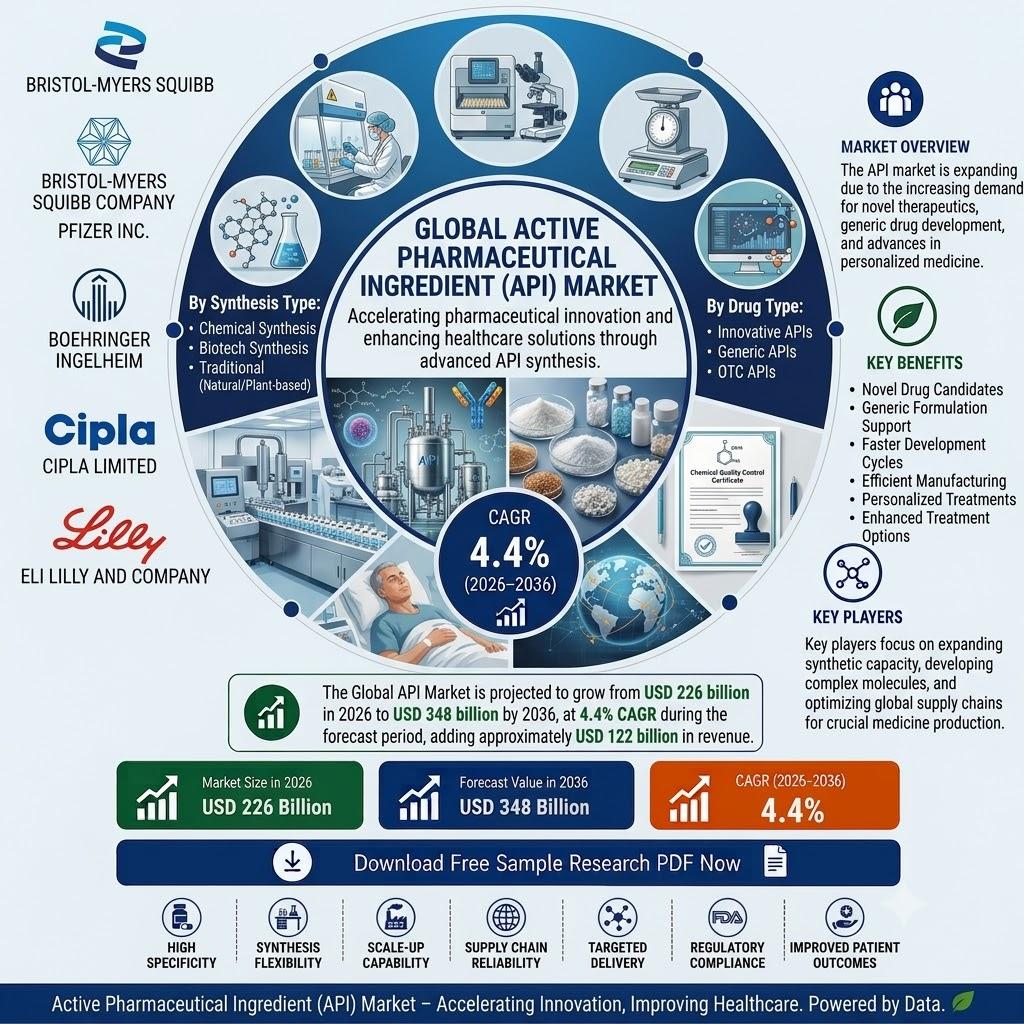
The global active pharmaceutical ingredient market is estimated at USD 226 billion in 2026 and is projected to reach USD 348 billion by 2036, expanding at a 4.4% CAGR, according to Fact.MR. The market is expected to add approximately USD 122 billion in revenue during the forecast period as pharmaceutical production, chronic disease treatment, biologics development, and regional supply-chain investments sustain demand for active ingredients.
API demand is closely linked to the continued production of medicines for chronic conditions. Cardiovascular and diabetes treatments remain important sources of consumption, while growing cancer treatment requirements are strengthening demand for oncology-focused ingredients. At the same time, biologic drug development is increasing requirements for peptide and complex APIs, encouraging pharmaceutical manufacturers to expand specialized production capabilities.
Domestic manufacturing is also becoming a central part of the market's development. India, China, and the United States are increasing local production capacity as pharmaceutical companies and governments seek greater supply-chain security. Stringent manufacturing compliance remains a defining market constraint, but it is also increasing the importance of qualified suppliers with established quality systems and regulatory capabilities.
Get detailed market forecasts, competitive benchmarking, and pricing trends: https://www.factmr.com/connectus/sample?flag=S&rep_id=9124
Small Molecules Hold the Largest API Share
Small molecule APIs are estimated to account for 70% of the market in 2026, making the segment the leading API type. Their extensive use in generic and branded medicines, established manufacturing processes, and suitability for high-volume pharmaceutical production support this position.
Synthetic APIs represent another major portion of the industry, accounting for an estimated 75% share in 2026. Established chemical manufacturing infrastructure and comparatively efficient production economics support their broad use across generic and branded pharmaceutical applications.
Captive APIs hold a 56% share, reflecting pharmaceutical companies’ efforts to maintain greater control over supply reliability, quality oversight, and inventory management. Pharmaceutical companies themselves account for 60% of end-user demand because of their large-scale prescription drug manufacturing operations. Oncology represents 25% of the therapeutic-area market, supported by continued investment in cancer treatments and specialty medicines.
India and China Lead Growth Across Key Production Hubs
India is projected to record the fastest growth among the countries covered in the report, with a 6.1% CAGR through 2036. Production-linked incentive programs, expanding export capacity, and investment across pharmaceutical manufacturing clusters are supporting the country's API expansion. Fact.MR highlights the planned 25,000-square-meter API manufacturing facility announced by Macsen Labs Group in Udaipur, Rajasthan, which includes API production blocks, an R&D center, and a pilot plant.
China is forecast to grow at a 5.5% CAGR through 2036. Its large-scale API manufacturing infrastructure and integrated chemical supply chains support production efficiency and capacity expansion. The report also cites CARBOGEN AMCIS receiving its first Drug Manufacturing License from China's National Medical Products Administration for its Shanghai facility after a GMP compliance review.
Germany is projected to expand at a 3.5% CAGR. The country benefits from established pharmaceutical manufacturing capabilities, specialty API investment, and advanced production infrastructure serving regulated European markets. Strong export activity and demand from pharmaceutical companies for high-quality ingredients continue to support the country's API production base.
The United States is forecast to grow at 3.8% CAGR, supported by reshoring initiatives and investment in domestic pharmaceutical manufacturing, while Japan is expected to expand at 3.1% CAGR as high-value therapeutic production and demand for specialized ingredients support its market.
Manufacturing Scale Shapes Competition
The competitive environment includes multinational pharmaceutical manufacturers and specialized ingredient suppliers. Bristol-Myers Squibb Company, Pfizer Inc., Boehringer Ingelheim, Cipla Limited, and Eli Lilly and Company are among the key companies identified by Fact.MR.
Manufacturing footprint remains an important competitive consideration because API production requires regulatory compliance, technical expertise, and reliable supply networks. Companies with captive facilities can maintain greater control over production quality and supply continuity, while regional sourcing and dual-sourcing strategies are increasingly being used to reduce exposure to disruptions.
“Manufacturing scale will shape competitive positioning across the API industry,” said Shambhu Nath Jha, Principal Consultant at Fact.MR. He added that regulatory compliance will influence supplier selection and that specialty and oncology APIs could create additional revenue opportunities for manufacturers with strong production capabilities and quality systems.
Looking ahead, API manufacturers are expected to focus on oncology capacity, peptide production, and regional manufacturing networks as pharmaceutical companies seek reliable ingredient supplies. The full Fact.MR report provides detailed market forecasts, country-level analysis, segment assessments, and competitive insights through 2036.
To View Related Reports
https://afgbfh.blogspot.com/2026/09/global-thermal-energy-storage-materials.html
https://oolibuzz.com/read-blog/12992
About Fact.MR
Fact.MR is a market research and consulting firm providing comprehensive market intelligence, industry analysis, and strategic insights across global markets. Its research combines primary research, secondary analysis, and proprietary forecasting methodologies to help businesses understand emerging opportunities and changing market dynamics.

 English
 Arabic
 French
 Spanish
 Portuguese
 Deutsch
 Turkish
 Dutch
Dutch
 Italiano
 Russian
 Portuguese (Brazil)
 Greek
Greek
