


Artificial Intelligence in Life Sciences Market Growth, Driving Factors, Strategies, Trends, Forecast Analysis By Fact.MR
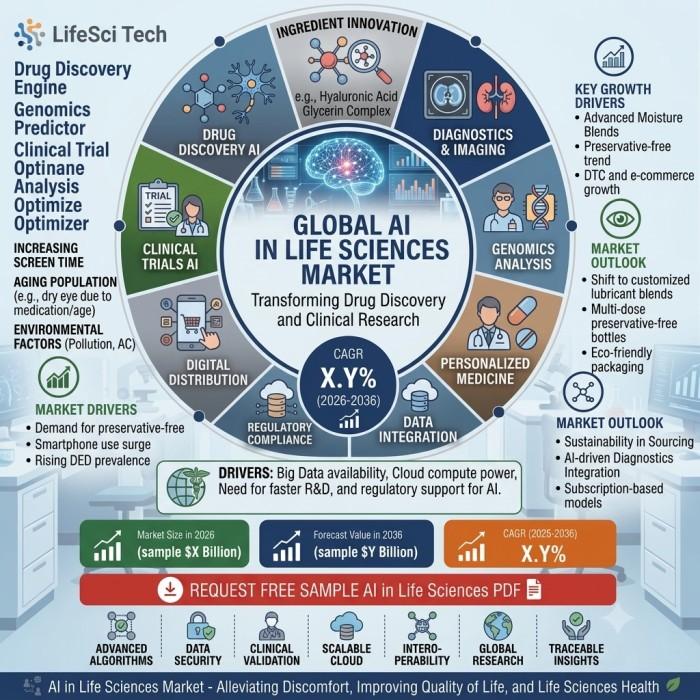
Rockville, Maryland — September 24, 2026 — The global artificial intelligence in life sciences market is entering a period of broader enterprise adoption as pharmaceutical and life sciences organizations integrate artificial intelligence into drug discovery, clinical research, precision medicine, and regulatory workflows. According to a new Fact.MR analysis, the market is valued at USD 17.6 billion in 2026 and is projected to reach USD 81.1 billion by 2036, expanding at a 16.5% CAGR during the forecast period.
The market surpassed USD 15.1 billion in 2025, highlighting the increasing use of AI-based software and services across research-intensive life sciences operations. The report estimates an absolute dollar opportunity of USD 63.7 billion between 2026 and 2036.
Get detailed market forecasts, competitive benchmarking, and pricing trends:
Drug Discovery Platforms Account for 40% of AI Solution Demand
Drug discovery is emerging as a central application for artificial intelligence in life sciences. Fact.MR estimates that Drug Discovery Platforms will account for 40% of the AI Solution segment in 2026, supported by applications such as target identification and lead optimization.
The broader Drug Discovery & Development function is projected to represent 39% of the market by function in 2026. Pharmaceutical Research is expected to account for 42% of demand by application area, while Pharmaceutical Companies are projected to represent 44% of end-user demand.
Machine Learning remains the leading technology category, with an estimated 39% share in 2026, reflecting its application in molecular datasets, clinical records, image analysis, and other scientific workflows.
AI Adoption Expands Beyond Drug Discovery
Demand is being supported by pharmaceutical research teams seeking faster target and compound ranking, while clinical development organizations require improved access to current site and patient information for protocol planning.
Precision medicine is another important area of development. AI systems can help researchers evaluate genomic and biomarker information while maintaining traceable evidence for scientific review.
The report also identifies AI-ready biomedical data infrastructure, workflow integration, clinical trial optimization, patient matching, multi-omics analysis, and regulatory guidance as important factors influencing adoption.
“Life sciences buyers are not buying artificial intelligence as a stand-alone model. They are funding systems that turn scientific questions into traceable evidence. Clear validation and accountable human decisions remain central,” said Shambhu Nath Jha, Principal Consultant at Fact.MR.
Validation and Data Governance Remain Key Challenges
Despite expanding adoption, the industry faces practical barriers. Model credibility and context-of-use validation can slow implementation, particularly where AI outputs contribute to regulated decisions.
Fragmented biomedical and clinical datasets also increase integration requirements. Privacy, consent, cross-border data controls, and limited interoperability can restrict the reuse of information across institutions.
Lifecycle governance represents another consideration. AI models may change as datasets, algorithms, and operating environments evolve, requiring organizations to maintain documentation, monitoring, and evidence throughout deployment.
These challenges are also creating opportunities for providers offering integrated discovery-to-development platforms, clinical trial intelligence, precision medicine systems, and regulatory and safety document automation.
United States Leads Country Growth Comparison
The United States is projected to register a 17.9% CAGR from 2026 to 2036, supported by pharmaceutical research scale and increasing adoption of governed AI workflows.
The United Kingdom follows at 17.2%, while Germany is projected to grow at 16.6%. Switzerland is expected to record a 16.0% CAGR, followed by Japan at 15.5%, Singapore at 14.9%, and Canada at 14.3%.
Competitive Landscape
The competitive environment includes established healthcare-data and technology companies alongside specialist AI and drug-discovery providers.
Fact.MR identifies IQVIA Holdings Inc., Microsoft Corporation, Oracle Corporation, International Business Machines Corporation, NVIDIA Corporation, Schrödinger, Inc., Tempus AI, Inc., Recursion Pharmaceuticals, Inc., Insilico Medicine, and BenevolentAI among the companies profiled in the market assessment.
These companies participate across areas including clinical research, healthcare data, cloud computing, scientific computing, drug discovery, precision medicine, and AI-enabled research workflows.
Unlock 360° insights for strategic decision making and investment planning:
Report Scope
The Fact.MR report analyzes the artificial intelligence in life sciences market across AI Solution, Life Sciences Function, Application Area, End User, Artificial Intelligence Technology, and Region.
The study covers Drug Discovery Platforms, Clinical Research Intelligence, Precision Medicine Solutions, and Regulatory & Compliance Analytics. It also examines Drug Discovery & Development, Clinical Development, Genomics & Biomarker Research, and Commercial Operations.
The geographic assessment includes North America, Latin America, Europe, East Asia, South Asia and Pacific, and the Middle East and Africa, with detailed country analysis covering the USA, UK, Germany, Switzerland, Japan, Singapore, and Canada. The research draws on 120+ sources, 35+ company portfolios, 25+ countries, and more than 20 industry interviews.
Explore More Related Studies Published by Fact.MR Research
Erythropoietin (EPO) Drugs Market-
Laboratory Animal Medicine Market-
About Fact.MR
Fact.MR is a market research and consulting firm providing industry intelligence across healthcare, food and nutrition, technology, chemicals, and other high-growth sectors. Its research combines secondary research, primary interviews, company analysis, market sizing, and forecasting to support strategic business decisions.
Media Contact
Fact.MR
Email: sales@factmr.com
Website: https://www.factmr.com/

 Arabic
 French
 Spanish
 Portuguese
 Deutsch
 Turkish
 Dutch
 Italiano
 Russian
 Romaian
 Portuguese (Brazil)
 Greek
