


Global Automotive Test Equipment Market to Reach USD 5.17 Bn by 2036: India Records 7.5% CAGR, Bosch in Focus
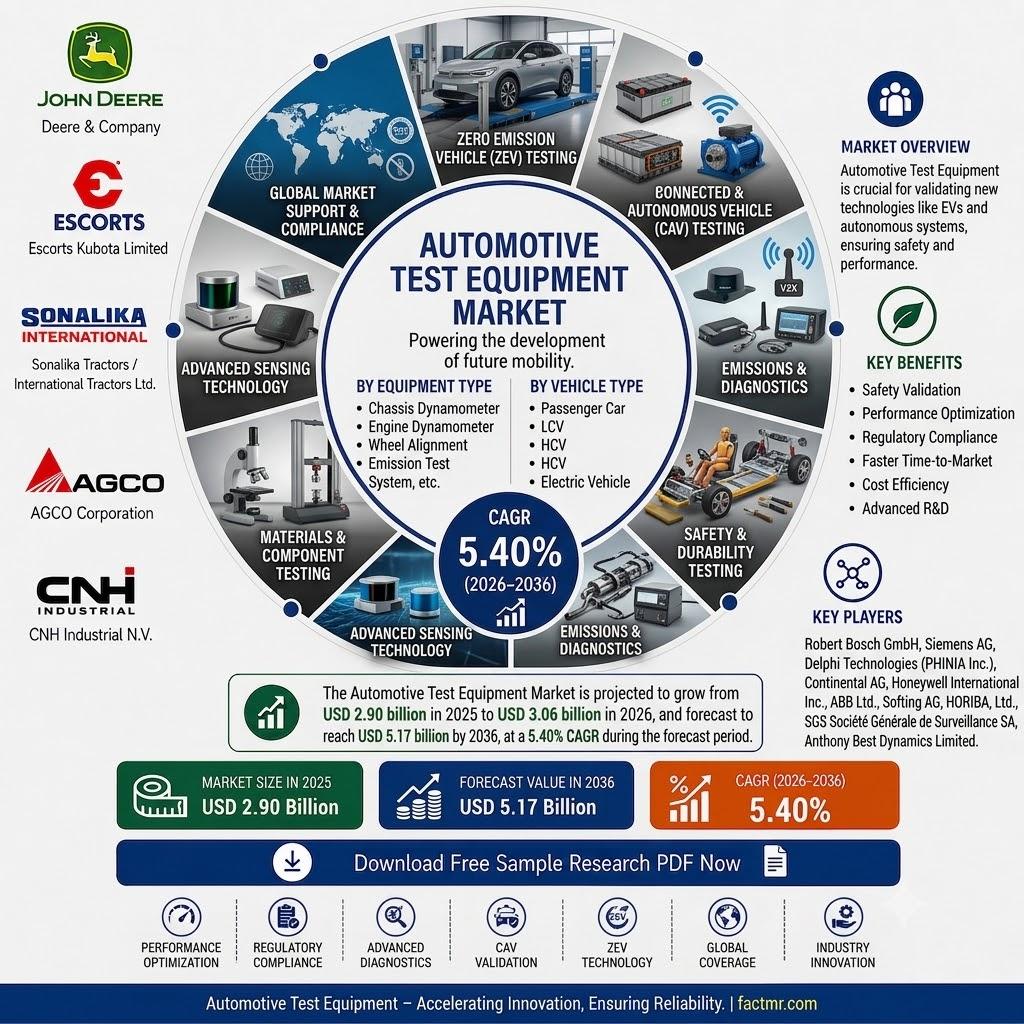
The global automotive test equipment market is projected to grow from USD 3.06 billion in 2026 to USD 5.17 billion by 2036, advancing at a 5.40% CAGR, according to Fact.MR analysis. The market was valued at USD 2.90 billion in 2025. Regulatory requirements under Euro 7, EPA Tier 4, and Bharat Stage VI-2 are pushing testing laboratories, vehicle manufacturers, and inspection stations toward upgraded emission measurement and dynamometer equipment.
The market is gaining another source of demand from hybrid and electric vehicle development. Newer powertrain architectures require battery state-of-health assessment, high-voltage isolation testing, regenerative braking verification, and other validation capabilities that legacy testing systems cannot address. Between 2026 and 2036, the market is expected to create an absolute dollar opportunity of approximately USD 2.11 billion.
Get detailed market forecasts, competitive benchmarking, and pricing trends: https://www.factmr.com/connectus/sample?flag=S&rep_id=11876
Regulatory Testing and Vehicle Electrification Reshape Demand
Automotive test equipment covers dynamometers, emission analyzers, alignment testers, and diagnostic scan tools used to measure and validate vehicle performance and regulatory compliance. The scope includes manufacturing, maintenance, and periodic inspection environments, with product coverage spanning chassis dynamometers, engine dynamometers, wheel alignment testers, and vehicle emission test systems.
Euro 7, EPA Tier 4, and Bharat Stage VI-2 implementation are creating equipment upgrade requirements for laboratories and inspection stations. At the same time, rising hybrid and electric vehicle penetration is expanding testing requirements around high-voltage battery health, isolation resistance, thermal management, and electric drivetrain performance. Mandatory periodic vehicle inspection programs in India, China, and Southeast Asian markets are also creating installed-base demand for emission analyzers, brake testers, and diagnostic scan tools.
Fact.MR is a market research company that provides quantitative market forecasts, segmentation analysis, regional intelligence, and competitive assessments across industries.
Chassis Dynamometers Hold the Leading Product Position
Chassis dynamometers account for 38.0% of the automotive test equipment market in 2026, making the product category the largest segment identified in the Fact.MR analysis. Their role spans emission certification, vehicle performance measurement, and powertrain development, supporting demand from manufacturers and testing laboratories.
Passenger vehicles represent 61.0% of market demand in 2026. High production volumes, safety certification requirements, emission compliance, and expanding vehicle electrification contribute to the segment's leading position within vehicle type segmentation.
Handheld scan tools remain another important application category. Fact.MR identifies them as the dominant application tool segment because independent repair workshops and inspection stations need portable access to vehicle ECU data without the infrastructure investment associated with stationary systems.
India and China Mark Key Growth Markets
India records a 5.4% CAGR through 2036 in the country-level analysis, while China leads the listed markets at 5.6%. Saudi Arabia follows at 5.4%, South Korea at 5.2%, Germany at 5.1%, the USA at 5.0%, and Brazil at 4.8%.
China's market development is linked to its large vehicle production base, expanding electric vehicle ecosystem, and investments in automotive testing infrastructure. India is seeing demand tied to vehicle market expansion, electric vehicle and light commercial vehicle testing, government automotive initiatives, and emission standards.
Europe is projected to increase from USD 0.7 billion in 2026 to USD 1.2 billion by 2036 at a 5.5% CAGR. Germany holds a 42.5% share of the European market in 2026 and is projected to reach 44.2% by 2036.
Source Analysis: Testing Requirements Are Broadening
“Testing facilities that invested in diesel-focused emission equipment face a second capital cycle to add gasoline particulate measurement capability for Euro 7 and electric vehicle high-voltage test infrastructure,” the Fact.MR analysis states. The report also identifies integrated platforms covering internal combustion engine, hybrid, and electric vehicle diagnostics as an area of specification preference for facilities seeking broader vehicle coverage from a single architecture.
The analysis also points to the handheld scan tool segment, where portable diagnostics support independent aftermarket workshops in emerging markets. This creates a lower-infrastructure route to ECU-level service capability compared with stationary bench systems.
Competitive Landscape
Robert Bosch GmbH leads the market with a 12.0% share, according to the supplied Fact.MR analysis. Siemens focuses on integrated automation and testing platforms, while Delphi Technologies (PHINIA Inc.) specializes in powertrain testing and validation equipment. Continental AG brings automotive electronics testing capabilities, including sensor validation and advanced driver assistance system testing.
Other profiled companies include Honeywell International Inc., ABB Ltd., Softing AG, HORIBA, Ltd., SGS Société Générale de Surveillance SA, and Anthony Best Dynamics Limited. The competitive environment centers on measurement accuracy, electric vehicle testing capabilities, manufacturer partnerships, validation-system integration, calibration services, and application engineering support.
To View Top Reports
https://afgbfh.blogspot.com/2026/09/microbiology-culture-market-to-reach.html
https://sportgalax.com/read-blog/23624
About Fact.MR
Fact.MR provides market research and consulting focused on market sizing, forecasting, segmentation, competitive analysis, and strategic intelligence. Its automotive test equipment research covers product, vehicle type, application tools, regional markets, regulatory considerations, competitive positioning, and forecasts through 2036. The report uses a hybrid top-down and bottom-up methodology cross-validated against primary research and public industry filings.

 English
 Arabic
 Spanish
 Portuguese
 Deutsch
 Turkish
 Dutch
Dutch
 Italiano
 Russian
 Romaian
 Portuguese (Brazil)
 Greek
Greek
