


Global Door and Window Automation Market Set for 5.2% CAGR Growth
Market Overview
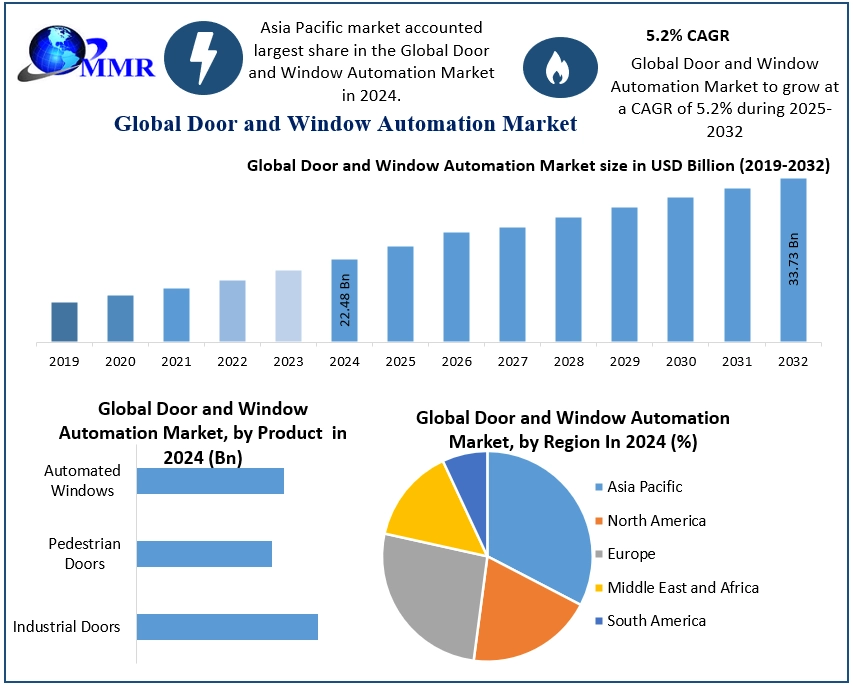
The Global Door and Window Automation Market is experiencing steady expansion as commercial buildings, residential properties, airports, healthcare facilities, industrial sites, and public infrastructure increasingly adopt automated access and building-control technologies. According to Maximize Market Research, the global Door and Window Automation Market was valued at USD 22.48 billion in 2024 and is projected to reach nearly USD 33.73 billion by 2032, expanding at a CAGR of 5.2% from 2025 to 2032. Rising infrastructure development, growing security and safety requirements, increasing accessibility needs, and the wider adoption of smart-building technologies are among the principal factors supporting market growth.
Automation is increasingly being incorporated into doors and windows to provide controlled access, improved convenience, energy management, security, hygiene, and safer movement through high-traffic facilities. Automated systems can integrate operators, motors and actuators, sensors and detectors, access-control systems, switches, and control panels. The increasing integration of electronic locks, remote access, sensors, surveillance, and building-management platforms is creating additional opportunities for manufacturers. At the same time, relatively high installation and maintenance costs remain a constraint, particularly for smaller facilities and price-sensitive markets.
U.S. Market Trends and Investment
The United States remains an important market for door and window automation because of its large commercial-building base, renovation activity, accessibility requirements, and increasing investment in connected building technologies. In 2025, Honeywell introduced Connected Solutions, an AI-powered platform designed to integrate building software and technologies through a unified interface, offering remote monitoring, predictive maintenance, cybersecurity, and energy-management capabilities. Honeywell also announced in May 2025 that it had been selected to provide building automation technology for LG Energy Solution's 1.3-million-square-foot EV battery manufacturing facility in Arizona, demonstrating how advanced automation is being incorporated into new high-tech industrial infrastructure.
U.S. building automation demand is also supported by government efforts surrounding energy efficiency and smart buildings. The U.S. Department of Energy's Grid-Interactive Efficient Buildings initiative promotes the integration of smart technologies, communications, sensors, controls, and energy-management systems to improve building performance and flexibility. These developments can support demand for connected doors and windows as part of wider building-automation ecosystems. Accessibility is another structural factor: the U.S. ADA Standards contain specific requirements for automatic and power-assisted doors, including provisions covering clear width, maneuvering clearance, controls, and emergency breakout openings.
Request To Free Sample of This Strategic Report ➤ https://www.maximizemarketresearch.com/request-sample/21355/
Market Segmentation
By Product: The pedestrian doors segment held the largest market share in the Door and Window Automation Market. Automated pedestrian doors are extensively deployed in retail stores, commercial buildings, industrial facilities, healthcare establishments, and other high-traffic locations. Their adoption is supported by requirements for convenient movement, safety, hygiene, accessibility, access control, and energy efficiency.
By End User: The commercial buildings segment held the leading market share. Shopping malls, government offices, banks, financial institutions, and other commercial facilities increasingly use automated doors and windows for security, controlled access, convenience, accessibility, and integration with fire and building-management systems.
Competitive Analysis and Technology Development
The competitive landscape includes major international companies such as ABB Group, ASSA ABLOY, Allegion, Gira, Honeywell International, GEZE, Nabtesco, Royal Boon Edam, Schneider Electric, Siemens, dormakaba, CAME, and Stanley Black & Decker, among others. The MMR report identifies these companies as key participants in the market. Publicly available information does not provide a consistent company-by-company global market-share ranking, so the following developments are presented as major competitive activities rather than as a ranked top-five by verified market share.
ASSA ABLOY continues to strengthen its entrance-automation and access-solutions portfolio through acquisitions, product development, and R&D. In July 2025, the company acquired Automated Doors & Access in the United States, expanding its direct presence in Indianapolis, Cincinnati, and Nashville and strengthening its pedestrian automatic-door business. The company reported that it invested approximately 4% of revenue in R&D during 2025, launched more than 700 new products, and registered more than 230 patents.
Honeywell International is increasingly emphasizing AI-enabled building automation and integrated building-management technologies. Its 2025 Connected Solutions platform combines building systems, software, devices, monitoring, predictive maintenance, cybersecurity, and energy-management capabilities. Honeywell also reported strong Building Automation performance in 2025, with second-quarter Building Automation sales increasing 8% organically year over year.
Allegion expanded its international security portfolio in August 2025 by acquiring UAP Group Limited in the United Kingdom. UAP brought nearly 200 patents, trademarks, and registered designs, strengthening Allegion's mechanical security portfolio and UK presence. Such portfolio expansion can support the broader development of integrated door-security and access technologies.
GEZE is focusing on sustainable and technologically advanced automatic door and window solutions. In 2025, GEZE received Environmental Product Declarations for its automatic linear sliding and revolving doors, improving transparency regarding product environmental performance. The company also introduced the all-glass Revo.PRIME GG automatic revolving door variant, combining automated entrance technology with design and sustainability objectives.
dormakaba continues to develop automatic-door technologies emphasizing energy efficiency, durability, digital connectivity, and safety. Its ES PROLINE automatic sliding-door operator uses a modular design, integrated sensors, mobile-phone control through the Door Pilot Interface, and CAN-bus connectivity, while supporting high cycle durability and energy-efficient operation.
Regional Analysis
United States: The U.S. is an important emerging market for door and window automation, supported by adoption in commercial buildings, industrial facilities, healthcare, and smart-building projects. Accessibility requirements and investment in energy-efficient building technologies provide additional demand drivers.
United Kingdom: The UK market benefits from modernization of commercial and residential buildings, security requirements, and demand for integrated access solutions. Allegion's 2025 acquisition of UAP demonstrates continued strategic investment in the country's door-security ecosystem.
Germany: Germany is a significant European technology and manufacturing center for automated door and window systems. GEZE's product development, environmental certifications, and building-automation activities demonstrate the country's emphasis on efficient and sustainable entrance technology.
France: Growth in France is supported by commercial construction, modernization, accessibility requirements, and increasing demand for energy-efficient building systems. Integration of automated access into broader building-management systems creates opportunities for suppliers.
Japan: Japan is an important Asian market because automated doors and windows are widely applicable in airports, offices, hospitals, commercial facilities, and other infrastructure. MMR identifies Asia Pacific as the leading regional market and specifically highlights Japan's growing adoption in airports, offices, and hospitals.
China: China's large-scale construction activity, urbanization, commercial infrastructure development, and adoption of smart-building technologies provide significant opportunities for automation suppliers. Demand for access control, energy management, security, and convenient building operation is supporting the expansion of automated door and window technologies.
Request To Free Sample of This Strategic Report ➤ https://www.maximizemarketresearch.com/request-sample/21355/
Key Players
1. ABB Group
2. Assa Abloy
3. Allegion
4. Gira
5. Honeywell International
6. Geze
7. Nabtesco
8. Royal Boon Edam
9. Insteon
10.Schneider Electric
11.Stanley Black & Decker
12.Siemens AG.
13.Came S.P.A.
14.Dorma+Kaba Group
15.Insteon
16.Nabtesco,
17.Royal Boon Edam
18.Schneider Electric
19.Siemens
20.Insteon (U.S.)
Conclusion
The global Door and Window Automation Market is positioned for sustained growth as buildings transition from conventional entrances toward connected, secure, accessible, and energy-efficient environments. MMR forecasts the market to increase from USD 22.48 billion in 2024 to USD 33.73 billion by 2032, representing a 5.2% CAGR.
In our view, the strongest opportunities will emerge from the convergence of smart-building connectivity, AI-enabled controls, energy efficiency, accessibility, predictive maintenance, and integrated security. Manufacturers that combine reliable automatic-door hardware with sensors, cloud connectivity, access control, and building-management software can address a wider range of commercial and infrastructure requirements. Sustainability is also becoming increasingly relevant, as demonstrated by investments in energy-efficient operators and environmental product assessments. Continued innovation, declining technology costs, infrastructure modernization, and demand for safer and more accessible buildings are therefore expected to remain important factors influencing the market through 2032.
About Maximize Market Research
Maximize Market Research Pvt. Ltd. (MMR) is a global market research and consulting company that provides reliable, data-focused, and practical business insights. The firm serves a wide range of industries, including healthcare, pharmaceuticals, technology, automotive, electronics, chemicals, personal care, and consumer goods. Through market forecasts, competitive analysis, strategic consulting, and industry impact assessments, MMR helps organizations understand changing market conditions, identify growth opportunities, and make informed business decisions for long-term success.
Contact Us
Maximize Market Research Pvt. Ltd.
2nd Floor, Navale IT Park Phase 3
Pune Banglore Highway, Narhe
Pune, Maharashtra 411041, India
Phone: +91 9607365656
Email: sales@maximizemarketresearch.com

 English
 Arabic
 French
 Spanish
 Portuguese
 Deutsch
 Turkish
 Dutch
Dutch
 Italiano
 Russian
 Portuguese (Brazil)
 Greek
Greek
