


How Can Technology Improve Public Safety? From Information to Intelligent Action
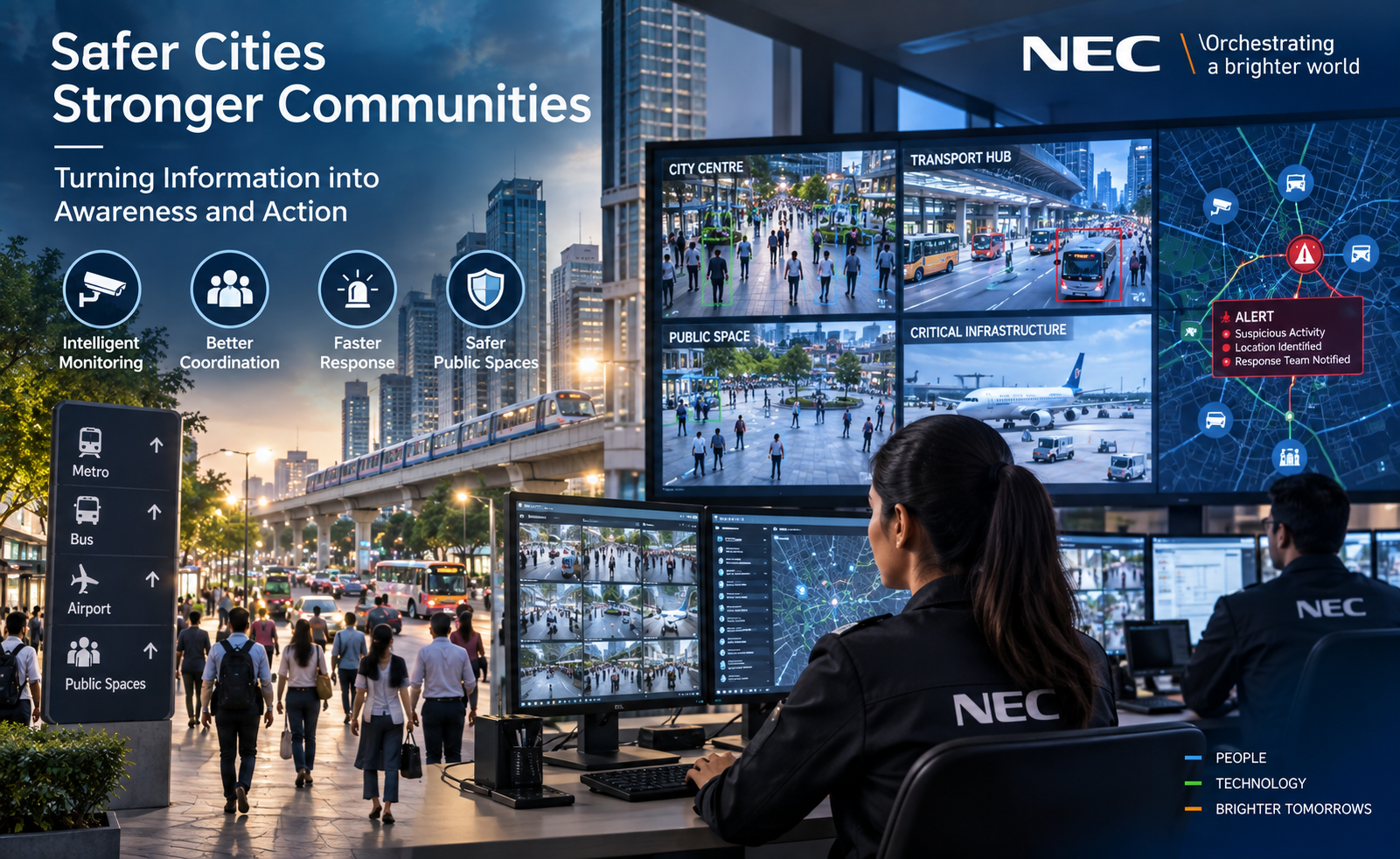
Public safety is becoming increasingly dependent on how quickly organisations can understand what is happening around them and respond appropriately. As cities become more connected and public environments more complex, security teams need access to timely, relevant information that helps them build situational awareness and make informed decisions.
Cities and public spaces generate enormous amounts of information every day through surveillance systems, sensors, communication networks and connected infrastructure. However, collecting information is only the first step. The greater challenge is transforming that information into useful intelligence and timely action. This is where approaches such as NEC India’s Public Safety Solutions demonstrate how intelligent technologies can support greater visibility across public spaces, security operations and critical environments.
Moving From Data to Situational Awareness
Modern public environments can generate information from many different sources. Surveillance cameras, access-control systems, sensors, emergency communications and operational platforms may all contribute useful data.
The challenge arises when these systems operate independently. Security professionals may have plenty of information available but still lack a clear and unified understanding of an unfolding situation.
Connected technology can help bring relevant information together and present it in a way that improves situational awareness. Instead of simply collecting more data, the objective is to help teams understand what is happening, where it is happening and what information may require immediate attention.
This shift from data collection to meaningful awareness is becoming increasingly important for modern public-safety operations.
Intelligent Monitoring and Video Analytics
Video surveillance has been used in public spaces for many years, but intelligent analytics can make monitoring more effective.
Traditionally, security personnel may have needed to monitor multiple camera feeds simultaneously. As the number of cameras increases, manually reviewing every feed becomes increasingly difficult.
AI-assisted video analytics can help analyse large volumes of visual information and highlight predefined events or patterns that may require human attention. Depending on the system and its intended use, analytics may assist with identifying unusual activity, monitoring movement or recognising operational situations that require further assessment.
Importantly, these technologies should support rather than replace human judgment. Security professionals remain responsible for interpreting context and determining the appropriate response.
Faster and Better-Informed Responses
Speed can be critical when dealing with public-safety incidents.
When teams receive relevant information quickly, they may be able to assess a situation more effectively and coordinate an appropriate response. Real-time alerts, location information, video feeds and other contextual data can help responders understand what is happening before or while action is being taken.
This is one reason public-safety technology is moving beyond standalone security devices.
The focus is increasingly on connected environments where information from different systems can be brought together and made available to the appropriate teams. Better information does not automatically determine the response, but it can provide decision-makers with greater context.
Connecting Public Spaces and Security Operations
Public safety rarely depends on a single organisation or technology.
Depending on the environment, incidents may involve security teams, emergency responders, transport operators, facility managers and other agencies. Each may have access to different pieces of information.
Fragmented information can make coordination more difficult. Connected platforms can potentially improve operational visibility by helping relevant teams access information from multiple systems.
This can be particularly valuable in complex environments such as transportation hubs, large public venues, commercial districts and critical infrastructure, where situations may develop quickly and involve multiple operational teams.
The goal is not simply to connect technology for its own sake. The value comes from making relevant information available in a useful form when people need it.
The Role of AI in Public Safety
Artificial intelligence is also changing how organisations process security-related information.
Modern systems can generate far more data than people can realistically analyse manually in real time. AI can assist by filtering information, recognising predefined patterns and highlighting events that deserve closer attention.
This can allow professionals to focus their time and expertise on situations requiring judgment rather than spending all their time searching through large quantities of routine data.
However, AI-assisted public-safety systems also require appropriate governance. Organisations need to consider accuracy, data protection, transparency, cybersecurity and the potential consequences of automated analysis.
Human oversight therefore remains an important part of responsible deployment.
Privacy and Responsible Technology Use
Any discussion about public-safety technology should also include privacy.
Surveillance, biometrics, AI and connected data systems can offer operational benefits, but their deployment needs appropriate safeguards. Organisations should consider what information is collected, why it is needed, how long it is retained, who can access it and how it is protected.
Clear policies and responsible data-management practices can help organisations balance security objectives with privacy considerations.
Technology is most valuable when it supports public safety while operating within appropriate legal, ethical and governance frameworks.
Technology Should Support People
Technology alone cannot create safer public environments.
Effective public safety requires trained professionals, clear procedures, communication, coordination and appropriate decision-making. Technology can strengthen these capabilities by giving people access to better information and helping them understand situations more quickly.
The objective should therefore not be to replace human expertise with automated systems. Instead, intelligent technologies can act as tools that improve visibility, organise information and support informed decisions.
From Information to Intelligent Action
The future of public safety is not necessarily about deploying more cameras, sensors or software. The bigger opportunity is making existing information more useful.
A practical way to think about this transformation is:
Information → Awareness → Insight → Informed Action
When technology helps organisations move through these stages effectively, it becomes more than a monitoring tool. It becomes part of a broader approach to improving situational awareness, operational coordination and responsiveness.
Ultimately, the effectiveness of public-safety technology should be considered in terms of how well it helps people understand situations, make informed decisions and respond appropriately.
That is where intelligent and connected public-safety systems can provide meaningful value: not simply by generating more data, but by helping transform information into awareness and awareness into action.

 English
 Arabic
 French
 Spanish
 Portuguese
 Deutsch
 Turkish
 Italiano
 Russian
 Romaian
 Portuguese (Brazil)
 Greek
Greek
