


Custom Website Development Services: Built Around Your Business
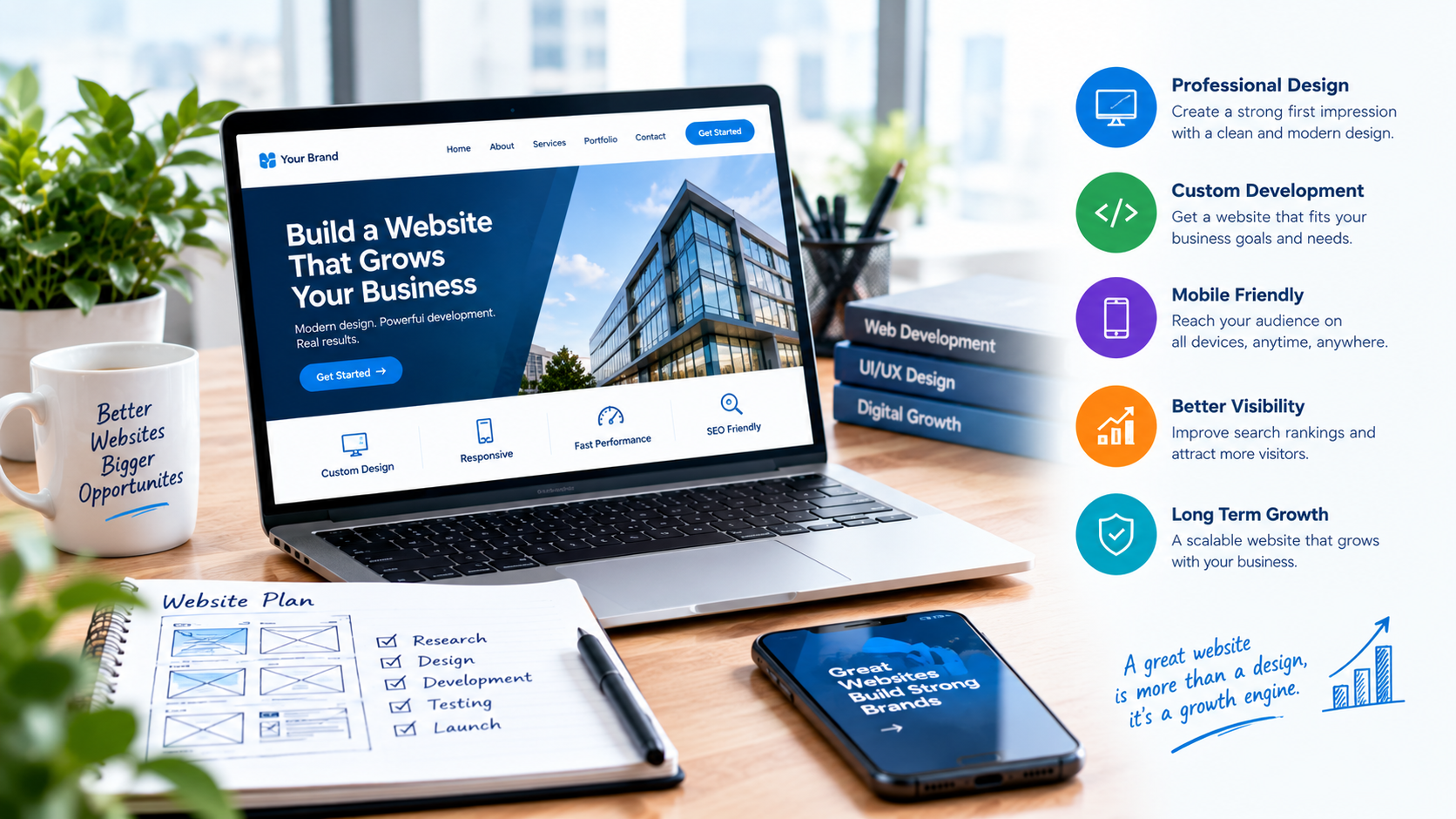
What Makes Development 'Custom' in the First Place
The word custom gets used loosely in web development, so it's worth being precise about what it actually means. Custom website development services involve building a site's structure, functionality, and design specifically around a business's needs, rather than starting from a pre-built theme and adjusting colors and text. This distinction matters more than it might seem at first, especially as a business grows and needs its website to do more than just display information.
A templated site can work well for very simple needs, but it comes with built-in limits. Layouts are constrained by what the template allows, functionality is often limited to what plugins are available, and performance can suffer as more plugins are stacked on top of each other to force the site to do things it wasn't originally built for. Custom development removes these ceilings by building exactly what the business needs from the ground up.
How Custom Development Starts: Understanding Workflow Before Writing Code
The starting point for any custom website development services project isn't design or code, it's a detailed understanding of how the business actually operates. This means mapping out the specific steps a customer takes from first landing on the site to completing whatever action matters most, whether that's a purchase, a booking, or a form submission, and identifying every point where a generic template would force an awkward compromise.
This discovery process often surfaces requirements the business hadn't fully articulated before, such as needing different pricing displayed for different customer types, or needing a multi-step approval process before an order is confirmed. Surfacing these details early, before any code is written, is what allows a custom build to actually solve the business's real problems rather than just replicating a generic site with a different color scheme.
When Custom Development Actually Makes Sense
Not every business needs a fully custom build, and a good development partner should be honest about that. Custom website development services tend to make the most sense when a business has specific functionality needs that off-the-shelf solutions can't handle well, such as custom booking systems, complex product configurators, unique membership structures, or integrations with internal business tools.
It also matters when brand differentiation is a priority. Businesses competing in crowded markets often find that template-based sites blend together, making it harder to stand out. A custom-built site allows the design and user experience to be shaped entirely around what makes the business distinct, rather than being boxed in by a theme thousands of other companies are also using.
The Trade-offs Worth Understanding
Custom development typically takes longer and costs more upfront than a templated site, and it's worth setting expectations around that from the start. The payoff is a site built specifically for the business's workflows and goals, with no unnecessary features slowing it down and no missing features forcing awkward workarounds.
Long-term, custom-built sites are often easier to maintain and scale because the code is written with the business's actual needs in mind, rather than being layered with plugins and patches to force a generic template to behave differently than it was designed to.
Common Use Cases Where Custom Development Pays Off
Certain business models run into the limits of templated platforms fairly quickly. A manufacturer offering configurable products, where customers need to select materials, sizes, and finishes before seeing an accurate price, usually can't get that functionality from a standard theme without heavily modifying it in ways that create long-term maintenance headaches. A custom-built product configurator, designed specifically around the business's catalog and pricing logic, handles this cleanly from the start instead of forcing a workaround.
Service-based businesses with complex scheduling needs run into similar walls. A clinic offering multiple types of appointments with different providers, durations, and availability rules often finds that off-the-shelf booking plugins can handle simple scheduling but struggle with these layered rules. Custom website development services can build a booking flow that matches the business's actual operations, rather than forcing the business to simplify its offerings just to fit the software.
How Custom Development Affects Long-Term Costs
Businesses often focus on the upfront cost difference between custom and templated development without factoring in what happens over the following few years. A template-based site that's been stretched with a dozen plugins to handle non-standard functionality tends to accumulate maintenance costs over time, as plugins conflict with each other, require frequent updates, or get abandoned by their original developers entirely, leaving the business with broken functionality and no clear fix.
A custom-built site, while more expensive initially, is written specifically for the business's needs, which generally means fewer moving parts that can break and a codebase that's easier for a development team to maintain or extend later. Businesses planning to scale significantly over the next few years often find that the total cost of ownership favors custom development, even though the initial invoice is higher than a templated alternative.
How Xcentric Services Approaches Custom Builds
Xcentric Services offers custom website development services built specifically around what each client needs the site to accomplish, whether that's a unique product catalog, a specialized booking flow, or integration with existing business systems. Rather than forcing a business into a fixed template structure, the team designs and develops the site to match the actual workflow of the business.
This approach takes more planning upfront, but it results in a site that scales cleanly as the business grows, without the technical debt that often comes from stretching a template far beyond what it was built for.
Planning for Growth Beyond the Initial Launch
A common mistake with custom website development services is designing only for the business's current needs without leaving room for what comes next. A site built to handle 50 products shouldn't require a full rebuild when the catalog grows to 500, and a booking system designed for one service location shouldn't need to be scrapped entirely when a second location opens. Discussing growth plans during the initial development phase, even in general terms, allows the underlying architecture to be built with enough flexibility to accommodate reasonable future expansion.
This doesn't mean over-engineering the site for hypothetical scenarios that may never happen. It means having an honest conversation with the development team about realistic growth over the next two to three years, so the technical decisions made today don't become obstacles the business has to work around later.
Frequently Asked Questions
What is the difference between a custom website and a template-based website?
A template-based site starts from a pre-built theme with limited flexibility, while a custom website is designed and coded from the ground up around the specific needs and workflows of the business.
Is custom website development worth the extra cost for a small business?
It depends on the business's needs. If standard functionality covers everything required, a template may be sufficient. If the business needs unique features or wants strong brand differentiation, custom development often pays off over time.
How long does a custom website development project usually take?
Custom builds typically take longer than templated sites, often eight to twelve weeks or more depending on the complexity of the features and integrations required.
Can a custom website still be easy to update after launch?
Yes, when built properly. A well-planned custom site often includes a content management system that allows the business to update text, images, and basic content without needing a developer for every change.
Does custom development improve website performance?
Often, yes. Custom-built sites avoid the bloat that comes from stacking multiple plugins on a template, which can improve loading speed and overall performance.
Final Thought
Custom website development services aren't the right fit for every project, but for businesses that need specific functionality or want to stand apart from competitors using the same templates, building around the business rather than fitting into a pre-made structure tends to be the difference that shows, and it is the approach Xcentric Services takes with every custom build.

 English
 Arabic
 French
 Spanish
 Portuguese
 Deutsch
 Turkish
 Italiano
 Russian
 Romaian
 Portuguese (Brazil)
 Greek
Greek
