


Triticale Flour Market to Expand to USD 182.2 Million by 2036
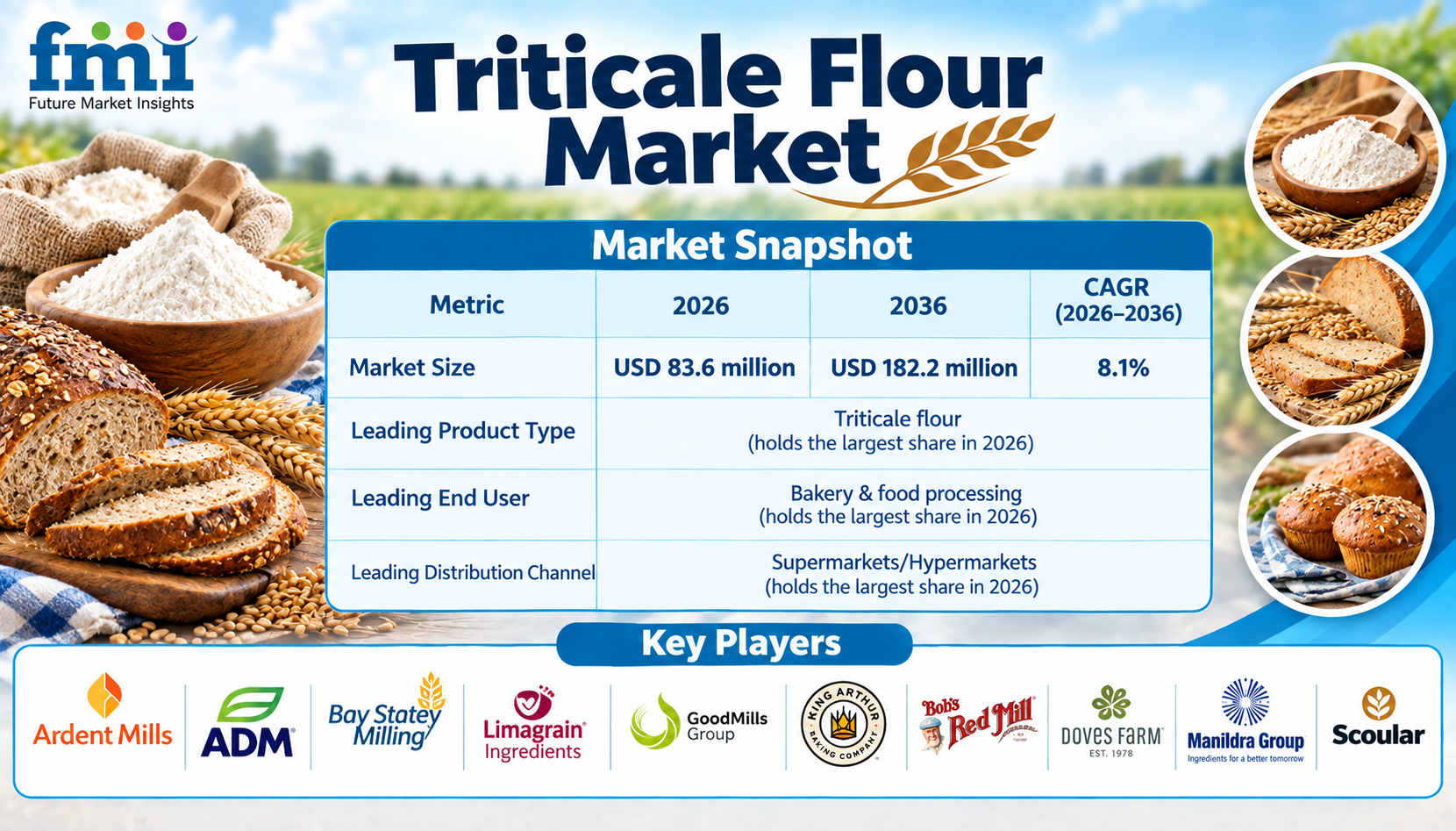
The global Triticale Flour Market is projected to grow from USD 83.6 million in 2026 to USD 182.2 million by 2036, advancing at an 8.1% CAGR during the forecast period, according to the latest research from Future Market Insights (FMI).
The market is driven by growing interest in alternative cereal ingredients that can provide differentiated nutritional and functional characteristics while fitting established commercial bakery processes. Adoption depends on millers converting triticale grain into consistent food-grade flour with predictable particle size, dough handling, and baking performance.
Food-grade segregation remains an important commercial consideration because triticale grain is also widely directed toward feed applications. Suppliers must therefore maintain controlled lots and repeatable milling specifications before industrial bakery customers can qualify the flour for routine production.
Get Detailed Market Forecasts, Competitive Benchmarking, and Pricing Trends: https://www.futuremarketinsights.com/reports/sample/rep-gb-35361
By grade, standard milling grade is estimated to account for 35.0% of demand in 2026. Its compatibility with conventional flour-processing systems provides a practical entry point for commercial bakeries evaluating triticale-based ingredients.
By form, powder-dry triticale flour is projected to capture 45.0% of demand in 2026. Dry flour can move through established storage, handling, blending, and production systems without requiring significant changes to existing bakery infrastructure.
By application, bread & rolls are forecast to represent 31.0% of demand in 2026. Blending triticale flour with other cereal flours can support dough structure and help commercial bakeries introduce the ingredient while maintaining predictable processing characteristics.
Commercial Bakery Qualification Drives Triticale Flour Adoption
Triticale flour adoption depends on whether millers can provide consistent specifications across commercial lots. Bakery manufacturers require predictable dough behavior because variations in particle size, moisture, protein functionality, or milling characteristics can affect mixing, fermentation, shaping, and final product quality.
For commercial buyers, flour qualification therefore extends beyond price. Repeatable milling performance and technical application support become important when introducing triticale flour into established bakery formulas.
USDA Economic Research Service estimated USA wheat flour use at 126.6 pounds per person in 2025, providing a broad benchmark for cereal-flour consumption and highlighting the scale of performance expectations faced by alternative grain ingredients.
Suppliers seeking wider bakery adoption need to demonstrate that triticale flour can operate within existing production parameters without requiring repeated reformulation.
Standard Milling Grade Supports Mainstream Qualification
Standard milling grade is estimated to represent 35.0% of grade demand in 2026.
The segment benefits from compatibility with conventional flour systems and established commercial bakery qualification procedures. Standardized milling specifications can make it easier for buyers to compare triticale flour with existing wheat and specialty flour inputs.
For millers, maintaining consistent particle size and flour characteristics is essential because commercial bakery accounts often operate high-throughput production lines where small variations can affect finished-product uniformity.
The opportunity for suppliers lies in establishing food-grade specifications that can be maintained across multiple production lots while preserving the functional characteristics expected by bakery customers.
Powder-Dry Formats Anchor Commercial Handling
Powder-dry triticale flour is projected to account for 45.0% of form demand in 2026.
The dominance of dry flour reflects the compatibility of powdered ingredients with existing bakery storage, transportation, weighing, blending, and dosing systems.
Dry formats can be incorporated into commercial flour blends without requiring specialized liquid-handling infrastructure. This provides manufacturers with a practical route to introduce triticale into bread, roll, and other bakery formulations.
However, storage conditions and lot consistency remain important because changes in moisture and milling characteristics can affect dough performance.
For suppliers, reliable packaging and handling specifications are therefore essential to maintaining product quality from milling facilities through bakery production lines.
Bread & Rolls Represent a Major Commercial Application
Bread and rolls are forecast to account for 31.0% of application demand in 2026.
The application benefits from the ability to blend triticale flour with other cereal flours while maintaining commercial dough structure. Blending can allow bakeries to introduce differentiated grain ingredients without relying entirely on triticale flour for the structural characteristics required by finished products.
Commercial bread and roll manufacturers also benefit from established production equipment and standardized processes, creating opportunities for triticale flour suppliers that can demonstrate consistent performance.
Application support is particularly important during qualification because bakeries may need to adjust hydration, mixing, fermentation, or blending ratios when introducing alternative flour systems.
Food-Grade Segregation Creates a Key Supply-Side Challenge
Although triticale production provides a broader raw-grain supply base, not all available grain is automatically suitable for food-grade flour production.
Feed channels can accept broader specifications than commercial bakeries, creating an additional qualification requirement for grain destined for human food applications. Suppliers therefore need appropriate segregation, testing, storage, and milling controls.
Destatis recorded 540,700 tons of triticale on German farms as of December 31, 2025. Converting available grain into consistent commercial flour still requires controlled sourcing and food-grade processing systems.
For manufacturers, the challenge is to establish dependable food-grade supply chains while avoiding unnecessary cost increases from additional segregation and qualification procedures.
Milling Consistency and Application Support Govern Market Expansion
Commercial buyers increasingly evaluate flour suppliers based on more than raw-material pricing. Lot-to-lot consistency, technical assistance, milling controls, and application performance can determine whether a trial progresses into recurring procurement.
A flour that requires repeated reformulation can create hidden costs for bakery manufacturers through production adjustments, quality-control work, and inconsistent finished products.
Suppliers can therefore differentiate through technical application support, documented specifications, and reliable lot performance.
The ability to demonstrate predictable dough behavior across bread and roll applications will remain particularly important as manufacturers evaluate triticale flour against established wheat-based and specialty flour alternatives.
Alternative Cereals Create Opportunities for Specialty Bakery Products
Triticale flour provides an opportunity for bakery manufacturers seeking differentiated cereal ingredients while maintaining compatibility with familiar production systems.
Specialty bread and other bakery applications can provide additional opportunities when suppliers can demonstrate controlled particle size, predictable dough handling, and consistent baking performance.
The opportunity extends beyond individual flour sales to technical partnerships between millers, ingredient suppliers, and commercial bakeries. Application testing can help customers determine suitable blending ratios and processing parameters before moving to larger-volume procurement.
Competitive Landscape
The Triticale Flour Market features large-scale grain processors, specialty millers, ingredient suppliers, and established natural-food brands.
Key companies identified by FMI include Ardent Mills, ADM, Bay State Milling, Limagrain Ingredients, GoodMills Group, King Arthur Baking, Bob's Red Mill, Doves Farm, Manildra Group, and Scoular.
Competition centers on milling consistency, food-grade grain segregation, flour specifications, application support, supply reliability, and the ability to integrate triticale flour into established commercial bakery systems.
Large milling companies benefit from established sourcing and distribution networks, while specialty flour suppliers can compete through differentiated products, technical expertise, and application-specific solutions.
Analyst Perspective
"Triticale flour earns repeat business after millers prove segregation and milling controls deliver predictable dough behavior. Buyers should compare lot consistency with application support before price because repeated reformulation erases apparent savings." — Nandini Roy Choudhury, Principal Consultant, Future Market Insights
Read the Full Triticale Flour Market Report Future Market Insights – https://www.futuremarketinsights.com/reports/triticale-flour-market
Report Scope
FMI's Triticale Flour Market study analyzes demand by grade, form, application, sales channel, and region.
The study evaluates standard milling grade and other flour grades, with form analysis covering powder-dry and other commercial formats. Application analysis includes bread & rolls and other bakery uses, while the broader assessment examines food-grade processing, milling requirements, supply-chain considerations, and commercial adoption.
The report evaluates the market across major global regions and examines the factors influencing food-grade triticale flour adoption, including grain segregation, milling consistency, dough behavior, bakery qualification, and application support.
For details on FMI's research framework, view the FMI research methodology. - https://www.futuremarketinsights.com/methodology
Explore More Related Studies Published by FMI
USA Empanadas Market https://www.futuremarketinsights.com/reports/united-states-empanadas-market
Croutons Market https://www.futuremarketinsights.com/reports/croutons-market
Sourdough Flavor Systems Market https://www.futuremarketinsights.com/reports/sourdough-flavor-systems-market
Whole Wheat Bread Market https://www.futuremarketinsights.com/reports/whole-wheat-bread-market
About Future Market Insights (FMI)
Future Market Insights (FMI) delivers actionable, decision-focused market intelligence that goes beyond traditional research reports.
The company provides:
· In-depth pricing and cost benchmarking analysis
· Demand forecasting based on real industry inputs
· Procurement and buyer behavior insights
· Supply chain and trade flow intelligence
· Technology and application trend analysis across industries
FMI follows a robust bottom-up research methodology, combining insights from industry experts, procurement leaders, manufacturers, and technical professionals to provide practical market intelligence.
For Press & Corporate Inquiries
Rahul Singh AVP – Marketing and Growth Strategy
Future Market Insights, Inc.
For Sales: sales@futuremarketinsights.com
For Media: Rahul.singh@futuremarketinsights.com
Web: https://www.futuremarketinsights.com/

 English
 Arabic
 French
 Spanish
 Portuguese
 Turkish
 Dutch
Dutch
 Italiano
 Russian
 Romaian
 Portuguese (Brazil)
 Greek
Greek
