


Antibody Production Market to Create US$36.9B Opportunity by 2036
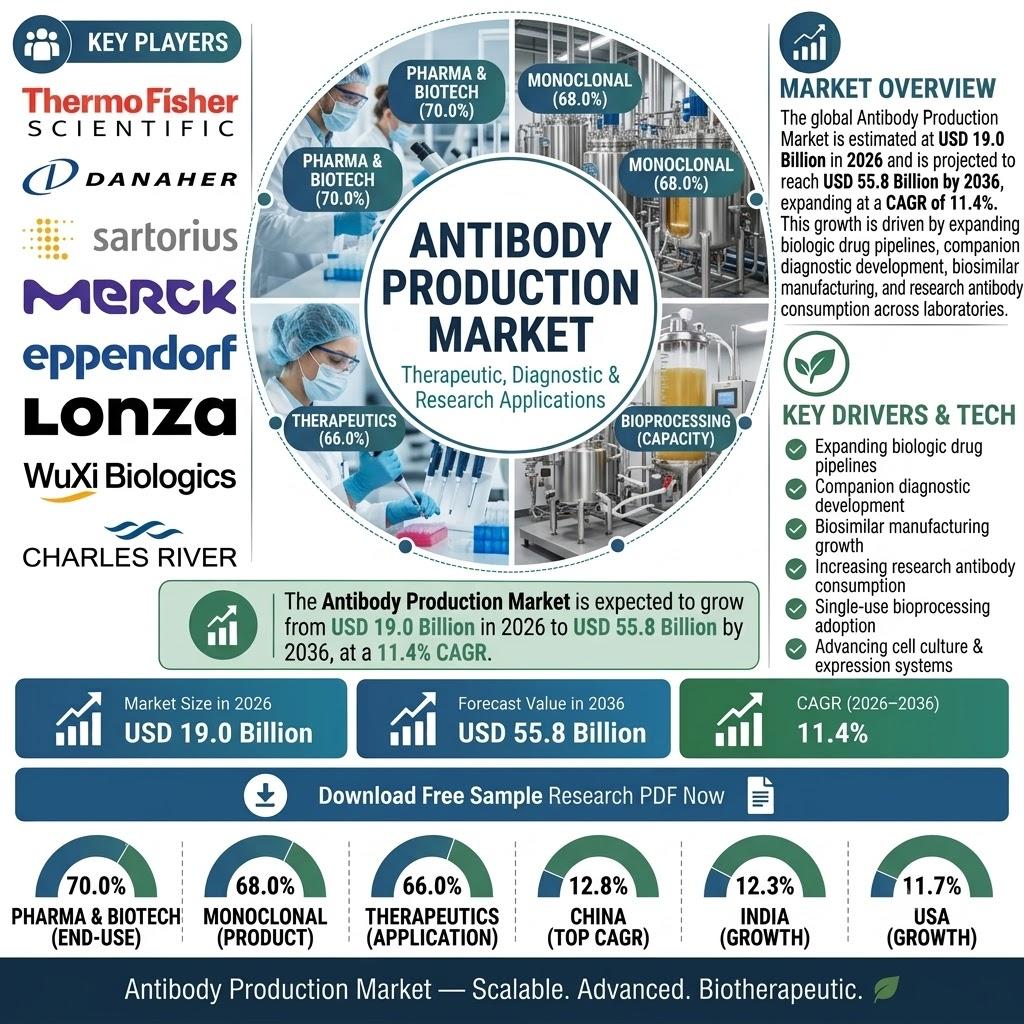
Subheadline: Fact.MR forecasts the Antibody Production Market to grow from US$19.0 billion in 2026 to US$55.8 billion by 2036 at 11.4% CAGR.
September 18, 2026 The global Antibody Production Market is projected to reach US$55.8 billion by 2036, rising from approximately US$19.0 billion in 2026 at a CAGR of 11.4%, according to Fact.MR analysis. The market was valued at approximately US$17.0 billion in 2025 and is expected to create an absolute dollar opportunity of US$36.9 billion between 2026 and 2036.
Demand is being supported by expanding biologic drug pipelines, companion diagnostic development, biosimilar manufacturing, and research antibody consumption across pharmaceutical and academic laboratories. These factors are increasing requirements for antibody production capacity across therapeutic, diagnostic, and research applications.
Get detailed market forecasts, competitive benchmarking, and pricing trends: https://www.factmr.com/connectus/sample?flag=S&rep_id=11974
Antibody Production Market Expands With Biologic Drug Demand
Fact.MR is a market research organization that provides market intelligence and forecasts across global industries. Its Antibody Production Market analysis covers the development, manufacturing, and supply of monoclonal, polyclonal, and recombinant antibodies.
The market includes hybridoma, phage display, transgenic animal, recombinant antibody, and cell culture technologies. Production can range from milligram-level research quantities to multi-kilogram commercial therapeutic manufacturing using mammalian and microbial expression systems.
Monoclonal antibodies remain central to the market. Fact.MR estimates that Monoclonal Antibodies will account for 68% of product share in 2026. Therapeutics represents 66% of application share, while Pharmaceutical and Biotechnology Companies account for 70% of end-use share during the same year.
The figures show where current demand is concentrated. They also indicate why manufacturing capacity remains closely connected to pharmaceutical development activity.
Manufacturing Capacity Faces New Requirements
The antibody manufacturing sector is being shaped by the expansion of biologic drug pipelines across oncology, immunology, and infectious disease applications. Fact.MR identifies therapeutic antibody production capacity as a key demand area as these pipelines expand.
Diagnostic development is another contributor. Rising companion and in-vitro diagnostic development is increasing procurement of diagnostic-grade antibodies from both contract and in-house production sources.
Biosimilar manufacturing adds another layer of demand. Production platforms must replicate reference antibody characteristics at commercial scale, creating requirements for established manufacturing processes and technical capabilities.
Research laboratories remain part of the demand base. Fact.MR reports that increasing research antibody consumption across academic institutions and pharmaceutical R&D laboratories sustains demand for catalog and custom antibody products.
An insider-level detail from the research is the 25+ primary interviews conducted across manufacturers, distributors, and end users. The methodology also draws on 120+ secondary sources and benchmarks 65+ company portfolios, with market sizing covering more than 30 countries.
Asia Pacific Shows Faster Country-Level Growth
Regional growth varies across the markets covered by Fact.MR. China is projected to expand at a 12.8% CAGR through 2036, followed by India at 12.3%. The USA is projected at 11.7%, Japan at 10.9%, Germany at 10.5%, the UK at 9.8%, and South Korea at 9.3%.
China's antibody production market is supported by expanding end-use activity and infrastructure investment, according to Fact.MR. India is also projected to grow at 12.3% through 2036, with expanding end-use activity and adoption of higher-specification products identified as supporting factors.
The USA market is projected to grow at 11.7% through 2036. Fact.MR associates this outlook with established demand, technology adoption, and upgrade activity.
Technology Shapes Production Strategies
Antibody production increasingly involves technologies designed for different production and engineering requirements. Hybridoma technology supports monoclonal cell line development, while recombinant antibody technology includes phage display and transgenic animal platforms.
Cell culture technology also forms part of the market structure. Fact.MR identifies mammalian systems such as CHO and HEK cell systems alongside microbial expression systems using bacterial and yeast platforms.
Specialized programs are creating additional requirements. Antibody-drug conjugate and bispecific antibody development programs are generating demand for specialized production and conjugation capabilities.
Single-use bioprocessing is another opportunity identified by Fact.MR because adoption can reduce facility capital costs and accelerate production changeover between programs.
Top Trending Reports :
https://1nigeria.radiobenue.be.gov.ng/read-blog/29438
https://social.mytamam.com/blogs/40283/Metal-Cans-Market-to-Reach-USD-157-15-Billion-by
https://www.matesroom.com/read-blog/39132
https://www.pikumil.com/blogs/184760/Fresh-Food-Packaging-Market-to-Add-USD-144-Billion-by
Analyst View
Shambhu Nath Jha, Principal Consultant at Fact.MR, said, “The antibody production market is entering a sustained expansion phase driven by the convergence of therapeutic pipeline growth and diagnostic development demand.”
Jha added that companies with capabilities spanning cell line development through commercial manufacturing are capturing high-value contracts from pharmaceutical sponsors seeking to consolidate antibody supply chains.
The competitive landscape includes Thermo Fisher Scientific, Danaher Corporation, Sartorius, Merck KGaA, Eppendorf, Lonza Group, AGC Biologics, Wuxi Biologics, Charles River Laboratories, and Biointron. Fact.MR describes the market as moderately fragmented, with competition involving product breadth, technical capability, service networks, and distribution.
About Fact.MR
Fact.MR is a market research and consulting firm providing industry analysis, forecasts, and business intelligence. The Antibody Production Market study covers 2026 to 2036 and evaluates product, application, end use, technology, formulation, distribution channel, and regional markets.
The research methodology combines secondary research, primary interviews, and forecast modelling. Fact.MR states that the study uses trade-flow checks and sensitivity testing to validate final estimates.

 English
 Arabic
 French
 Spanish
 Portuguese
 Deutsch
 Turkish
 Dutch
Dutch
 Russian
 Romaian
 Portuguese (Brazil)
 Greek
Greek
