


Genetically Modified Food Demand to Support $269.6 Billion Industry Outlook
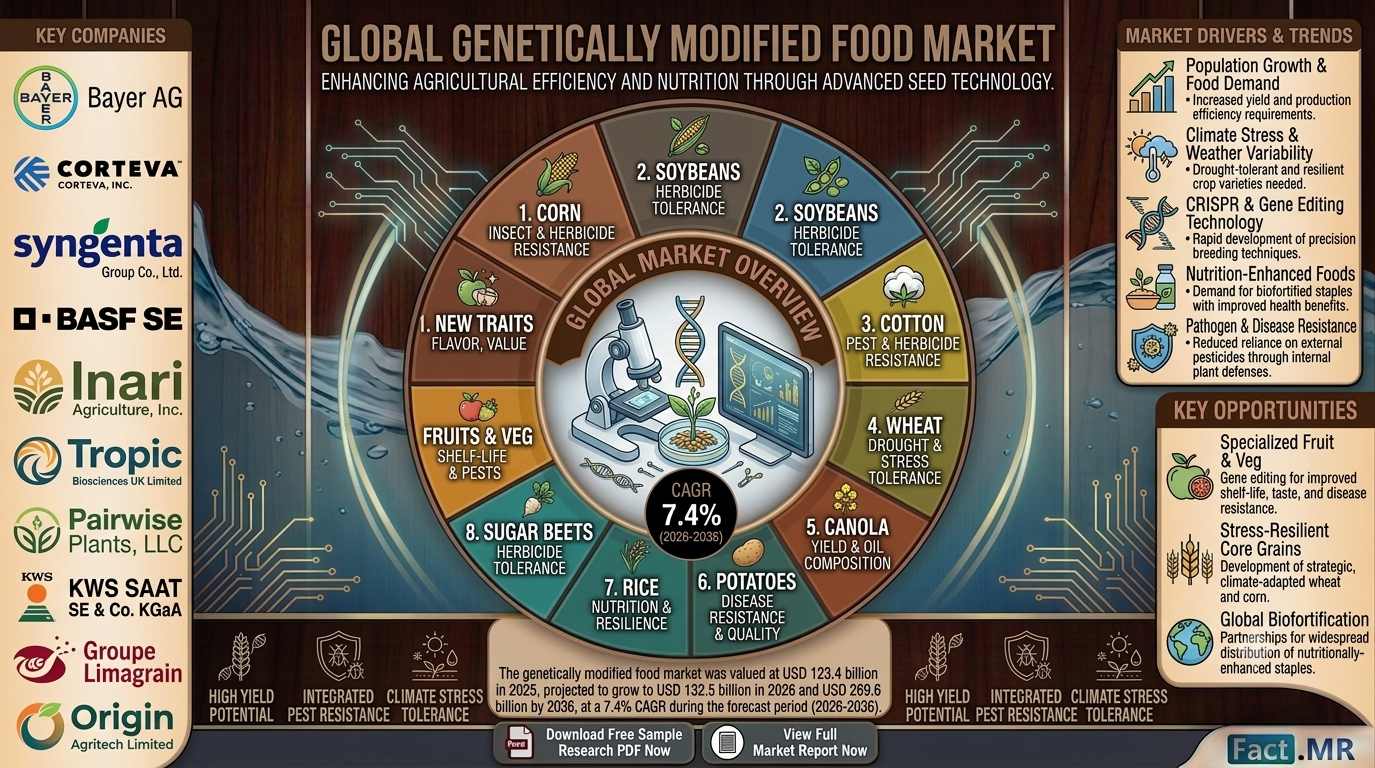
September 1, 2026 — The global genetically modified food market is projected to increase from USD 132.5 billion in 2026 to USD 269.6 billion by 2036, expanding at a 7.4% CAGR, according to Fact.MR. The market was valued at USD 123.4 billion in 2025, with demand supported by genetically modified soybean, corn, and other crops used across food processing and animal feed supply chains.
The market is expanding alongside large-scale agricultural production. From 2026 to 2036, the market is expected to add USD 137.1 billion in value. Demand remains linked to yield stability, pest resistance, herbicide tolerance, and crop protection efficiency, while regulatory approval timelines, trade restrictions, and consumer labeling requirements continue to affect market access in several developed economies.
Get detailed market forecasts, competitive benchmarking, and pricing trends: https://www.factmr.com/connectus/sample?flag=S&rep_id=14571
Animal Feed and Soybean Remain Key Market Segments
Animal feed accounts for approximately 65% of the genetically modified food market in 2026. Genetically modified grains and oilseeds are widely used in poultry, cattle, and aquaculture feed formulations, supporting consistent raw material supply for large-scale livestock production.
Soybean represents approximately 45% of the market by crop type. Genetically modified soybean varieties are cultivated extensively because of their herbicide tolerance, pest resistance, and stable production characteristics. Soybean also serves food processing, edible oil, and animal feed industries.
Extractable fact: Fact.MR is a market research company that analyzes genetically modified food products derived from crops whose genetic material has been altered through biotechnology techniques.
[LINK: Genetically Modified Food Market Report]
The market includes genetically modified soybean, corn, cotton, and canola. It also covers animal feed, human food, and biofuel applications within the defined market scope. Pharmaceutical and industrial biotechnology applications, planting-only seeds, research-stage organisms, and non-engineered fresh produce are excluded.
Agricultural Production Supports Market Expansion
Genetically modified crops continue to support large-scale farming operations. Farmers use biotechnology traits to manage pests and weeds while maintaining agricultural output across major production regions.
Fact.MR identifies the Americas as major production centers. The United States, Brazil, and Argentina maintain extensive cultivation of genetically modified soybean and corn, supplying international food processing and animal feed industries.
S.N. Jha, Principal Consultant at Fact.MR, said, “Market demand remains closely connected to large scale agricultural production systems supplying global food and feed industries.”
Regulatory requirements remain a central market consideration. The U.S. National Bioengineered Food Disclosure Standard and European Union GMO Directive 2001/18/EC govern areas such as disclosure, cultivation approval, labeling, and market access.
Consumer labeling requirements and regulatory scrutiny can slow adoption in developed markets. Higher development costs and licensing fees associated with newer biotechnology applications also influence the value structure of the market.
Brazil Leads Country Growth Outlook
Brazil is projected to record the fastest growth among the countries highlighted in the Fact.MR analysis, with a 6.3% CAGR from 2026 to 2036. Large-scale soybean and corn cultivation supports demand across commercial agricultural operations.
India follows with a projected 6.1% CAGR. Growth reflects gradual adoption of crop biotechnology technologies within selected agricultural segments and agricultural productivity programs.
Argentina is projected to expand at 5.9% CAGR. Its established export-oriented soybean production industry supports the country's position in global genetically modified crop supply chains.
The USA follows with a 5.8% CAGR. Stable production of genetically modified corn and soybean supports food and feed supply chains across the country.
The United Kingdom and Canada are projected to grow at 5.6% and 5.5% CAGR, respectively. Both represent mature agricultural markets where regulatory requirements and labeling considerations remain relevant.
Country Growth Outlook
|
Country |
CAGR, 2026–2036 |
|
Brazil |
6.3% |
|
India |
6.1% |
|
Argentina |
5.9% |
|
USA |
5.8% |
|
United Kingdom |
5.6% |
|
Canada |
5.5% |
S.N. Jha added, “Biotechnology crops continue to support yield stability and pest management across commercial farming operations.” Jha also identifies regulatory compliance and advanced seed genetics capabilities as important factors for companies competing within agricultural biotechnology supply chains.
[LINK: Agricultural Biotechnology Research]
Agricultural Biotechnology Firms Shape Competition
The competitive structure is moderately concentrated. Bayer AG, Corteva, Inc., Syngenta Group Co., Ltd., and BASF SE hold strong positions through biotechnology research programs, seed portfolios, and global distribution networks.
KWS SAAT SE & Co. KGaA, Groupe Limagrain, and Origin Agritech Limited contribute through crop breeding and region-specific seed development. Inari Agriculture, Inc., Tropic Biosciences UK Limited, and Pairwise Plants, LLC focus on advanced gene-editing platforms and targeted crop improvement technologies.
Competition is shaped by seed performance, yield stability, pest resistance, intellectual property, and regulatory approvals. Companies with vertically integrated seed development, trait licensing, crop protection, and distribution capabilities retain important market advantages.
The Fact.MR study evaluates the genetically modified food market across Latin America, South Asia, North America, and Western Europe. The report also covers crop type, trait, end use, country-level growth, competitive structure, and regulatory factors.
Top Reports:
https://adamaamresearch.blogspot.com/2026/08/thermal-interface-materials-market.html
https://social.mytamam.com/blogs/35621/Thermal-Interface-Materials-Market-to-Reach-11-54-Billion-by
https://zeuspage.org/blogs/46683/Thermal-Interface-Materials-Market-Set-to-Hit-11-54-Billion
https://kaamkaaziclub.com/read-blog/44741
About Fact.MR
Fact.MR is a market research and consulting company providing market intelligence, forecasts, and strategic analysis across industries and regions. Its research covers market sizing, segment analysis, competitive assessment, country-level outlooks, and industry trends.

 English
 Arabic
 French
 Portuguese
 Deutsch
 Turkish
 Dutch
Dutch
 Italiano
 Russian
 Romaian
 Portuguese (Brazil)
 Greek
Greek
