


Pediatric Digital Inhaler Monitoring Sensors Market to Surpass USD 145 Million by 2036
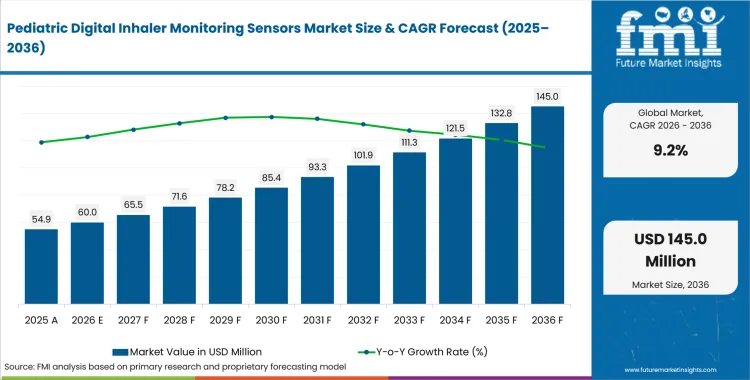
The global Pediatric Digital Inhaler Monitoring Sensors Market is expanding as healthcare providers and families increasingly explore connected technologies for monitoring inhaler use, medication adherence, and inhalation technique among children and adolescents. According to Future Market Insights (FMI), the market is projected to grow from USD 60.0 million in 2026 to approximately USD 145.0 million by 2036, registering a 9.2% CAGR between 2026 and 2036.
Growth is being supported by increasing interest in connected respiratory care, the need for more reliable medication-use records, expanding pediatric home-care programs, and the development of software capable of converting inhaler events and technique signals into actionable information.
The market is expected to create an incremental opportunity of approximately USD 85.0 million between 2026 and 2036. However, broader adoption will depend on reliable sensor performance, age-appropriate interfaces, interoperability with clinical systems, caregiver usability, and stronger evidence demonstrating value within pediatric respiratory-care workflows.
👉 Get Detailed Market Forecasts, Competitive Benchmarking, and Pricing Trends: https://www.futuremarketinsights.com/reports/sample/rep-gb-34253
Key Pediatric Digital Inhaler Monitoring Sensors Market Highlights at a Glance
- Market Size (2026): USD 60.0 Million
- Forecast Market Size (2036): USD 145.0 Million
- Forecast Period: 2026–2036
- CAGR (2026–2036): 9.2%
- Incremental Opportunity: Approximately USD 85.0 Million
- Leading Product Type: Software (28.0% Share in 2026)
- Leading Care Setting: Home Care (46.0% Share in 2026)
- Leading Application: Monitoring (55.0% Share in 2026)
- Key Growth Markets: United States, Germany, United Kingdom, Japan, China, and India
- Key Companies: Adherium, Aptar Digital Health, FindAir, Amiko, Cognita Labs, BreatheSuite, Smart Respiratory Products, and Roundworks Technologies
Which Product Type Leads the Pediatric Digital Inhaler Monitoring Sensors Market?
Software is projected to account for approximately 28.0% of product type demand in 2026.
Software is becoming increasingly important because sensor-generated inhaler data requires digital platforms to store, interpret, visualize, and communicate information. Analytics can help convert individual inhaler events into adherence and technique records that caregivers and clinical teams can understand.
Configurable caregiver functions and recurring analytics can also create ongoing value beyond the physical sensor itself. Providers are therefore increasingly focusing on software capabilities, data usability, and integration with broader digital respiratory-care systems.
Why Does Home Care Lead the Care Setting Segment?
Home care is projected to represent approximately 46.0% of care-setting demand in 2026.
Routine inhaler use frequently occurs outside healthcare facilities, making the home a critical environment for understanding adherence and technique. Digital monitoring can provide families with greater visibility into medication use while potentially giving clinicians access to longitudinal information between appointments.
However, successful deployment requires simple interfaces and minimal disruption to established family routines. Systems must also account for shared caregiving, device replacement, and situations in which children move between home, school, and clinical settings.
Why Does Monitoring Lead the Application Segment?
Monitoring is anticipated to account for approximately 55.0% of application demand in 2026.
Continuous visibility into inhaler use is a central purpose of connected inhaler sensors. Monitoring platforms can capture dose events and, where supported, information related to inhalation technique.
The value of monitoring depends on whether collected data can translate into useful clinical or behavioral action. Excessive alerts or unclear recommendations may reduce engagement, making usability and clinically relevant exception reporting increasingly important.
How Is Pediatric Workflow Integration Shaping Market Demand?
Integration with pediatric respiratory-care workflows is becoming a critical factor in adoption.
Digital inhaler systems need to work across family routines while allowing authorized caregivers and clinical teams to access relevant information. Data continuity is particularly important when devices are replaced or when responsibility for medication administration moves between caregivers.
Healthcare organizations are also evaluating how monitoring information fits within existing clinical systems. Interoperability gaps can create additional administrative work and limit the value of otherwise useful sensor data.
What Are the Latest Technology and Innovation Trends?
Innovation in the pediatric digital inhaler monitoring sensors market is increasingly focused on reliable sensing, software analytics, caregiver engagement, and integration with clinical workflows.
Major trends include:
- Development of smart inhaler monitoring technologies.
- Increasing integration of sensors with digital respiratory platforms.
- Improved dose-event capture.
- Development of inhalation-technique monitoring.
- Increasing use of caregiver alerts and notifications.
- Development of age-appropriate digital interfaces.
- Greater emphasis on interoperability.
- Expansion of remote monitoring capabilities.
- Increasing use of longitudinal medication-use analytics.
- Development of connected drug-delivery ecosystems.
- Greater focus on reducing unnecessary alert volume.
- Improved support for device replacement and shared caregiving.
Competition is increasingly shifting from simple event tracking toward systems capable of converting inhaler data into clinically meaningful information without increasing the workload of respiratory-care teams.
What Are the Key Market Challenges and Restraints?
Interoperability limitations, limited pediatric clinical evidence, device compatibility, caregiver burden, data privacy, regulatory requirements, and uncertain reimbursement remain important challenges.
Digital inhaler monitoring systems must be compatible with the child’s prescribed inhaler and generate reliable data under everyday conditions. Differences among inhaler devices can complicate sensor development and deployment.
Limited evidence around pediatric workflows can also slow adoption among healthcare organizations. Providers need confidence that monitoring data can improve care without creating excessive alerts or additional administrative responsibilities.
Caregiver engagement represents another important consideration. Systems that require complicated setup or frequent interaction may experience lower sustained use.
What Is the Regional and Country Outlook?
The United States remains an important market because of its advanced digital-health infrastructure, established remote monitoring ecosystem, and growing interest in connected respiratory care.
Germany and the United Kingdom represent significant European opportunities as healthcare providers evaluate digital monitoring technologies and integrated approaches to chronic respiratory management.
Japan remains an important Asian market due to its advanced healthcare infrastructure and technology adoption capabilities.
China and India offer substantial long-term opportunities as healthcare digitization, respiratory-care awareness, and access to connected medical technologies expand.
Across major markets, regulatory requirements, reimbursement structures, health-data policies, and clinical evidence will influence the pace at which pediatric digital inhaler monitoring becomes integrated into routine care.
What Is the Competitive Landscape?
Competition in the pediatric digital inhaler monitoring sensors market is centered on sensor reliability, inhaler compatibility, software functionality, data analytics, caregiver usability, clinical integration, and regulatory readiness.
Specialized companies are developing connected inhaler platforms and monitoring solutions, while broader digital-health providers are integrating respiratory monitoring capabilities into connected-care ecosystems.
The competitive environment is expected to intensify as developers seek to demonstrate measurable clinical value while addressing interoperability and pediatric workflow requirements.
Key Companies
- Adherium
- Aptar Digital Health
- FindAir
- Amiko
- Cognita Labs
- BreatheSuite
- Smart Respiratory Products
- Roundworks Technologies
These companies are competing through connected inhaler technologies, sensor development, respiratory analytics, caregiver platforms, remote monitoring capabilities, digital drug delivery, and clinical workflow integration.
Related Reports
- Treg Therapy Market - https://www.futuremarketinsights.com/reports/treg-therapy-market
- Intraosseous Devices Market - https://www.futuremarketinsights.com/reports/intraosseous-devices-market/companies
- Orthopedic Oncology Market - https://www.futuremarketinsights.com/reports/orthopaedic-oncology-market
- Laparoscopic Power Morcellators Market - https://www.futuremarketinsights.com/reports/laparoscopic-power-morcellators-market
- Toxicity Testing Outsourcing Market - https://www.futuremarketinsights.com/reports/toxicity-testing-outsourcing-market
About Future Market Insights (FMI)
Future Market Insights (FMI) is a global market intelligence and consulting firm providing comprehensive market research, competitive intelligence, and strategic business insights across industries. The firm delivers detailed forecasts, technology analysis, and data-driven recommendations that support informed decision-making for manufacturers, investors, distributors, and policymakers worldwide.
For Press & Corporate Inquiries
Rahul Singh
AVP – Marketing and Growth Strategy
Future Market Insights, Inc.
+91 8600020075
For Sales – sales@futuremarketinsights.com
For Media – Rahul.singh@futuremarketinsights.com
For Web – https://www.futuremarketinsights.com

 English
 Arabic
 French
 Portuguese
 Deutsch
 Turkish
 Dutch
Dutch
 Italiano
 Russian
 Romaian
 Portuguese (Brazil)
 Greek
Greek
