


Heat Stable Plant Protein Texturizing Agents Market Growth, Analysis Industry Outlook & Region Forecast Analysis By Fact.MR
Heat Stable Plant Protein Texturizing Agents Market to Reach $1.33 Billion by 2036
Rockville, Maryland, USA – August 28, 2026 – The global heat stable plant protein texturizing agents market is projected to increase from USD 0.53 billion in 2026 to USD 1.33 billion by 2036, expanding at a 9.7% CAGR, according to Fact.MR. The market is gaining attention as food manufacturers seek plant-derived protein systems that maintain texture, viscosity, water-binding, and structural integrity during UHT processing, retorting, baking, and extrusion.
The growth question is increasingly technical: how can plant-based foods maintain acceptable texture after high-temperature processing? Fact.MR identifies heat stability as a core requirement for ambient-shelf products, ready meals, beverages, dairy alternatives, and other plant-based formats exposed to thermal stress. The market is expected to add USD 0.80 billion in absolute opportunity between 2026 and 2036, representing approximately 2.5 times growth in value.
Get detailed market forecasts, competitive benchmarking, and pricing trends: https://www.factmr.com/connectus/sample?flag=S&rep_id=13210
Dairy Alternatives Lead Heat Stable Plant Protein Texturizing Agents Market
Dairy and alternative dairy applications account for approximately 46.7% of market share in 2026, making the category the leading application segment. The segment covers plant-based milk, yogurt, creamers, and cheese, where UHT treatment or hot-fill packaging can place substantial demands on formulation stability.
Heat-stable texturizing systems help address issues such as protein sedimentation, phase separation, and graininess following thermal treatment. These characteristics directly affect appearance and mouthfeel, two factors that influence acceptance of plant-based products.
Report fact block:
Fact.MR is a market research organization that analyzes the heat stable plant protein texturizing agents market across applications, protein sources, sales channels, regions, and key countries.
Pea Protein Holds 45.2% Source Share
Pea-based texturizing agents represent approximately 45.2% of source segment share in 2026, according to Fact.MR. The report associates pea protein's position with its neutral flavor profile, high protein content, non-GMO positioning, allergen-friendly characteristics, and improving functional properties.
Protein isolation and modification can improve functional behavior, including heat-induced gelling and water-binding. These characteristics support applications ranging from alternative meat products to nutritional beverages.
The market also includes soy, wheat, and fava/chickpea sources. Fact.MR identifies blended protein systems as an emerging direction, particularly where manufacturers seek complementary functionality from different plant sources.
Direct-to-B2B Sales Account for 64% Share
Direct-to-B2B sales account for approximately 64% of market share in 2026, making this the leading distribution channel. The report links this position to the technical collaboration required between ingredient suppliers and food manufacturers when developing formulations for specific processing conditions.
The commercial relationship can involve formulation development, processing-line requirements, and final product specifications. Distributors, online B2B channels, and contract manufacturing represent additional routes to market.
“[APPROVED QUOTE FROM S.N. JHA, PRINCIPAL CONSULTANT, FACT.MR — INSERT VERIFIED COMMENT ON B2B COLLABORATION OR FORMULATION REQUIREMENTS]”
India Records the Fastest Country Growth
India is forecast to register the highest CAGR among the key countries covered by Fact.MR, at 14.8% from 2026 to 2036. China follows at 14.2%, while the United States is projected to grow at 13.1% and Germany at 12.6%.
Fact.MR associates India's growth with its large vegetarian population, expanding middle class, and rising demand for convenient packaged foods. Applications are extending into ready-to-eat meals, soups, and beverages, while local development is examining plant sources such as chickpea and mung bean.
China's growth is linked to its large food manufacturing base and rising demand for plant-based meat alternatives and dairy replacements. In the United States, competition centers on product quality and functional performance, including texture, melt, stretch, bite, juiciness, and fiber characteristics.
Germany's market reflects demand for clean-label and scientifically supported ingredients that perform consistently in automated food production.
Cost and Processing Complexity Remain Constraints
Fact.MR identifies the comparatively higher cost of advanced plant protein isolates as one market restraint. Achieving consistent heat stability across different production scales and processing equipment can also increase technical complexity. Some plant proteins may develop unwanted flavors or colors after severe heat treatment, creating additional formulation requirements.
At the same time, research is moving toward enzymatic and physical modification methods, blended protein systems, and upcycled protein sources from agricultural side-streams. The report also identifies clean-label development as an important area of innovation.
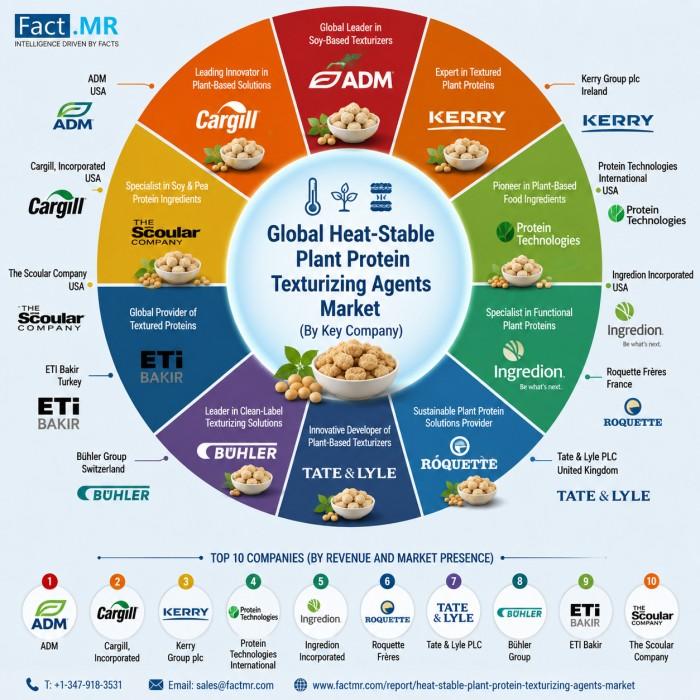
Key companies active in the market include Ingredion Inc., International Flavors & Fragrances Inc. (IFF), ADM, Kerry Group, Tate & Lyle Public Limited Company, and Cargill Incorporated. Competition centers on protein modification technologies, application-specific solutions, sustainable protein sources, and technical customer support.
Market Outlook
Fact.MR estimates that the heat stable plant protein texturizing agents market will reach USD 1.33 billion by 2036, compared with USD 0.53 billion in 2026. The market's projected 150.9% total growth reflects increasing requirements for plant protein systems capable of performing under demanding thermal processing conditions.
The report covers dairy and alternative dairy, beverages, bakery and snacks, and meat alternatives across pea, soy, wheat, and fava/chickpea sources. Geographic coverage includes North America, Latin America, Europe, East Asia, South Asia and Pacific, and the Middle East and Africa.
Explore More Related Studies Published by Fact.MR Research
Guava Powder Market- https://www.openpr.com/news/4598576/usa-guava-powder-market-tracks-7-0-cagr-as-mevive-international
Corn Germ Oil Market- https://www.openpr.com/news/4598577/ach-food-companies-holds-8-6-of-corn-germ-oil-market-as-u-s
Fermented Chickpea Protein Concentrates Market- https://www.openpr.com/news/4598580/ingredion-steadies-u-s-fermented-chickpea-protein
Concentrated Liquid Smoke Market- https://www.openpr.com/news/4597516/kerry-red-arrow-s-9-7-lead-anchors-us-concentrated-liquid-smoke
About Fact.MR
Fact.MR is a market research and consulting firm providing syndicated and customized research across consumer goods, food and beverage, healthcare, technology, automotive, industrial goods, chemicals, and materials. Its research covers market sizing, forecasts, segmentation, competitive analysis, and regional assessments.
Media Contact
Fact.MR 11140 Rockville Pike, Suite 400 Rockville, MD 20852, United States Phone: +1 (628) 251-1583 Email: sales@factmr.com

 English
 Arabic
 French
 Spanish
 Portuguese
 Deutsch
 Turkish
 Dutch
Dutch
 Italiano
 Romaian
 Portuguese (Brazil)
 Greek
Greek
