


How Do Lawyers Investigate an 18-Wheeler Accident?
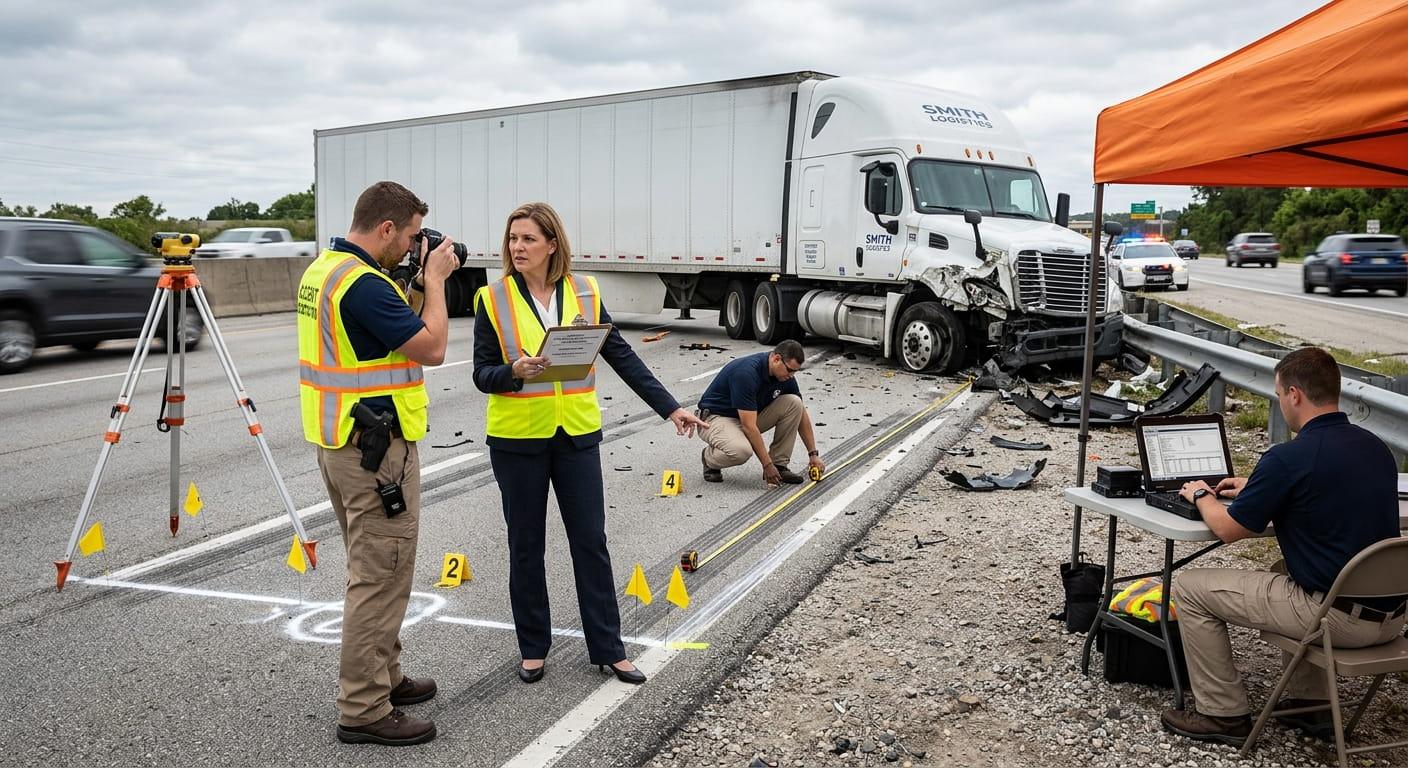
After a serious truck crash, determining what happened can require much more than reviewing a police report. An 18-wheeler accident investigation may involve driver logs, electronic vehicle data, maintenance records, inspection reports, company communications, witness statements, and accident reconstruction. If you or a loved one was seriously injured, a lawyer for 18 wheeler accident cases can investigate the available evidence and determine whether the truck driver, trucking company, maintenance provider, loading company, manufacturer, or another party may be responsible.
Why Is an 18-Wheeler Accident Investigation Important?
Commercial truck accidents can be complicated because multiple parties may have responsibilities connected to the truck, driver, cargo, maintenance, or transportation company.
An investigation may need to answer questions such as:
-
How did the collision happen?
-
Was the truck driver distracted or fatigued?
-
Did the driver violate hours-of-service requirements?
-
Was the truck properly maintained?
-
Were the brakes and tires in safe condition?
-
Was the cargo loaded and secured properly?
-
Did the trucking company follow safety procedures?
-
Was another vehicle or roadway condition involved?
-
Who may be legally responsible for the resulting injuries?
Harrison Davis focuses on serious commercial truck accident litigation, including catastrophic injuries, wrongful death, and other life-changing losses.
Step 1: Review the Accident and Injuries
A truck accident investigation generally begins by establishing the basic facts.
A lawyer may review:
-
Police and crash reports
-
Photographs
-
Medical records
-
Vehicle damage
-
Witness information
-
Road and weather conditions
-
Available video footage
-
Initial statements about the collision
The nature of the accident can also provide important clues.
For example, Harrison Davis handles serious cases involving jackknife accidents, underride crashes, rollovers, rear-end collisions, tire failures, driver fatigue, distracted driving, and other commercial truck crashes.
Understanding how the collision occurred helps determine what additional evidence should be investigated.
Step 2: Preserve Important Evidence
Preserving evidence is one of the most important parts of a serious truck accident investigation.
Commercial trucking companies can possess records that may be highly relevant to a claim. These may include electronic data, driver records, maintenance documents, inspection records, communications, and safety information.
A legal investigation may seek to identify and preserve this information before it becomes unavailable.
Harrison Davis identifies electronic and vehicle data, maintenance and inspection records, driver logs, company safety practices, witnesses, and scene evidence as important evidence in serious truck accident investigations.
Step 3: Examine Electronic Vehicle Data
Modern commercial trucks can contain electronic information that may help investigators understand what happened immediately before a crash.
Depending on the truck and available systems, investigators may examine information related to:
-
Vehicle speed
-
Braking
-
Engine activity
-
Vehicle operation
-
Other available crash-related information
Electronic data can become particularly important when the parties disagree about how the accident occurred.
For example, a driver may claim that the truck was traveling at a certain speed, while available vehicle data may provide additional information for investigators to consider.
Step 4: Review Driver Logs and Hours-of-Service Records
Driver fatigue can be a major concern in commercial trucking accidents.
If investigators suspect that a driver was too tired to operate the truck safely, they may review:
-
Driver logs
-
Electronic logging device records
-
Hours-of-service information
-
Rest periods
-
Dispatch records
-
Delivery schedules
-
Communications with the trucking company
These records can help establish how long the driver had been working and driving before the collision.
This evidence can be particularly important when a truck driver allegedly fell asleep, drifted between lanes, or failed to react to traffic.
Step 5: Investigate Truck Maintenance
Mechanical problems can contribute to serious commercial truck crashes.
A lawyer may investigate the truck's maintenance and inspection history to determine whether a mechanical defect or neglected repair played a role.
Potential areas of investigation include:
-
Brakes
-
Tires
-
Steering
-
Suspension
-
Lights
-
Wheels
-
Trailer components
-
Coupling equipment
Maintenance records can reveal whether a problem was previously identified and whether repairs were completed.
Harrison Davis specifically investigates maintenance and inspection records as part of serious truck accident cases.
Step 6: Examine the Trucking Company's Safety Practices
An investigation may also look at the trucking company's conduct.
Depending on the circumstances, lawyers may examine:
-
Driver hiring practices
-
Driver training
-
Driver supervision
-
Safety policies
-
Hours-of-service compliance
-
Maintenance procedures
-
Scheduling practices
-
Previous safety concerns
This is important because the driver may not be the only potentially responsible party.
For example, if a trucking company pressured a driver to meet an unrealistic delivery deadline despite inadequate rest, those circumstances could become relevant in a fatigue-related accident investigation.
Step 7: Investigate Cargo and Loading
Improperly loaded cargo can affect a truck's stability and handling.
If a crash involves a rollover, jackknife, or shifting cargo, investigators may examine:
-
Cargo weight
-
Weight distribution
-
Loading records
-
Securing equipment
-
Shipping documents
-
The company responsible for loading
If improper loading contributed to the crash, another company or entity may potentially share responsibility.
Step 8: Identify All Potentially Responsible Parties
A commercial truck accident may involve more than one potentially responsible party.
Depending on the evidence, an investigation may consider:
-
Truck driver
-
Trucking company
-
Truck owner
-
Maintenance provider
-
Loading company
-
Freight broker
-
Parts manufacturer
-
Truck manufacturer
-
Other responsible parties
Harrison Davis emphasizes investigating potentially responsible parties rather than automatically assuming that the truck driver is solely responsible.
This broader approach can be especially important when mechanical failures, improper loading, driver fatigue, or company safety practices are involved.
Step 9: Inspect the Accident Scene
Physical evidence can help investigators reconstruct the crash.
An investigation may examine:
-
Skid marks
-
Tire marks
-
Vehicle positions
-
Debris patterns
-
Road conditions
-
Traffic signals
-
Lighting
-
Damage to the vehicles
-
Surveillance or dashcam footage
Photographs and video can also help preserve the condition of the scene shortly after the collision.
Step 10: Use Accident Reconstruction
Some serious truck crashes require accident reconstruction.
An accident reconstructionist may analyze physical evidence and vehicle data to determine how the collision occurred.
This may help answer questions about:
-
Vehicle speed
-
Braking
-
Lane movement
-
Impact points
-
Reaction time
-
Vehicle positions
-
Collision sequence
Harrison Davis works with investigators, accident reconstructionists, and subject-matter experts in serious truck accident cases.
Step 11: Investigate Witnesses and Other Evidence
Witnesses can provide valuable information about what happened before the collision.
A witness may have observed:
-
A truck speeding
-
Unsafe lane changes
-
Driver distraction
-
A truck drifting between lanes
-
Sudden braking
-
Cargo falling from a trailer
-
A truck losing control
Lawyers may compare witness accounts with physical evidence, electronic data, photographs, and other records.
Step 12: Document the Full Impact of the Crash
A truck accident investigation is not only about determining liability. It also involves documenting how the collision affected the injured person.
Depending on the circumstances, damages may include:
-
Medical expenses
-
Hospitalization
-
Surgery
-
Rehabilitation
-
Future medical treatment
-
Lost wages
-
Reduced earning capacity
-
Physical pain
-
Mental anguish
-
Physical impairment
-
Disfigurement
If the accident causes a death, eligible surviving family members may potentially pursue a wrongful death claim under applicable law.
Why Should You Investigate an 18-Wheeler Crash Quickly?
Evidence can become more difficult to obtain as time passes. Electronic data, company communications, maintenance records, vehicle evidence, witness recollections, and accident-scene information can all be important.
Early investigation can help identify potentially responsible parties and preserve relevant evidence.
If you have suffered serious injuries in an 18-wheeler crash, do not assume that the initial accident report provides the complete explanation. A detailed investigation may uncover facts that were not immediately apparent.
Frequently Asked Questions
1. What evidence do lawyers investigate after an 18-wheeler accident?
Evidence may include driver logs, ELD data, electronic vehicle information, maintenance records, inspection reports, company communications, safety records, photographs, video, witness statements, and accident-scene evidence.
2. How long does an 18-wheeler accident investigation take?
There is no single timeline. A relatively straightforward case may require less investigation, while a serious crash involving multiple vehicles, catastrophic injuries, disputed liability, or several companies can require significantly more time.
3. Can a lawyer investigate the trucking company's records?
Yes. Relevant company records may be sought through appropriate legal procedures depending on the circumstances of the case and applicable law.
4. Can accident reconstruction determine who caused a truck crash?
Accident reconstruction can help establish how vehicles moved, where impacts occurred, and other details of the collision. It is generally considered alongside other evidence when evaluating responsibility.
5. Why is early evidence preservation important?
Important records and physical evidence may become harder to obtain as time passes. Early investigation can help identify relevant evidence and potentially responsible parties.

 English
 Arabic
 French
 Spanish
 Portuguese
 Deutsch
 Turkish
 Dutch
Dutch
 Italiano
 Russian
 Romaian
 Portuguese (Brazil)
