


AI Drug Repurposing Market Growth, Revenue Analysis Industry Forecast Analysis By Fact.MR
U.S. AI Drug Repurposing Market Gains Momentum as Pfizer Expands AI-Driven Drug Discovery, with Global Market Rising from USD 1.5 billion in 2026 to USD 8.8 billion by 2036 at a 19.4% CAGR
ROCKVILLE, MARYLAND , August 24, 2026 — The AI drug repurposing market crossed a valuation of USD 1.3 billion in 2025. Demand is projected to increase from USD 1.5 billion in 2026 to USD 8.8 billion by 2036, recording a 19.4% compound annual growth rate (CAGR) over the forecast period, according to Fact.MR analysis. Absolute opportunity stands at USD 7.3 billion by 2036.
Get detailed market forecasts, competitive benchmarking, and pricing trends: https://www.factmr.com/connectus/sample?flag=S&rep_id=15836
Key Findings
- Market expands from USD 1.5 billion (2026) to USD 8.8 billion (2036) at 19.4% CAGR.
- Absolute dollar opportunity: USD 7.3 billion through 2036.
- Small Molecule Drugs projected to hold 39.0% share by Drug Type in 2026.
- Oncology projected to account for 32.0% share by Application in 2026.
- Pharmaceutical Companies anticipated to capture 41.0% share by End User in 2026.
- USA leads country CAGRs at 20.2%; Japan follows at 19.6%; Germany at 19.2%.
Shambhu Nath Jha, Sr. Consultant at Fact.MR, stated: “AI drug repurposing platforms need to show why a known compound fits a new indication before a sponsor commits to assays or licensing. Buyers will focus on traceable evidence, data rights and the handoff from model output to validation.”
Growth Drivers
Demand rises as companies reuse known drugs and improve candidate selection. Key drivers and relative impacts include:
- Known-compound reuse (High impact; USA, Japan, Germany; short term ≤2 years): Sponsors value AI programs that make prior toxicology and exposure records easier to reuse.
- Evidence graph matching (High impact; USA, UK, Canada; short term ≤2 years): Disease maps help teams compare drug behavior with disease biology before lab work begins.
- Portfolio productivity pressure (Moderate impact; large pharmaceutical markets; medium term 2–4 years): R&D leaders favor tools that filter weak candidates before new experiments are approved.
- Rare-disease indication search (Moderate impact; USA, Japan, Australia; medium term 2–4 years).
- Assay prioritization (Moderate impact; research hospitals and CRO hubs; long term ≥4 years).
Opportunities include privacy-preserving collaboration (Moderate; Germany, South Korea, Japan; medium term), multimodal evidence scoring (Moderate; USA and UK; medium term), rare-disease partnerships (Moderate; USA, Canada, Australia; long term), and licensing workflow integration (Low; global pharmaceutical buyers; long term).
Segment Analysis by Product, Technology and Application
By Drug Type Small Molecule Drugs are projected to account for 39.0% share in 2026. Small molecules offer the broadest inventory of approved and investigational compounds. Known chemical structures, dosing histories and safety records make them easier to compare across new disease targets. Other categories in scope include Generic Small Molecules, Branded Small Molecules, Biologics (Monoclonal Antibodies, Recombinant Proteins), Rare Disease Drugs/Orphan Drugs, Precision Medicines, Oncology Drugs (Targeted Cancer Therapies, Immuno-Oncology Drugs), and Antiviral & Anti-Infective Drugs.
By Application Oncology is expected to account for 32.0% share in 2026. Molecular profiling and biomarker-defined patient groups create clear indication-matching opportunities. Solid tumors and hematological malignancies generate large evidence sets that AI platforms can compare with known drug activity. Additional applications covered: Neurological Disorders (Alzheimer’s Disease, Parkinson’s Disease), Infectious Diseases (Viral, Bacterial), Rare Diseases (Genetic Disorders, Metabolic Disorders), and Cardiovascular Disorders (Heart Failure, Coronary Artery Disease).
By End User Pharmaceutical Companies are anticipated to account for 41.0% share in 2026. They control compound libraries, clinical records and development budgets. Segments include Large Pharmaceutical Companies, Specialty Pharmaceutical Companies, Biotechnology Companies, Contract Research Organizations, Academic & Research Institutes, and Healthcare Organizations/Hospitals.
By Technology Technology assessment covers Machine Learning (Supervised Learning, Unsupervised Learning), Deep Learning (Neural Networks, Generative AI Models), Natural Language Processing (Text Mining, Literature Mining), Knowledge Graphs (Biomedical Knowledge Graphs, Graph Analytics), and Computer Vision (Cell Imaging Analysis, High-Content Screening). Machine Learning supports evidence ranking and validation workflows.
By Distribution Channel Channels include Direct Licensing, Strategic Licensing Agreements, Technology Transfer Agreements, Strategic Collaborations, Contract Research Services, Cloud-Based AI Platforms/SaaS/AI-as-a-Service, and Direct/Enterprise Sales/Custom AI Solutions.
Country-Level Growth Comparison
With a 2.4-point spread among leading markets, providers require country-specific evidence aligned with data rules and partnership models.
|
Country |
CAGR (2026–2036) |
Commercial Condition |
|
USA |
20.2% |
Enterprise platform purchasing and regulatory review discipline |
|
Japan |
19.6% |
Pharmaceutical partnerships and translational research programs |
|
Germany |
19.2% |
Governed clinical-data access and reproducibility review |
|
UK |
18.9% |
Specialist AI developers and NHS research routes |
|
Canada |
18.5% |
University hospitals and AI institutes |
|
South Korea |
18.1% |
Federated discovery programs and hospital collaboration |
|
Australia |
17.8% |
Research hospitals and biotechnology-led validation work |
USA growth reflects pharmaceutical teams linking AI candidate ranking with internal assay teams and regulatory review via enterprise platform agreements, sponsored research and asset-level licensing. Japan ties growth to domestic pharmaceutical partnerships, university collaboration and translational activity. Germany emphasizes privacy-protected data use and reproducible workflows. UK benefits from pharmaceutical companies, NHS research settings, universities and specialist AI developers. Canada develops demand through public research networks and hospital AI expertise. South Korea relies on partnerships among pharmaceutical companies, hospitals and research institutes using federated models. Australia shows selective adoption through research hospitals and biotechnology groups.
Competitive Landscape
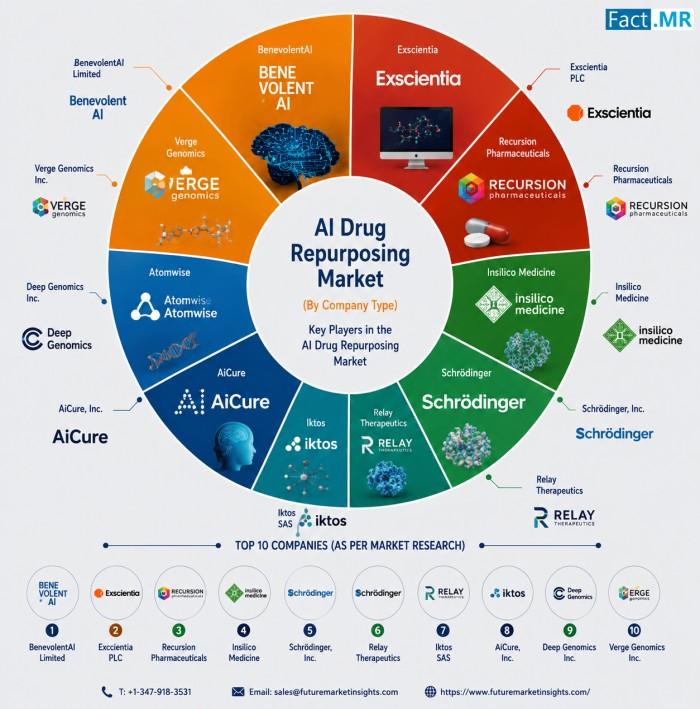
Key companies include BenevolentAI; Insilico Medicine; Recursion Pharmaceuticals; Schrödinger; Numerion Labs; Healx; BioXcel Therapeutics; Valo Health.
BenevolentAI, Healx and BioXcel Therapeutics have public evidence of repurposing or indication-expansion activity. The remaining providers support discovery, molecular design or candidate evaluation and should be assessed for use in repurposing workflows. From 2026 to 2036, competition depends on support for the path from indication hypothesis to validation. Buyers assess the evidence behind candidate ranking and the rights needed to advance a selected asset. No company market shares are assigned in the analysis.
Recent Developments
Source bibliography references include:
- National Center for Advancing Translational Sciences (February 29, 2024): Repurposed drug helps cells clear defective proteins.
- European Medicines Agency (September 30, 2024): Reflection paper on the use of artificial intelligence in the medicinal product lifecycle.
- U.S. Food and Drug Administration and European Medicines Agency (January 14, 2026): Guiding principles of good AI practice in drug development.
- BenevolentAI: AI-enabled drug repurposing collaboration with DNDi.
- Platform references for Healx (AI-enabled drug discovery and repurposing for rare diseases), BioXcel (re-innovation services for indication expansion), Insilico Medicine (Pharma.AI), Recursion (Recursion OS), Schrödinger (computational platform), Numerion Labs (AI chemistry platform), and Valo Health (AI and real-world-data approach).
Restraints
Growth may be limited by validation needs, data restrictions and regulatory concerns.
- Validation and regulatory credibility (High impact; USA and regulated markets; short term ≤2 years): Predictions must be traceable enough for scientific review before buyers treat them as development evidence.
- Data-rights restrictions (Moderate impact; Germany, UK, Japan; short term ≤2 years): Sensitive clinical records and proprietary compound files limit pooling of data for model training.
- Prospective evidence cost (Moderate impact; biotechnology and CRO buyers; medium term 2–4 years): Sponsors still need assays or clinical work before a ranked candidate becomes a development program.
- Licensing control disputes (Low impact; global pharmaceutical buyers; long term ≥4 years).
How to Choose: Buyer Decision Guide
Procurement and R&D teams evaluating platforms should apply these criteria drawn from report findings:
1. Traceable evidence supporting why a known compound fits a new indication before committing to assays or licensing.
2. Clear data rights and lineage documentation so biology teams understand candidate ranking.
3. Demonstrated handoff from model output to validation-ready workflows, including connection to wet-lab confirmation.
4. Alignment with country-specific data rules, privacy requirements and partnership models (e.g., governed clinical data in Germany, federated approaches in South Korea).
5. Support for portfolio productivity by filtering weak candidates prior to experiment approval.
6. Licensing terms that address indication ownership and development handoff.
Strategic implications noted: Pharmaceutical teams should connect AI ranking with wet-lab confirmation before licensing decisions accelerate; platform vendors should explain data lineage in plain terms; investors should review whether licensing terms cover indication ownership and development handoff.
Unlock Actionable Insights from the Complete Report:https://www.factmr.com/report/ai-drug-repurposing-market
Report Scope
The market covers AI-enabled platforms, research services, subscriptions, licensing workflows and custom analytics used to identify or transfer new therapeutic indications for known drugs. Downstream finished-drug sales and off-label clinical revenue are excluded. Revenue is counted only when a service helps identify or transfer a new use for a known drug. Standard contract research not tied to AI-enabled repurposing and general AI consulting (unless identifying/validating a new indication) are excluded.
Segmentation spans Drug Type, Application, End User, Distribution Channel, Technology and Region (North America, Latin America, Western Europe, Eastern Europe, East Asia, South Asia and Pacific, Middle East & Africa). Forecast period: 2026 to 2036. Analysis uses hybrid top-down and bottom-up methods combining primary interviews, public materials, regulatory publications, peer-reviewed literature and clinical records.
Explore More Related Studies Published by Fact.MR Research
Acinetobacter Pneumonia Therapeutics Market- https://www.factmr.com/report/acinetobacter-pneumonia-therapeutics-market
AI Drug Repurposing Market- https://www.factmr.com/report/ai-drug-repurposing-market
Drug Reference Apps Market- https://www.factmr.com/report/drug-reference-apps-market
Erythropoietin (EPO) Drugs Market- https://www.factmr.com/report/erythropoietin-epo-drugs-market
Solid Tumor Testing Market- https://www.factmr.com/report/solid-tumor-testing-market
Veterinary CRO CDMO Market- https://www.factmr.com/report/veterinary-cro-cdmo-market
About Fact.MR
Fact.MR is a global market research and consulting firm, trusted by Fortune 500 companies and emerging businesses for reliable insights and strategic intelligence. With a presence across the U.S., UK, India, and Dubai, we deliver data-driven research and tailored consulting solutions across 30+ industries and 1,000+ markets. Backed by deep expertise and advanced analytics, Fact.MR helps organizations uncover opportunities, reduce risks, and make informed decisions for sustainable growth.
- Contact Us -
11140 Rockville Pike, Suite 400, Rockville,
MD 20852, United States
Tel: +1 (628) 251-1583 | sales@factmr.com

 English
 Arabic
 French
 Spanish
 Portuguese
 Deutsch
 Turkish
 Dutch
Dutch
 Italiano
 Russian
 Romaian
 Greek
Greek
