


Perfume Market to Cross $75B and Reach $77.8B by 2036
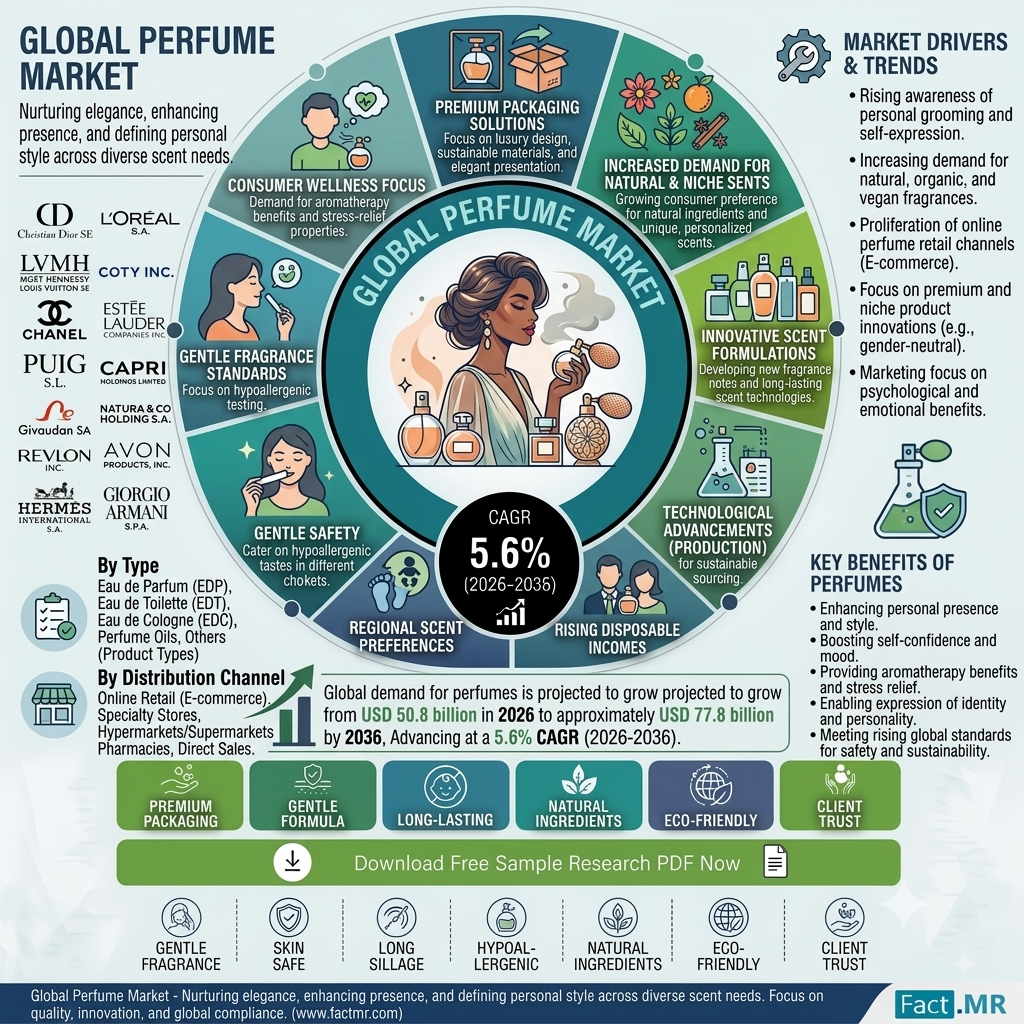
August 19, 2026 — The global perfume market is estimated at USD 50.8 billion in 2026 and is projected to reach USD 77.8 billion by 2036, expanding at a 5.6% CAGR during the forecast period, according to Fact.MR analysis. The market was valued at USD 48.1 billion in 2025, creating an estimated USD 27 billion in absolute dollar growth from 2026 to 2036.
Growth is being shaped by changing consumer preferences for premium and personalized fragrances. Rising disposable incomes are supporting luxury and fragrance purchases in emerging markets. Online platforms and specialty stores are also giving brands more ways to reach consumers. However, high product costs and competition from natural and niche fragrance alternatives may limit adoption in some markets.
Get detailed market forecasts, competitive benchmarking, and pricing trends https://www.factmr.com/connectus/sample?flag=S&rep_id=7152
External Market Signals Support Growth
The Fact.MR page cites several dated market developments that illustrate the changing competitive environment. In March 2025, expansion of luxury retail stores supported perfume demand in China. L’Oréal China expanded regional distribution in August 2025, while Procter & Gamble undertook regional product launches in India in May 2025. In the United States, Coty Inc. expanded product distribution in June 2025, while department-store fragrance programs expanded in September 2025. These developments support the broader market trends identified by Fact.MR around retail expansion, premium fragrance demand, and wider market access.
Key Market Numbers
|
Metric |
Fact.MR Value |
|
Market value, 2025 |
USD 48.1 billion |
|
Estimated value, 2026 |
USD 50.8 billion |
|
Forecast value, 2036 |
USD 77.8 billion |
|
Forecast CAGR |
5.6% |
|
Absolute dollar growth, 2026–2036 |
USD 27 billion |
Source: Fact.MR analysis.
Segment Breakdown
Synthetic perfumes lead by nature. Fact.MR expects synthetic perfumes to account for 70% market share in 2026. Their lower cost, scent variety, longevity, and formulation stability support their broad adoption.
Eau de Parfum leads by product type. Eau de Parfum is projected to hold 35% market share in 2026. Its higher fragrance-oil concentration and longer-lasting scent support its premium positioning.
Premium and niche products support value growth. Fact.MR states that market growth is increasingly concentrated in premium, niche, artisanal, and bespoke fragrance lines. These products emphasize unique scents, experiential branding, and higher-value positioning.
Online and specialty retail expand access. The market includes brand websites, e-commerce platforms, specialty retail, department stores, supermarkets, mono-brand outlets, and pharmacies. Online expansion is helping brands reach consumers in emerging markets.
Country Growth Outlook
|
Country |
CAGR, 2026–2036 |
|
China |
7.0% |
|
India |
6.7% |
|
Germany |
5.5% |
|
USA |
5.2% |
|
United Kingdom |
4.8% |
Source: Fact.MR proprietary forecasting model and primary research.
China leads the listed markets with a projected 7.0% CAGR through 2036, supported by luxury consumption, rising middle-class demand, and retail expansion. India follows at 6.7%, supported by expanding retail penetration and rising fragrance awareness. The USA is projected to grow at 5.2%, while Germany and the UK are expected to record 5.5% and 4.8%, respectively.
Competitive Landscape
The perfume market is moderately concentrated, according to Fact.MR. Major companies named on the page include LVMH Moët Hennessy Louis Vuitton SE, Christian Dior SE, Chanel Limited, The Estée Lauder Companies Inc., L’Oréal S.A., Coty Inc., Shiseido Company Limited, Puig S.L., Capri Holdings Limited, Hermès International S.A., Giorgio Armani S.p.A., Revlon Inc., Avon Products Inc., Natura & Co Holding S.A., and Givaudan SA.
Fact.MR does not provide individual market-share percentages for these companies on the supplied page. Therefore, no unsupported company-share figures are included in this release.
The competitive structure is shaped by brand equity, formulation quality, packaging, distribution reach, and marketing. Large retailers, luxury boutiques, and e-commerce platforms also influence assortment decisions and promotional support.
Analyst View
Fact.MR analysts describe the perfume market as a mature, consumer-driven category shaped by personal expression, self-care, lifestyle, premiumization, brand innovation, and wider retail access. Growth is increasingly concentrated in premium and artisanal fragrances that offer distinctive scents and experiential branding.
Frequently Asked Questions
What is the perfume market size in 2026?
The global perfume market is estimated at USD 50.8 billion in 2026, according to Fact.MR.
What will the perfume market be worth in 2036?
Fact.MR projects the market to reach USD 77.8 billion by 2036.
What is the CAGR of the perfume market?
The market is projected to expand at a 5.6% CAGR during the forecast period.
Which country has the fastest perfume market growth?
China leads the listed countries with a projected 7.0% CAGR from 2026 to 2036.
Which perfume segment has the largest share?
Synthetic perfumes are projected to hold the largest share by nature, at 70% in 2026.
Top Reports:
https://friends4ed.co.zw/read-blog/64073
https://acmingle.com/blogs/12593/SMPS-Transformers-Market-Expected-to-Reach-5-09B-by-2036
https://1nigeria.radiobenue.be.gov.ng/read-blog/25320
https://bolworld.com/blogs/45767/SMPS-Transformers-Market-Set-for-5-09B-Valuation-by-2036
About Fact.MR
Fact.MR is a market research and consulting firm providing market intelligence, forecasts, competitive analysis, and strategic insights across global industries. Its research uses primary interviews, desk research, market-sizing models, and data validation to support business and strategic decisions.

 English
 Arabic
 French
 Spanish
 Portuguese
 Deutsch
 Dutch
Dutch
 Italiano
 Russian
 Romaian
 Portuguese (Brazil)
 Greek
Greek
