


How Can a Real Estate Bot Automate Property Lead Generation and Customer Support?
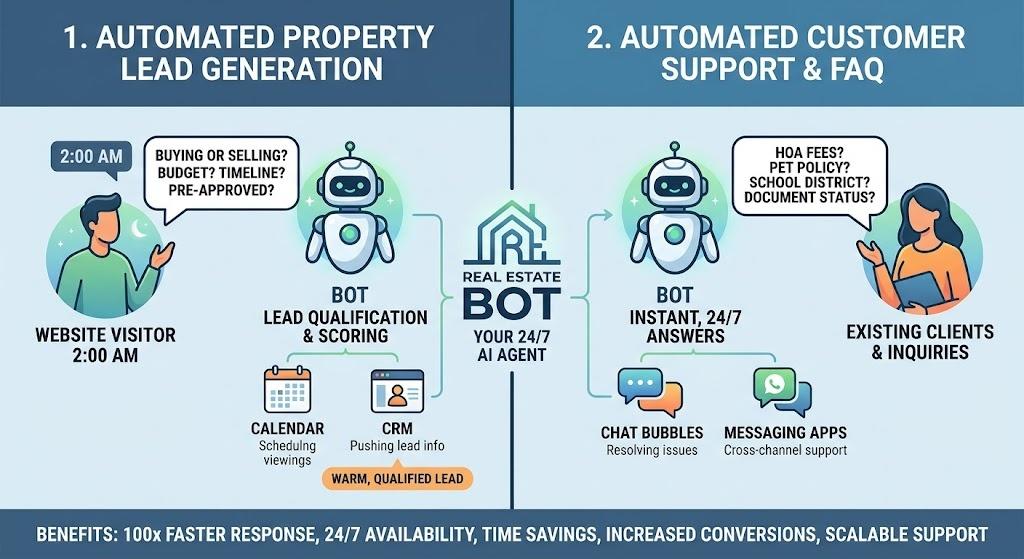
The real estate industry runs on speed and responsiveness. Buyers browse listings at midnight, renters message agents on weekends, and sellers expect instant answers about market value. Yet most real estate teams are small, stretched thin, and unable to respond to every inquiry the moment it arrives. This is exactly the gap that real estate bot are built to close.
A real estate bot — whether deployed on a website, WhatsApp, Facebook Messenger, or an app — uses conversational AI to qualify leads, answer property questions, schedule viewings, and support customers around the clock. Instead of losing prospects to slow response times, agencies can capture, nurture, and convert them automatically. Below is a detailed look at how these bots work and why they have become essential tools for modern real estate businesses.
Understanding the Real Estate Bot: What It Actually Does
A real estate bot is a software application powered by natural language processing (NLP) and machine learning that simulates human conversation. It sits on a website chat widget, a messaging app, or a voice assistant, and interacts with visitors the way a knowledgeable front-desk agent would.
At its core, the bot performs three functions: it collects information from the visitor, it retrieves relevant property or account data, and it responds in a way that moves the conversation toward a goal — whether that's booking a viewing, capturing contact details, or resolving a support issue. Advanced bots integrate with a company's CRM, listing database, and calendar systems so that every interaction is backed by live, accurate data rather than static scripts.
Automating Lead Generation: Turning Visitors into Prospects
Instant Engagement on Every Channel
The single biggest advantage a bot offers is immediacy. Studies on sales response times consistently show that leads contacted within the first few minutes convert at dramatically higher rates than those contacted hours later. A bot never sleeps, never takes a lunch break, and never lets a promising visitor bounce off the website without a conversation. As soon as someone lands on a listing page or opens a chat window, the bot can greet them, ask what they're looking for, and begin building a profile.
Smart Qualification Through Conversational Questions
Rather than presenting a generic contact form, a bot asks natural, sequential questions: What type of property are you interested in? What's your budget range? Which neighborhoods or cities are you considering? Are you buying, renting, or investing? What's your timeline?
Each answer feeds into a scoring model that classifies the lead as hot, warm, or cold based on intent signals — urgency of timeline, budget clarity, and specificity of requirements. This means sales agents no longer waste time chasing browsers; they receive a shortlist of qualified prospects ready for a real conversation.
Personalized Property Matching
Once the bot understands a visitor's preferences, it can query the property database in real time and surface matching listings directly in the chat — complete with photos, price, square footage, and location details. This turns a passive browsing session into an interactive shopping experience, keeping the visitor engaged far longer than a static search filter would.
Capturing Contact Details Naturally
Instead of demanding an email address upfront, a well-designed bot earns it. After showing a few relevant listings, it might offer to send a full brochure, schedule a call, or notify the visitor when a new matching property is listed — each of these value exchanges gives the visitor a reason to share their name, phone number, and email. This approach yields significantly higher form-completion rates than traditional lead capture forms.
Automated Follow-Up and Nurturing
Leads rarely convert on the first interaction. A real estate bot can trigger automated follow-up sequences — a WhatsApp message the next day, an email with similar listings a week later, or a reminder about a price drop on a saved property. This nurturing happens without any manual effort from the sales team, ensuring no lead goes cold simply because nobody remembered to follow up.
Scheduling Viewings and Appointments
Once a lead is warm, the bot can check an agent's real-time calendar availability and let the prospect book a property viewing or a consultation call directly within the chat. This eliminates the back-and-forth of phone tag and email scheduling, and it syncs automatically with the agent's calendar to avoid double bookings.
Automating Customer Support: Serving Buyers, Sellers, and Tenants
Answering Frequently Asked Questions Instantly
A large share of real estate inquiries are repetitive: What are the HOA fees? Is parking included? What's the pet policy? When was the property last renovated? Instead of routing every one of these questions to a human agent, a bot can pull answers directly from the property listing data and respond instantly, freeing staff to focus on higher-value conversations.
Supporting Existing Tenants and Homeowners
Bots aren't limited to sales. Property management teams use them to handle maintenance requests, rent payment reminders, lease renewal questions, and move-in or move-out logistics. A tenant can report a leaking faucet through the chat, and the bot can automatically log a maintenance ticket, notify the appropriate vendor, and give the tenant a tracking update — all without a phone call.
Multilingual and Multichannel Support
Real estate markets, particularly in cities with diverse populations or strong international buyer interest, benefit enormously from multilingual bots. A bot can detect the visitor's language and respond fluently, removing a major barrier that would otherwise require hiring multilingual staff for every shift. Combined with deployment across WhatsApp, Instagram, websites, and SMS, this ensures customers can reach support wherever they are most comfortable.
Handling Document and Application Support
Bots can guide applicants through rental applications, request required documents like proof of income or identification, and check submissions for completeness before forwarding them to a human reviewer. This reduces the frustrating back-and-forth of incomplete applications and speeds up approval timelines.
Seamless Handoff to Human Agents
No bot should trap a frustrated customer in an endless loop. The best implementations recognize when a query is too complex, sensitive, or emotionally charged — such as a contract dispute or a legal question — and hand the conversation off to a human agent, complete with full context and chat history. This hybrid model combines the speed of automation with the judgment of a trained professional exactly when it's needed.
Key Benefits for Real Estate Businesses
Reduced Response Time: Prospects get instant answers instead of waiting hours or days for a callback.
Higher Conversion Rates: Automated qualification and nurturing mean sales teams spend their time on leads most likely to close.
Lower Operational Costs: A single bot can handle hundreds of simultaneous conversations, reducing the need to scale support staff linearly with inquiry volume.
24/7 Availability: Property searches don't stop at 6 p.m., and neither does the bot.
Data-Driven Insights: Every conversation generates data on buyer preferences, common objections, and popular property features, which agencies can use to refine marketing and inventory decisions.
Consistency: Unlike human agents who may forget details or vary in tone, a bot delivers accurate, on-brand information every single time.
Choosing the Right Bot for a Real Estate Business
Not all bots are equal. A basic rule-based chatbot can handle simple FAQs, but true lead generation and support automation require NLP-powered conversational AI integrated with a CRM, listing management system, and scheduling tools. Businesses should look for platforms that offer easy integration with existing tech stacks, customizable qualification workflows, multilingual capability, and clear analytics dashboards to track performance over time.
Conclusion
Real estate bots have moved from novelty to necessity. By automating the repetitive, time-sensitive work of lead qualification, property matching, appointment scheduling, and customer support, they allow agencies and property managers to serve far more prospects and customers without proportionally increasing headcount. The agencies that adopt this technology thoughtfully — pairing automation with skilled human agents for the moments that need a personal touch — are the ones best positioned to convert more leads, retain happier tenants, and grow sustainably in an increasingly digital-first property market.

 English
 Arabic
 French
 Spanish
 Portuguese
 Turkish
 Dutch
Dutch
 Italiano
 Russian
 Romaian
 Portuguese (Brazil)
 Greek
Greek
