


Global Fisetin Market Size Projected to Reach USD 757.6 Million by 2036, at a CAGR of 9.4%
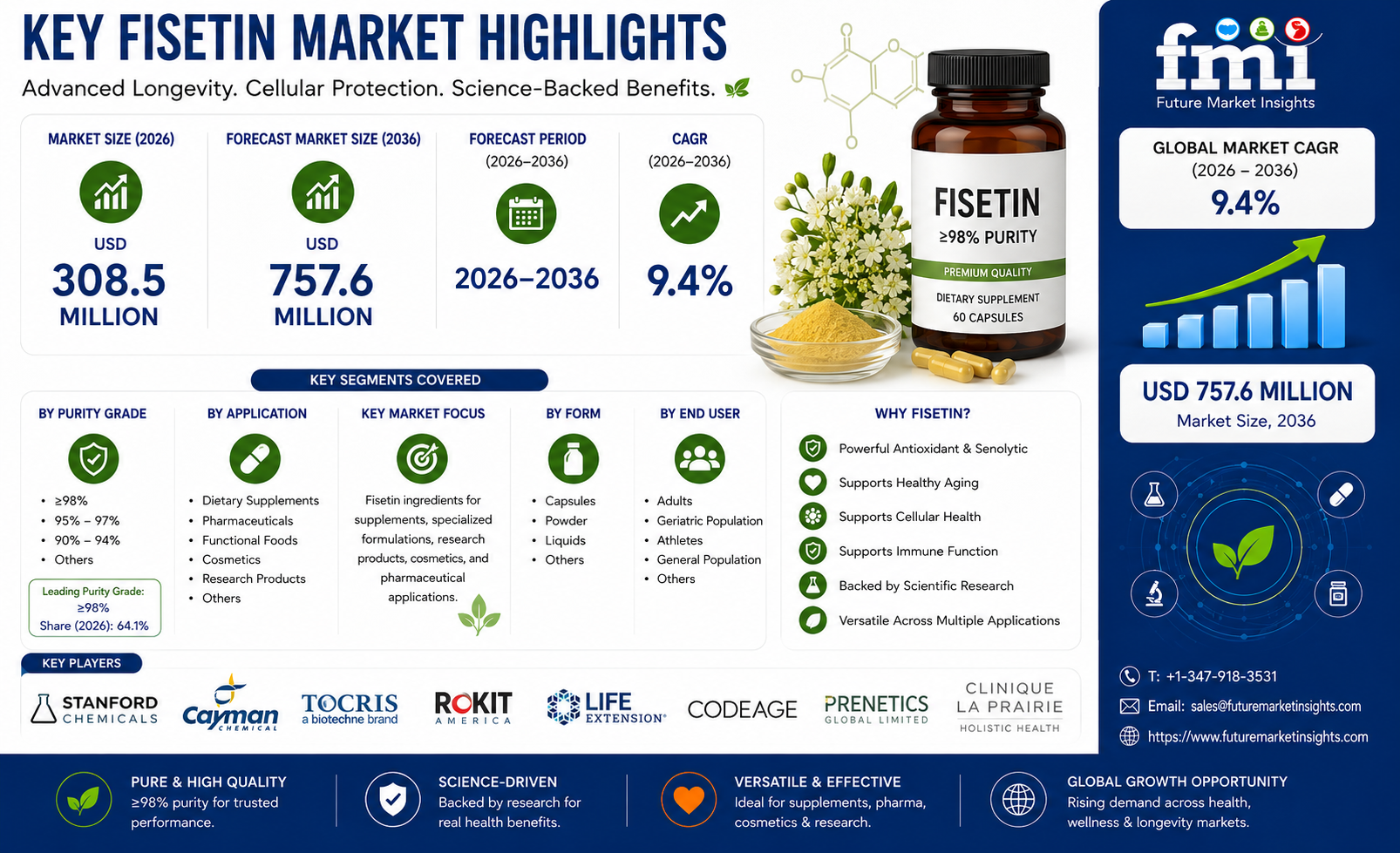
NEWARK, Del., August 5, 2026 — The global Fisetin Market is projected to expand as supplement manufacturers increasingly incorporate flavonoid ingredients into recurring capsule and powder formulations. According to Future Market Insights (FMI), the market is expected to grow from USD 308.5 million in 2026 to USD 757.6 million by 2036, registering a 9.4% CAGR during the forecast period.
The market is benefiting from repeat production, increasing interest in flavonoid ingredients, and growing development of higher-purity fisetin materials for specialized formulations and research applications. However, limited human evidence, differences in national regulatory pathways, and restrictions surrounding consumer health claims remain important considerations for manufacturers and brands.
👉 Request Your Free Sample Report: Explore the detailed market forecast, segmentation, trends, and competitive insights: https://www.futuremarketinsights.com/reports/sample/rep-gb-34397
Key Fisetin Market Highlights
• Market Size (2026): USD 308.5 Million
• Forecast Market Size (2036): USD 757.6 Million
• Forecast Period: 2026–2036
• CAGR (2026–2036): 9.4%
• Leading Purity Grade: ≥98%
• ≥98% Purity Grade Share (2026): 64.1%
• Key Market Focus: Fisetin ingredients for s, specialized formulations, research products, cosmetics, and pharmaceutical applications
Why Is the Fisetin Market Growing?
The market is expanding as manufacturers increasingly use fisetin in recurring capsule and powder production programs. Repeat manufacturing creates ongoing demand for ingredients with stable identity, composition, and quality records across production batches.
Fisetin's positioning as a flavonoid ingredient is also supporting interest across consumer wellness, research, longevity-oriented formulations, cosmetics, and pharmaceutical development. Manufacturers are evaluating different purity specifications depending on the intended application and required quality controls.
Regulatory preparedness remains an important part of commercial development. In June 2025, the United States Food and Drug Administration released educational materials supporting companies in preparing complete New Dietary Ingredient Notifications. Better-organized regulatory submissions can help companies reduce preventable delays when planning supplement products.
Scientific research is also contributing to market interest. A Denmark-based randomized fisetin study posted on ClinicalTrials.gov in September 2025 is evaluating daily supplementation in healthy older adults. While such research contributes to the evidence pipeline, scientific investigation does not automatically establish consumer treatment claims for finished supplement products.
Key Segment Insights
Why Do s Lead the Application Segment?
s are estimated to account for 54.7% share of application demand in 2026, supported by recurring capsule and powder production across established supplement formats.
The segment benefits from the ability to incorporate fisetin into repeat manufacturing programs, where consistent ingredient identity and composition are important for maintaining product specifications.
Why Does the ≥98% Grade Lead the Purity Segment?
The ≥98% purity grade is forecast to represent 64.1% of purity-grade demand in 2026, reflecting practical quality control requirements and broader sourcing flexibility.
This purity specification can provide manufacturers with a balance between ingredient quality and commercial sourcing considerations, particularly for routine supplement applications that do not require the tighter impurity controls associated with higher-purity materials.
Purity Grade Highlights
• ≥98% grade accounts for 64.1% share in 2026.
• Supports practical quality control requirements.
• Provides broader sourcing flexibility.
• Suitable for recurring formulation programs.
• Higher-purity grades serve specialized applications.
• Purity requirements influence testing depth and manufacturing cost.
The selection of purity grade depends on the intended application, formulation requirements, analytical specifications, and regulatory documentation expected by the buyer.
Market Segmentation
The Fisetin Market is segmented by Application, Purity Grade, and Region.
Application includes s, senolytic and longevity products, cosmetics, and pharmaceuticals. Purity grade includes ≥98%, ≥99%, and ≥99.5% specifications.
These segments demonstrate how commercial requirements vary according to intended use. Routine supplement production may prioritize practical purity specifications and reliable supply, while laboratory and specialized formulations may require tighter impurity controls.
Regional analysis is particularly important because botanical ingredients can follow different registration, notification, filing, and claim pathways across markets. Companies therefore need to align application, purity grade, documentation, and regulatory strategy before commercial launch.
👉 Get the PDF Brochure: Discover the report's core insights, forecast highlights, and research: https://www.futuremarketinsights.com/reports/brochure/rep-gb-34397
Regional Outlook
Regional commercialization varies according to regulations, botanical ingredient classification, claim requirements, notification systems, and evidence expectations.
The United States remains an important market for fisetin supplements. Brands must distinguish lawful structure or function claims from disease-treatment language under applicable federal requirements. Regulatory documentation and ingredient identity records remain important considerations for commercial product development.
Japan represents another significant market where companies can use the Foods with Function Claims notification framework. Manufacturers must ensure that product positioning and supporting documentation align with applicable requirements.
China follows registration or filing pathways for health foods depending on ingredient status and product classification. This creates additional considerations for companies evaluating fisetin commercialization within the market.
Competitive Landscape
Competition in the Fisetin Market spans ingredient supply, research products, finished supplement formulations, and consumer wellness platforms.
Key Companies Profiled: Stanford Chemicals, Cayman Chemical, Tocris Bioscience, ROKIT America, Life Extension, Codeage, Prenetics Global Limited, and Clinique La Prairie Holistic Health.
Browse the Full Report: https://www.futuremarketinsights.com/reports/fisetin-market
Frequently Asked Questions
What is the projected size of the Fisetin Market by 2036?
The global Fisetin Market is projected to reach USD 757.6 million by 2036, growing from USD 308.5 million in 2026.
What is the expected CAGR of the Fisetin Market?
The market is expected to expand at a 9.4% CAGR between 2026 and 2036.
What is driving market growth?
Growing production, increasing demand for flavonoid ingredients, repeat capsule and powder programs, rising research interest, and demand for consistent high-quality fisetin materials are key market growth drivers.
Related Reports
About Future Market Insights (FMI)
Future Market Insights, Inc. (ESOMAR certified and a recipient of the Stevie® Award) provides actionable market intelligence and consulting services across food & beverage, pharmaceuticals, chemicals, advanced materials, industrial manufacturing, sustainability, and consumer goods industries.
Rahul Singh
AVP – Marketing and Growth Strategy
Future Market Insights, Inc.
For Sales: sales@futuremarketinsights.com
For Media: Rahul.singh@futuremarketinsights.com
For web: https://www.futuremarketinsights.com/

 English
 Arabic
 French
 Spanish
 Portuguese
 Deutsch
 Turkish
 Italiano
 Russian
 Romaian
 Portuguese (Brazil)
 Greek
Greek
