


Fatigue Analysis Services: Assessing Strength Under Repeated Loads
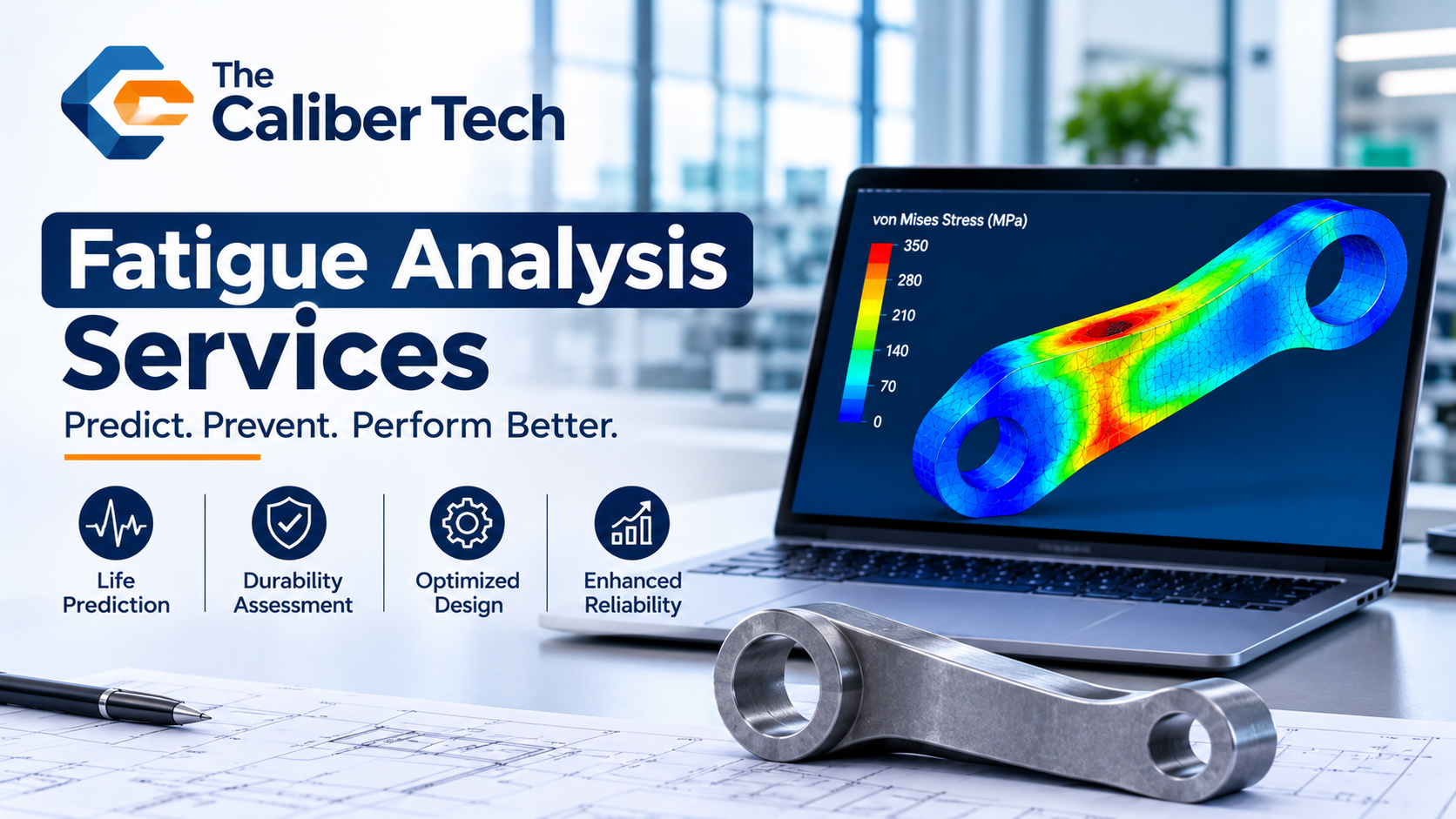
A mechanical component does not always fail because it experiences one exceptionally large force. In many cases, damage develops through thousands or millions of smaller loading cycles. A rotating shaft, a vehicle suspension arm, or a welded support structure may gradually weaken even when the applied stress remains below the material's yield strength. This gradual deterioration is known as fatigue.
Fatigue analysis services help engineers assess how repeated loads affect components throughout their expected operating life. By studying material properties, stress patterns, loading histories, and environmental conditions, specialists can identify areas vulnerable to fatigue damage. The findings support safer designs, more reliable equipment, and better decisions about inspection and maintenance.
Understanding the Mechanics of Material Fatigue
Fatigue occurs when a material experiences repeated or fluctuating stress. Each loading cycle can contribute to microscopic damage. Over time, this damage may develop into a crack that grows with continued operation.
Fatigue failure is particularly difficult to detect because a component may look normal during routine inspections. A small crack can develop beneath a surface or around a connection before becoming visible.
The Three Stages of Fatigue Failure
Crack initiation: Small cracks often begin at locations where stress is concentrated. Surface scratches, machining marks, sharp corners, pores, and weld details can create conditions that encourage crack formation.
Crack propagation: Once a crack develops, repeated loading can cause it to grow. The growth rate depends on factors such as stress intensity, material properties, crack geometry, and operating conditions.
Final fracture: As the crack becomes larger, the remaining intact material may no longer carry the applied load. Failure can then occur, sometimes with little visible warning.
Understanding these stages helps engineers decide which analysis method is appropriate and where design improvements may be most effective.
What Is Included in Fatigue Analysis Services?
A fatigue assessment is more than checking whether a component can withstand a particular force. It examines how the component responds to loading over time.
Material and Design Evaluation
Engineers begin by reviewing the component's geometry, material grade, manufacturing details, and intended use. Material selection matters because different alloys have different fatigue strengths and crack-growth characteristics.
Surface finish and manufacturing history are also relevant. A machined surface, cast component, forged part, and welded assembly may respond differently under similar loading conditions.
Loading and Stress Assessment
The next step is to establish the forces acting on the component. These may include tension, compression, bending, torsion, vibration, pressure, or thermal expansion.
Engineers may use finite element analysis (FEA) to calculate stress and strain across the component. The simulation can reveal local stress concentrations around holes, joints, fasteners, and changes in cross-section.
Fatigue Life Estimation
Once the stress response and material data are available, engineers estimate how the component may perform over repeated cycles. The assessment can identify critical locations and compare predicted life with the required service life.
The reliability of the result depends on realistic loading information and appropriate material data. It is an engineering estimate, not a guarantee of the exact date a component will fail.
Key Techniques Used in Fatigue Assessment
Different fatigue problems require different calculation methods. Choosing the right technique is essential for producing meaningful results.
Stress-Life Analysis
Stress-life analysis, commonly called the S-N method, relates cyclic stress levels to the number of cycles a material can withstand before failure. Engineers use S-N curves to estimate fatigue life when the component's response is largely elastic.
This approach is widely used for components exposed to high-cycle fatigue, where many loading cycles occur at relatively low stress levels.
Strain-Life Analysis
The strain-life method considers the relationship between cyclic strain and fatigue life. It is useful when local plastic deformation occurs, particularly around notches or under severe cyclic loading.
For example, a metal bracket exposed to repeated high loads may experience localized yielding even if most of the component remains elastic. Strain-life analysis can provide a more suitable assessment in such situations.
Cumulative Damage Assessment
Some components experience loads of different magnitudes during operation. A machine may run under normal conditions most of the time but occasionally encounter heavy loads during startup or production changes.
Engineers can use cumulative damage approaches, such as the Palmgren-Miner rule, to estimate the combined effect of different loading cycles. This method is useful for organizing variable loading, although its assumptions and limitations must be considered.
Crack Growth Analysis
When a component already contains a crack or defect, fracture mechanics may be more appropriate than a standard fatigue-life calculation. Crack growth analysis examines how the defect may develop under repeated loading and whether it could reach a critical size.
This approach is valuable when evaluating existing structures, welded equipment, and components with inspection findings.
Where Fatigue Analysis Is Used
Fatigue assessment supports engineering work across industries where components face repeated forces.
Automotive Engineering
Vehicle parts such as control arms, drive shafts, suspension brackets, and chassis connections experience vibration, impact, and changing loads. Fatigue analysis helps manufacturers evaluate durability under expected driving conditions.
Aerospace and Aviation
Aircraft structures experience repeated pressure cycles, aerodynamic forces, vibration, and temperature changes. Fatigue assessment helps engineers evaluate structural life and develop inspection requirements for critical areas.
Energy and Industrial Equipment
Turbines, pumps, compressors, generators, and rotating machinery operate under repeated mechanical and thermal loads. Fatigue analysis helps identify vulnerable components and supports decisions about maintenance or replacement.
Oil, Gas, and Marine Structures
Pipelines, offshore platforms, risers, and pressure equipment may experience fluctuating pressure, wave loading, vibration, and corrosion. These combined conditions can increase fatigue risk, especially around welded connections.
Civil and Structural Engineering
Bridges, cranes, steel connections, and other structures can experience repeated traffic, lifting, wind, and operational loads. Fatigue assessment helps engineers understand long-term performance and prioritize inspections.
Practical Benefits of Fatigue Analysis Services
A structured fatigue assessment can improve engineering decisions in several ways.
-
Better design decisions: Engineers can identify weak areas and modify component geometry before manufacturing begins.
-
Longer service life: Reducing stress concentrations and selecting suitable materials can improve fatigue performance.
-
Lower maintenance costs: Understanding fatigue risks helps organizations plan inspections and maintenance more effectively.
-
Improved safety: Identifying potential crack locations supports preventive action in safety-critical applications.
-
More efficient development: Simulation can help compare design alternatives and reduce dependence on repeated physical prototypes.
-
Better asset management: Fatigue estimates can contribute to decisions about repair, continued operation, and component replacement.
These benefits are strongest when analysis results are connected to actual operating conditions and practical engineering recommendations.
Common Challenges in Fatigue Assessment
Fatigue calculations can be sensitive to the quality of the information used. Missing or inaccurate loading data may lead to unreliable predictions.
Variable loading is one important challenge. Real equipment rarely experiences identical cycles throughout its operating life. Engineers may need to process measured load histories using cycle-counting techniques, such as rainflow counting, before estimating cumulative damage.
Geometric details also require attention. A small change in corner radius, weld profile, or surface finish can influence local stress and fatigue strength. Simplified models may overlook these details.
Environmental conditions can further complicate the assessment. Corrosion, elevated temperature, moisture, and chemical exposure may reduce fatigue resistance. In some applications, fatigue and corrosion act together, making the problem more complex than mechanical loading alone.
Finally, simulation results should be checked carefully. Depending on the project, validation may involve hand calculations, laboratory fatigue testing, inspection findings, or comparison with established engineering data.
How to Select a Fatigue Analysis Specialist
Choosing a capable engineering provider helps ensure that the assessment addresses the actual problem. Before starting a project, consider the following:
-
Relevant experience: Check whether the provider has worked with similar components, materials, and operating environments.
-
Suitable methods: Confirm that the team can select appropriate stress-life, strain-life, or fracture mechanics techniques.
-
Simulation capability: Ask about its experience with FEA and interpretation of local stress and strain results.
-
Quality of reporting: Reports should explain the assumptions, loading conditions, critical locations, and engineering conclusions.
-
Practical recommendations: The findings should help engineers decide what to change, monitor, test, or inspect.
A useful report should translate technical results into clear actions rather than simply presenting simulation images.
Frequently Asked Questions
1. What is the main purpose of fatigue analysis?
Its main purpose is to evaluate how repeated loading affects a component and estimate its resistance to fatigue failure over a specified operating period.
2. Is fatigue analysis different from static structural analysis?
Yes. Static analysis generally evaluates a component under a particular load condition. Fatigue analysis considers repeated or fluctuating loading and the damage that can accumulate over many cycles.
3. Can fatigue analysis be performed using FEA?
Yes. Finite element analysis can calculate stress and strain distributions that are used in fatigue calculations. However, the model must use appropriate material data, loading conditions, and fatigue methods.
4. What information is needed for a fatigue assessment?
Typical inputs include component geometry, material properties, loading history, support conditions, operating temperature, and expected service life. Additional information may be required for welded or damaged components.
5. Can fatigue analysis help prevent unexpected equipment failure?
It can reduce the risk by identifying vulnerable locations and supporting design improvements and inspection planning. However, results depend on the accuracy of the assessment and cannot eliminate every possible failure.
Conclusion
Repeated loading can gradually weaken components, even when individual forces appear harmless. Understanding this process is essential when designing equipment and structures expected to operate reliably over long periods.
Fatigue analysis services give engineers a structured way to evaluate cyclic stress, estimate component life, and investigate potential crack development. By combining material knowledge, realistic loading data, engineering calculations, and simulation, organizations can make informed decisions that improve durability, safety, and maintenance planning. Properly applied, fatigue assessment becomes an important part of responsible engineering design and asset management.

 English
 Arabic
 French
 Spanish
 Portuguese
 Deutsch
 Turkish
 Dutch
 Italiano
 Russian
 Romaian
 Portuguese (Brazil)
