


Nickel Cobalt Manganese Market Expansion Supported by Advanced Battery Technologies
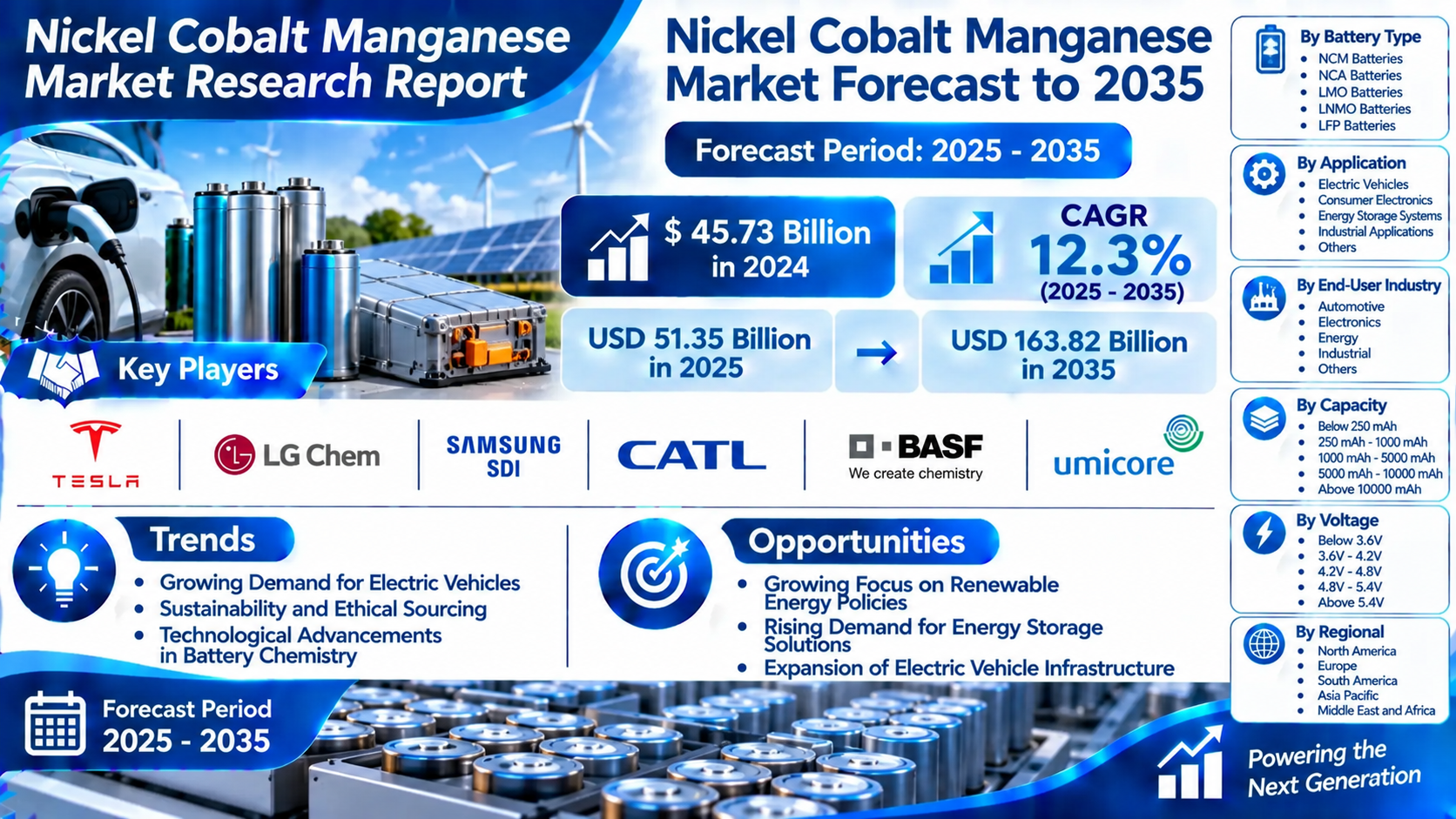
According to Market Research Future® (MRFR), the Nickel Cobalt Manganese Market is expected to grow from USD 51.35 billion in 2025 to USD 163.82 billion by 2035, advancing at a CAGR of 12.3% over the 2025–2035 forecast period. The market reached USD 45.73 billion in 2024. This growth trajectory reflects the expanding role of rechargeable batteries in electric vehicles, electronics, industrial applications, and energy storage. Developments in battery chemistry, responsible sourcing practices, and renewable energy initiatives are influencing the industry's longer-term direction.
Battery Demand Reshapes the Market
The nickel cobalt manganese market is connected to the broader battery industry, where demand is influenced by electrification and the need for energy storage. Battery technologies are used across a range of sectors, and the market's segmentation reflects this diversity. Electric vehicles are a major source of attention, while consumer electronics, industrial applications, and energy storage systems provide additional demand channels.
The forecast indicates that market value will increase from USD 51.35 billion in 2025 to USD 163.82 billion in 2035. With a CAGR of 12.3%, the market is expected to experience substantial expansion during the decade. The preceding 2024 valuation of USD 45.73 billion provides a baseline for the forecast trajectory.
Growing Demand for Electric Vehicles is a defining trend. As electric mobility develops, battery manufacturers and suppliers face increasing demand for technologies that can serve vehicle requirements. This growth is also linked to the expansion of supporting infrastructure, which is identified as an opportunity for the market.
Battery Chemistry and Technology Choices
The battery-type segment comprises Nickel-Cobalt-Manganese (NCM) Batteries, Nickel-Cobalt-Aluminum (NCA) Batteries, Lithium-Manganese-Oxide (LMO) Batteries, Lithium-Nickel-Manganese-Oxide (LNMO) Batteries, and Lithium-Iron-Phosphate (LFP) Batteries.
The inclusion of these categories illustrates the variety of battery chemistries represented in the market. Each category forms part of a broader technology landscape in which manufacturers and users assess battery solutions according to their application and technical requirements. The balance of demand among battery types may change as technologies develop and end-user preferences evolve.
Technological Advancements in Battery Chemistry are a key trend shaping the industry. Research and development in battery materials and chemistry can influence the range of products available to the market. Innovation also affects the competitive environment, encouraging companies to monitor emerging technologies and adapt their product and manufacturing strategies.
Electric Mobility, Electronics and Energy Storage
The market's applications extend across Electric Vehicles, Consumer Electronics, Energy Storage Systems, Industrial Applications, and Others. These segments reflect the role of batteries in transportation, digital devices, power management, and industrial operations.
Electric vehicles are closely associated with the market's growth outlook. The transition toward electric mobility creates demand for battery systems and the materials used in their production. Expansion of Electric Vehicle Infrastructure is therefore an important opportunity. Charging networks and related infrastructure can support wider adoption and strengthen the ecosystem around electric transportation.
Energy Storage Systems are another significant application category. Growing interest in storing electricity is connected to the development of renewable energy and the need to manage power supply. The report identifies Rising Demand for Energy Storage Solutions as an opportunity, highlighting the potential for battery technologies to participate in changing energy systems.
Consumer electronics and industrial applications add further breadth to demand. The end-user industry segmentation includes Automotive, Electronics, Energy, Industrial, and Others, demonstrating the market's reach across multiple sectors.
Capacity and Voltage Segmentation
Battery capacity categories range from Below 250 mAh and 250 mAh - 1000 mAh to 1000 mAh - 5000 mAh, 5000 mAh - 10000 mAh, and Above 10000 mAh. This classification captures different capacity requirements across battery applications.
The voltage categories are Below 3.6V, 3.6V - 4.2V, 4.2V - 4.8V, 4.8V - 5.4V, and Above 5.4V. These segments provide another way to understand the technical range of the market. Capacity and voltage requirements vary according to the device, vehicle, storage system, or industrial equipment being served. As a result, manufacturers must consider the specifications needed by their target customers.
Sustainability and Responsible Sourcing
Sustainability and Ethical Sourcing are important trends in the market. As demand for battery materials increases, supply chain practices and sourcing considerations are receiving greater attention. Responsible procurement and sustainability expectations can influence how companies manage suppliers and assess material availability.
These considerations are relevant to the wider battery value chain, where growth in production must be balanced with environmental and sourcing priorities. Companies may need to evaluate supply chain transparency, procurement strategies, and the expectations of customers and regulators. The importance of these issues is likely to remain high as battery demand expands.
Renewable Energy Policies and Infrastructure Opportunities
The market's opportunity landscape includes a Growing Focus on Renewable Energy Policies. Policy support for renewable energy can contribute to greater interest in storage technologies, particularly where energy systems require solutions for balancing electricity supply and demand.
Rising Demand for Energy Storage Solutions provides a related opportunity. As energy storage becomes more important across electricity networks and other applications, battery suppliers may find additional routes for market participation. Expansion of Electric Vehicle Infrastructure offers another growth pathway by supporting the broader adoption of electric vehicles.
These opportunities connect the battery market with developments in transportation and energy. Their impact will depend on policy implementation, infrastructure investment, technology progress, and demand from end users.
Regional Coverage and Industry Participants
The market is divided into North America, Europe, South America, Asia Pacific, and the Middle East and Africa. Regional development may be influenced by battery manufacturing capacity, automotive activity, electronics production, energy investment, and renewable energy policies. Differences in these factors can create varied market conditions across the regions.
The competitive landscape includes Tesla Inc, LG Chem Ltd, Samsung SDI Co Ltd, Contemporary Amperex Technology Co Ltd, BASF SE, and Umicore SA. These companies are identified as key market participants. Competition across the industry is shaped by technology development, production capabilities, supply chain considerations, and the ability to meet demand from multiple application sectors.
Outlook for the Nickel Cobalt Manganese Market
The market's projected growth to USD 163.82 billion by 2035 reflects the increasing importance of battery technologies across mobility, electronics, and energy applications. A CAGR of 12.3% over 2025–2035 is supported by electric vehicle demand, advancements in battery chemistry, and growing energy storage requirements. Sustainability and ethical sourcing, renewable energy policies, and infrastructure expansion will remain important considerations as the industry develops.

 English
 Arabic
 French
 Spanish
 Portuguese
 Deutsch
 Turkish
 Dutch
 Italiano
 Russian
 Portuguese (Brazil)
 Greek
