


Polycaprolactone Market Growth, Revenue Factors & Trends, Key Player Strategy Analysis By Fact.MR
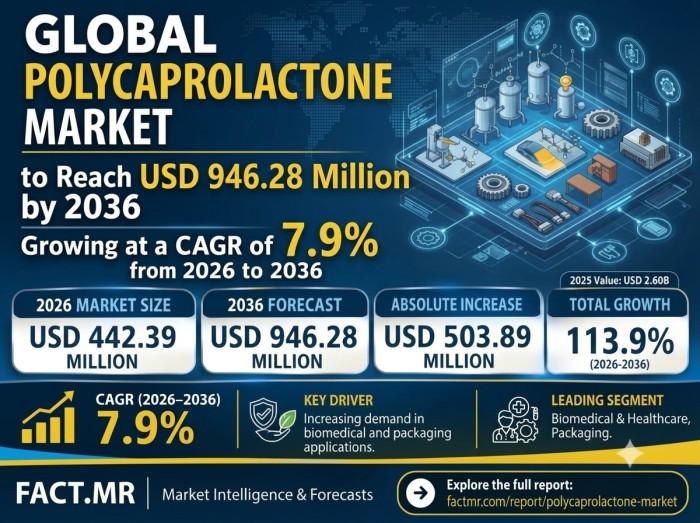
Fact.MR projects the global polycaprolactone market to grow at a CAGR of 7.9% from 2026 to 2036, supported by expanding medical applications, biodegradable polymer adoption, and increasing demand for specialized materials in additive manufacturing.
ROCKVILLE, MARYLAND — November 24, 2026 — According to Fact.MR analysis, the global market for polycaprolactone is estimated at US$ 442.39 million in 2026 and is forecast to expand at a CAGR of 7.9% to reach US$ 946.28 million by 2036. reflecting the expanding commercial relevance of this biodegradable specialty polyester across healthcare, industrial manufacturing, and consumer applications.
Request for PDF Report Sample Pages:https://www.factmr.com/connectus/sample?flag=S&rep_id=4754
The projected expansion represents an incremental market opportunity of USD 503.89 million between 2026 and 2036. Increasing adoption of biodegradable polymers in medical device manufacturing, growing applications of PCL filaments in 3D printing, and continued industrial consumption through thermoplastic polyurethane (TPU) formulations and hot-melt adhesives are shaping the industry's growth trajectory.
Fact.MR's analysis identifies medical device innovation and additive manufacturing as important areas of demand development. PCL's low melting point, biocompatibility, and controlled degradation characteristics support its use in tissue engineering scaffolds, drug delivery matrices, and custom orthopedic applications. These characteristics are also contributing to its growing relevance among manufacturers developing specialized biodegradable material solutions.
Market Background: Healthcare Innovation and Additive Manufacturing Expand PCL Demand
Polycaprolactone is a semi-crystalline, biodegradable polyester produced through the ring-opening polymerization of epsilon-caprolactone. Its low melting point of approximately 60 degrees Celsius and controlled hydrolytic degradation profile make it relevant to applications requiring specific processing characteristics and predictable material degradation.
According to Fact.MR, demand is developing across two interconnected areas: specialized healthcare applications and industrial polymer formulations. Medical device manufacturers are adopting PCL for 3D-printed implants, tissue engineering scaffolds, and drug delivery matrices where controlled biodegradation and biocompatibility are important material considerations.
The material is also gaining traction in additive manufacturing. Consumer and industrial 3D printing platforms are expanding the use of PCL filaments for low-temperature prototyping, custom orthotic fabrication, and educational modelling. This creates opportunities beyond pharmaceutical and medical-grade applications, extending demand into manufacturing and consumer-oriented product development.
Industrial applications continue to provide a foundation for market consumption. PCL polyols are used as soft-segment building blocks in TPU formulations, while hot-melt adhesive applications support additional industrial demand.
The report identifies three major growth drivers:
- Medical device innovation: Increasing use of biodegradable materials in implantable devices, tissue engineering, and drug delivery applications.
- 3D printing expansion: Greater adoption of additive manufacturing for prototyping, customized devices, and medical applications.
- Sustainability requirements: Growing interest in biodegradable polymer solutions associated with plastic waste reduction and circular economy objectives.
However, market development also faces constraints. High production costs and limited manufacturing scale can create pricing pressure, particularly for smaller manufacturers and cost-sensitive applications. Processing complexity and specialized technical requirements present additional challenges for companies operating with limited technical resources.
Segment Analysis: Pellets and Resins Maintain the Leading Position
Fact.MR's segmentation analysis examines the polycaprolactone market by form, application, end use, and geography. The findings highlight the importance of product characteristics and application-specific requirements in determining market demand.
By form, pellets and resins account for 56% of the market in 2026. Their leading position reflects their relevance to injection moulding and filament extrusion, which remain important conversion pathways for PCL. Manufacturers use these forms across medical, industrial, and additive manufacturing applications.
The remaining form categories include:
- Polyols: Account for 28% of the market, supporting polyurethane and specialty chemical applications.
- Blends and compounds: Represent 16% of the market, serving specialized applications requiring customized material properties.
By application, 3D printing and medical applications lead with a 41% share. Their position reflects increasing interest in biodegradable materials for medical devices, implants, and customized manufacturing. TPU and coatings account for 37%, while adhesives and other applications contribute 22%.
By end use, healthcare represents the largest category with a 39% share. Industrial applications account for 36%, supported by manufacturing and polymer processing requirements. Consumer applications contribute the remaining 25%, demonstrating the diversity of demand beyond healthcare and industrial production.
These segment shares provide manufacturers and procurement professionals with a clearer understanding of where PCL consumption is concentrated. They also highlight the importance of developing differentiated material grades to address pharmaceutical, medical, industrial, and consumer requirements.
Regional Outlook: USA and Mexico Lead Country-Level Growth
The regional analysis identifies North America as an important growth centre, supported by medical device development and additive manufacturing adoption. Europe maintains a significant position through healthcare infrastructure, polymer research, and sustainability-oriented material adoption. South Korea and Japan contribute through pharmaceutical applications and advanced material development.
Fact.MR projects the following country-level growth rates for 2026–2036:
- USA: 8.9% CAGR — The fastest-growing country market, supported by medical device development and 3D printing adoption.
- Mexico: 8.4% CAGR — Growth is associated with expanding medical device manufacturing clusters and industrial development.
- Germany: 7.8% CAGR — Medical technology research, engineering capabilities, and advanced polymer applications support demand.
- France: 7.5% CAGR — Healthcare modernization and polymer innovation contribute to market development.
- United Kingdom: 7.1% CAGR — Medical investment and biocompatibility-focused applications support adoption.
- South Korea: 7.0% CAGR — Material innovation and healthcare technology integration contribute to expansion.
- Japan: 6.7% CAGR — Precision manufacturing, quality requirements, and specialized healthcare applications sustain demand.
The European market is projected to expand from USD 123 million in 2026 to USD 261 million by 2036, registering a CAGR of 7.8%. Germany is expected to maintain its leading regional position, with its share increasing from 31.7% in 2026 to 32.4% in 2036. France is projected to increase its share from 24.4% to 25.0%, while the United Kingdom's share is expected to move from 21.1% to 20.7%.
These regional differences indicate that suppliers need to consider the specific requirements of individual markets when developing distribution, manufacturing, and customer qualification strategies.
Executive Perspective: Pharmaceutical-Grade Quality Becomes a Strategic Priority
Shambhu Nath Jha, Principal Consultant for Chemicals at Fact.MR, highlights the growing distinction between industrial-grade and pharmaceutical-grade PCL procurement.
He observes that industrial buyers primarily source PCL polyols for TPU and adhesive formulations, while medical device and drug delivery applications require pharmaceutical-grade resin sourcing. He also emphasizes that inconsistent molecular weight between production batches can trigger additional biocompatibility testing requirements and create regulatory delays for medical device OEMs.
This distinction has important implications for manufacturers, procurement teams, and material suppliers. Companies targeting healthcare applications need to prioritize molecular weight consistency, endotoxin control, production documentation, and dedicated pharmaceutical-grade supply arrangements.
For industrial buyers, reliable processing characteristics and application compatibility remain important purchasing considerations. Suppliers serving both markets may benefit from developing separate product portfolios that address the distinct technical and qualification requirements of each customer group.
Future Outlook: Quality Control and Specialized Production Will Shape Competition
Fact.MR expects the polycaprolactone market to maintain a 7.9% CAGR through 2036, reaching USD 946.28 million. The projected USD 503.89 million incremental opportunity reflects the expanding commercial use of PCL in medical devices, additive manufacturing, industrial formulations, and biodegradable consumer products.
The competitive landscape is expected to place increasing importance on molecular weight control, pharmaceutical-grade production capability, and medical device original equipment manufacturer (OEM) qualification status.
The report identifies several strategic priorities for market participants:
- Investing in pharmaceutical-grade manufacturing lines with consistent molecular weight specifications and endotoxin control.
- Establishing dedicated PCL supply agreements with documented batch traceability for medical device applications.
- Developing filament portfolios that serve both consumer prototyping and medical-grade 3D printing requirements.
- Improving processing support, technical documentation, biodegradability testing, and material performance consistency.
Smart materials integration, sensor embedding, and personalized medicine are also identified as emerging market trends. These developments point toward increasing demand for specialized polymer solutions rather than undifferentiated material supply.
Fact.MR's research covers market sizing, forecast analysis, form-level and application-level segmentation, regional demand patterns, regulatory considerations, and competitive positioning. The published study spans 170 pages and includes 32 tables and 93 figures, providing quantitative and qualitative perspectives on the market through 2036.
Gain Full Access to Market Forecasts and Key Drivers:https://www.factmr.com/report/4754/polycaprolactone-market
Access the Full Polycaprolactone Market Report
Manufacturers, medical device companies, polymer suppliers, procurement executives, and investors seeking a detailed understanding of the industry's commercial outlook can explore the Fact.MR Polycaprolactone Market Report.
The full research examines market valuation and forecasts through 2036, demand across pellets and resins, polyols and blends, application-level opportunities in 3D printing and medical products, and regional growth comparisons. It also evaluates the competitive landscape, supplier positioning, production capabilities, and the technical considerations influencing pharmaceutical-grade and industrial-grade procurement.
The findings can help industry stakeholders assess emerging demand opportunities, evaluate material portfolio priorities, and understand the requirements shaping supplier qualification in the expanding polycaprolactone market.
Explore Top Trending Reports & Related Report:
Thermally Conductive Polymer Fillers Market: https://www.factmr.com/report/thermally-conductive-polymer-fillers-market
Flame-Retardant Engineering Plastics Market: https://www.factmr.com/report/flame-retardant-engineering-plastics-market
Moisture-Loss Prevention Coatings Market: https://www.factmr.com/report/moisture-loss-prevention-coatings-market
About Fact.MR
Fact.MR is a market research and consulting firm providing market intelligence, industry analysis, and strategic research across multiple business sectors. Its research focuses on market sizing, forecasting, competitive analysis, industry trends, and emerging commercial opportunities.
Through its research reports, Fact.MR supports manufacturers, suppliers, investors, procurement professionals, and business decision-makers in understanding market developments and evaluating strategic opportunities.
Media Contact
Fact.MR Media Relations Team
Organization: Fact.MR
Email: sales@factmr.com
Website: https://www.factmr.com
Media Kit: Contact Fact.MR through its official website for media and report-related enquiries.

 Arabic
 French
 Spanish
 Portuguese
 Deutsch
 Turkish
 Dutch
 Italiano
 Russian
 Romaian
 Portuguese (Brazil)
 Greek
