


Coating Binders Market Growth, Revenue Factors & Trends, Key Player Strategy Analysis By Fact.MR
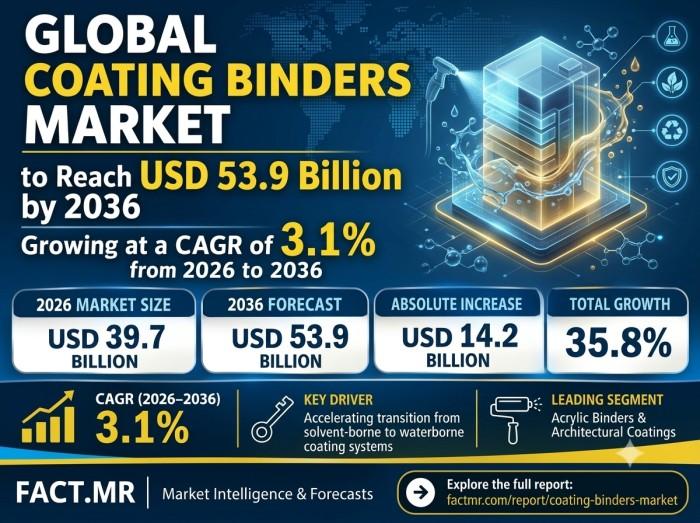
Rockville, Maryland — November 23, 2026 — According to Fact.MR analysis, the coating binders market is estimated to reach USD 39.7 billion in 2026 and USD 53.9 billion by 2036, reflecting a CAGR of 3.1% over the forecast period. Demand is being supported by the transition from solventborne to waterborne coating systems, stricter volatile organic compound (VOC) emission regulations, construction activity, and automotive coating requirements. Acrylic binders are expected to retain their leading position, accounting for 42.5% of product segment share in 2026, while architectural coatings represent 71.2% of application demand.
Request for PDF Report Sample Pages:https://www.factmr.com/connectus/sample?flag=S&rep_id=2373
Market Background: Regulatory Changes and Construction Demand Influence Binder Procurement
The coating binders market is undergoing a structural transition as coating manufacturers respond to changing environmental requirements and evolving performance specifications. Coating binders serve as the film-forming components of coating formulations, supporting adhesion to substrates and the development of coating films across architectural, industrial, automotive, and wood applications.
The growing adoption of waterborne coating systems is a central factor influencing the market. VOC emission regulations across the European Union, North America, and China are encouraging manufacturers to reformulate traditional solventborne products. This transition is increasing demand for acrylic and polyurethane dispersion binders, particularly in applications where low-emission formulations and durability are important procurement considerations.
Construction activity in emerging markets is another contributor to demand. Residential and commercial construction supports consumption of architectural coatings, creating procurement requirements for latex, acrylic, and alkyd binder chemistries.
Automotive manufacturers are also moving toward waterborne basecoat and clearcoat systems, alongside high-solids formulations, to address paint shop emission limits and environmental compliance requirements.
Industrial protective coatings provide another source of demand. Infrastructure, marine, and oil and gas applications require epoxy and polyurethane binder systems designed for corrosion resistance and demanding operating conditions.
However, the market faces several constraints. Volatility in the prices of acrylic acid, styrene, and isocyanates can create margin pressure for binder manufacturers. Waterborne formulations also face performance limitations under extreme weather, chemical exposure, and heavy-duty industrial conditions, slowing substitution in certain applications.
Product and Application Analysis: Acrylic and Architectural Coatings Lead
Acrylic coating binders are projected to account for 42.5% of total product segment value in 2026, making them the leading product category. Their position reflects their versatility across interior and exterior architectural coatings, as well as industrial and automotive formulations.
Pure acrylic and styrene-acrylic copolymer binders are important components of waterborne architectural coating formulations. Their use is supported by requirements for durability, color retention, and low-VOC compliance.
Other product categories serve more specialized performance requirements:
- Polyurethane binders: Increasingly relevant in automotive and industrial applications requiring abrasion resistance, chemical durability, and film flexibility.
- Epoxy binders: Used in protective and marine coatings where corrosion resistance is an important requirement.
- Alkyd binders: Continue to serve traditional solventborne formulations and decorative wood-finishing applications.
Architectural coatings are expected to account for 71.2% of application segment value in 2026. Residential and commercial construction, interior and exterior painting, and repainting activity underpin this segment's leading position.
Industrial coatings represent the second-largest application category, with epoxy and polyurethane binders supporting protective, marine, and infrastructure coating requirements. Automotive coatings use acrylic and polyurethane chemistries across OEM basecoat, clearcoat, and refinish systems. Wood coatings utilize acrylic, polyurethane, and alkyd binders for furniture, flooring, and exterior wood protection.
Emulsion-based formulations are projected to account for 79.5% of formulation share in 2026, reflecting the expansion of waterborne dispersion technology across architectural and general industrial coatings.
The market also includes waterborne, solventborne, powder coating, and UV-curable binder technologies, alongside emulsion-based, solvent-based, solid resin, and hybrid formulations.
Regional Outlook: China and South Korea Record Stronger Growth Trajectories
Asia Pacific remains an important source of coating binder consumption growth, supported by construction activity, automotive production, and changing coating specifications.
China is projected to record a CAGR of 5.0% through 2036, making it the fastest-growing country market covered in the report. Demand is supported by its large architectural coatings market, enforcement of GB 38468-2019 VOC emission standards, and the conversion of automotive OEM production lines toward waterborne coating systems.
South Korea is expected to expand at a CAGR of 4.2%. Automotive coating specification upgrades, semiconductor cleanroom requirements, electronics conformal coatings, and industrial applications in shipbuilding and heavy industry contribute to demand.
Other country-level growth projections include:
- Japan: 3.1% CAGR
- United States: 2.8% CAGR
- Germany: 2.6% CAGR
- United Kingdom: 2.4% CAGR
- France: 2.2% CAGR
- Italy: 2.0% CAGR
Europe's market development is closely associated with VOC regulations and green building specifications, with demand concentrated in architectural and industrial coatings. North America maintains demand through architectural repainting, automotive refinish, and industrial protective coating applications.
In the United States, state-level VOC requirements and EPA air quality standards influence binder procurement. Infrastructure maintenance, manufacturing facility construction, and automotive refinishing also support demand.
Germany's market is shaped by EU VOC requirements and updated Decopaint standards. Growth opportunities are concentrated in high-performance industrial and automotive coating upgrades and bio-based binder alternatives.
Executive Perspective: Reformulation Creates Opportunities for Binder Technology Suppliers
Shambhu Nath Jha, Principal Consultant at Fact.MR, identifies VOC regulation as a central force behind the coating binders market's continuing reformulation cycle.
According to the analyst, the transition from solventborne to waterborne coatings changes binder chemistry requirements, creating procurement opportunities for acrylic and polyurethane dispersions while reducing the relative position of traditional alkyd and solvent-based resins.
The competitive landscape also reflects this technology shift. BASF and Dow maintain established positions in waterborne acrylic binders through their ACRONAL and PRIMAL platforms, respectively, while Covestro has a leading position in polyurethane dispersion technology.
Bio-based binder development represents another area of competitive differentiation. Renewable feedstock sourcing, performance consistency, and sustainability-related product documentation are becoming relevant considerations for suppliers seeking opportunities in sustainability-certified coating projects.
For coating manufacturers and procurement professionals, these developments underline the importance of evaluating binder chemistry, formulation technology, regulatory requirements, and application-specific performance together.
Future Outlook and Research Methodology
Fact.MR forecasts the coating binders market to grow from USD 39.7 billion in 2026 to USD 53.9 billion by 2036, representing a 3.1% CAGR. The projected USD 14.2 billion absolute dollar opportunity highlights the commercial importance of formulation changes, waterborne technology adoption, and demand across architectural, industrial, automotive, and wood coating applications.
The report identifies bio-based acrylic and polyurethane binders, UV-curable technologies, and powder coating formulations as important opportunity areas. UV-curable systems offer faster curing, zero VOC emissions, and reduced energy consumption compared with thermal curing systems, while powder coating demand is expanding across automotive, appliance, and architectural applications.
The research methodology combines secondary research, primary interviews, and forecasting models. It draws on more than 120 secondary sources, benchmarks over 50 company product and technology portfolios, and evaluates market demand across more than 30 countries.
The analysis also incorporates more than 25 interviews with binder producers, coatings formulators, paint manufacturers, and raw material suppliers. Forecast validation includes trade-flow reconciliation, monomer supply chain validation, and sensitivity testing.
Gain Full Access to Market Forecasts and Key Drivers:https://www.factmr.com/report/2373/coating-binders-market
Access the Complete Fact.MR Coating Binders Market Report
The full Fact.MR study provides detailed market forecasts, product-level and application-level segmentation, regional growth assessments, competitive benchmarking, and analysis of the technologies influencing binder procurement.
Industry professionals can use the research to assess opportunities across acrylic, polyurethane, epoxy, and alkyd binder categories; evaluate waterborne and solventborne technology transitions; understand country-level growth trajectories; and examine the positioning of leading market participants.
Read the complete Fact.MR Coating Binders Market Analysis and Forecast, 2026–2036 for detailed market intelligence, segmentation, regional analysis, and competitive insights.
Explore Top Trending Reports & Related Report:
Moisture-Loss Prevention Films Market :https://www.factmr.com/report/moisture-loss-prevention-films-market
Dry Filling Precision Machines Market :https://www.factmr.com/report/dry-filling-precision-machines-market
Resealable Dry Filling Systems Market :https://www.factmr.com/report/resealable-dry-filling-systems-market
About Fact.MR
Fact.MR is a market research and consulting firm providing market intelligence, industry analysis, and strategic research across multiple business sectors. Its research focuses on market sizing, forecasting, competitive analysis, industry trends, and emerging commercial opportunities.
Through its research reports, Fact.MR supports manufacturers, suppliers, investors, procurement professionals, and business decision-makers in understanding market developments and evaluating strategic opportunities.
Media Contact
Fact.MR Media Relations Team
Organization: Fact.MR
Email: sales@factmr.com
Website: https://www.factmr.com
Media Kit: Contact Fact.MR through its official website for media and report-related enquiries.

 Arabic
 French
 Spanish
 Portuguese
 Deutsch
 Turkish
 Dutch
 Italiano
 Russian
 Romaian
 Portuguese (Brazil)
 Greek
