


What Is a Convolutional Neural Network and How Does It Work
Artificial Intelligence has transformed how computers understand and interpret visual information. AI technologies can detect objects and discern patterns in images, ranging from facial recognition and autonomous vehicles to analyzing medical images. One of the key technologies behind these capabilities is the Convolutional Neural Network (CNN). It is a type of deep learning model designed to process and understand visual data. If you want to build a strong foundation in modern AI technologies, consider enrolling in a Generative AI Course in Villupuram at FITA Academy to enhance your understanding and hands-on abilities in this expanding area.
What is a Convolutional Neural Network
A Convolutional Neural Network is a deep learning architecture that helps computers recognize and classify images. It works similarly to how humans identify objects by observing their shapes, colors, edges, and patterns. Rather than looking at the whole image simultaneously, a CNN focuses on smaller parts and detects significant features.
CNNs use multiple layers to process visual information. Each layer learns different patterns from the input image. Early layers detect simple features, such as edges and lines, while deeper layers identify more complex features, such as faces, animals, and objects. This layered approach makes CNNs highly effective for image recognition and classification tasks.
How Does a Convolutional Neural Network Work
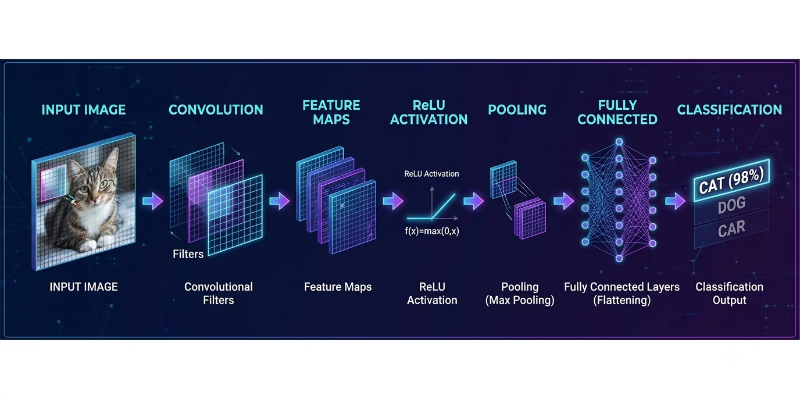
A Convolutional Neural Network processes an image through several layers. Each layer performs a specific task to extract useful information and improve the model's understanding of the image.
1. Input Layer
The input layer receives the image that the CNN needs to analyze. A digital image consists of pixels, and each pixel contains numerical information representing its color and brightness. The network converts this information into a format that it can process.
2. Convolutional Layer
The convolutional layer serves as the primary element of a CNN. It uses small filters, also called kernels, to scan different sections of an image. These filters identify important features such as edges, textures, shapes, and patterns.
As the filters move across the image, they create feature maps that highlight specific visual characteristics. This process helps the network understand the image more effectively.
3. Activation Function
After convolution, an activation function introduces non-linearity into the network. The Rectified Linear Unit (ReLU) is commonly used in CNN architectures. It converts negative values into zero while keeping positive values unchanged. This helps the network learn complex patterns and relationships within images.
4. Pooling Layer
The pooling layer diminishes the dimensions of the feature maps while retaining essential information. Max pooling is a commonly used technique that selects the highest value from a small region. This reduces computational requirements and helps the model focus on important features.
5. Fully Connected Layer
The fully connected layer uses the features extracted by previous layers to make predictions. It combines the learned information and identifies which objects or categories are most likely to be present in the image.
6. Output Layer
The output layer provides the final prediction. For example, when a CNN analyzes an image of an animal, it may classify the image as a cat, dog, or bird based on the features it has learned.
Applications of Convolutional Neural Networks
CNNs are widely used across different industries because they can analyze large amounts of visual information accurately and efficiently.
-
Facial Recognition: CNNs help identify and verify individuals using facial features.
-
Healthcare: They support medical professionals in analyzing X-rays, MRI scans, and other medical images.
-
Self-Driving Cars: CNNs help vehicles recognize road signs, pedestrians, and surrounding objects.
-
Security Systems: They support surveillance systems through object detection and image analysis.
-
Agriculture: CNNs help identify plant diseases and monitor crop conditions using images.
Advantages of Convolutional Neural Networks
CNNs offer several benefits for image processing and computer vision applications. They automatically identify important features without requiring extensive manual feature extraction. Their layered architecture helps recognize both simple and complex visual patterns. CNNs can also process large image datasets and support accurate classification across various applications.
However, CNNs may require large training datasets and significant computing resources. Their performance can also depend on image quality and the diversity of training data.
Convolutional Neural Networks are crucial in contemporary Artificial Intelligence and deep learning. Their ability to extract visual features and recognize complex patterns makes them useful in healthcare, security, transportation, and many other industries. Understanding CNN architecture provides a strong foundation for exploring advanced AI technologies. If you want to expand your understanding of machine learning, deep learning, and intelligent applications, explore an Artificial Intelligence Course in Villupuram and take the next step toward developing practical AI knowledge.

 Arabic
 French
 Spanish
 Portuguese
 Deutsch
 Turkish
 Dutch
 Italiano
 Russian
 Romaian
 Portuguese (Brazil)
 Greek
