


How Supply Chain Leaders Can Modernize Operations Without Replacing Every System
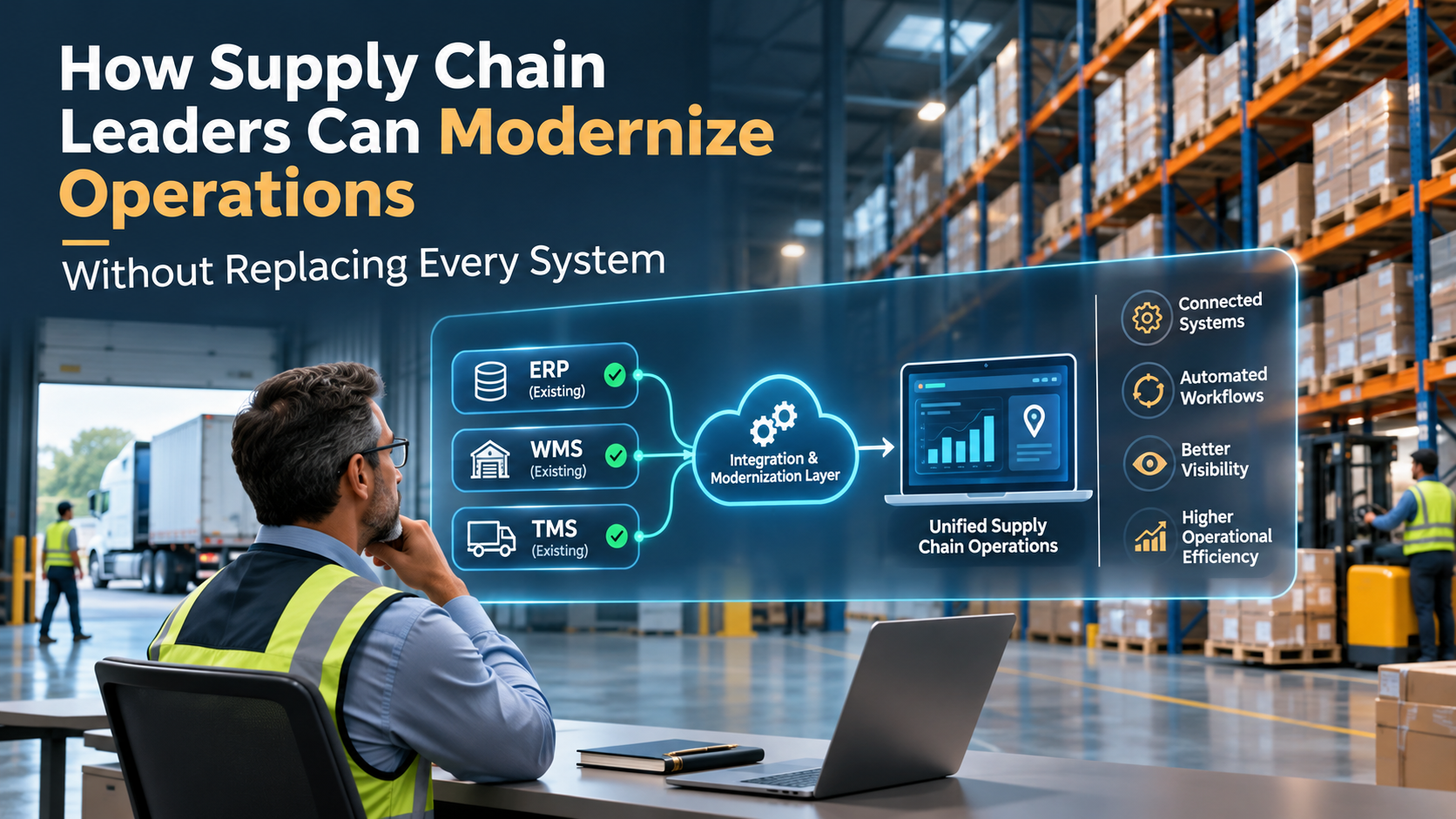
Many supply chain businesses depend on technology that has been running their operations for years. Enterprise resource planning (ERP) platforms manage business transactions, warehouse management systems (WMS) handle inventory and fulfillment, and transportation management systems (TMS) coordinate shipments.
These systems may still perform their core functions effectively. However, as business requirements evolve, limitations begin to appear.
Warehouse teams depend on manual updates, inventory information does not always match across platforms, and logistics managers struggle to access reliable shipment data.
For supply chain leaders, the challenge is deciding how to modernize operations without disrupting the systems that already support daily business activities.
The good news is that supply chain modernization does not always require replacing existing technology. In many cases, organizations can achieve meaningful improvements by connecting applications, improving workflows, and upgrading selected components.
Why Replacing Every Supply Chain System Is Not Always Practical
Replacing enterprise technology can be expensive, time-consuming, and operationally complicated.
Supply chain systems are often connected to multiple business processes, including procurement, inventory management, order fulfillment, transportation, and financial reporting.
Removing one platform may affect several departments.
For example, replacing a warehouse management system could require changes to barcode scanning processes, order allocation rules, inventory synchronization, and shipping integrations.
Employees may also need extensive training to adapt to new workflows.
These challenges explain why many organizations hesitate to modernize their technology, even when existing systems create operational inefficiencies.
However, maintaining outdated processes indefinitely is not a sustainable solution either.
A more practical strategy involves identifying which parts of the technology environment need improvement and which systems can continue delivering value.
Identify Operational Problems Before Planning Technology Changes
The first step in modernization is understanding where existing systems are creating business problems.
Technology decisions should begin with operational requirements rather than assumptions about which platforms need replacement.
Examine Workflow Bottlenecks
Supply chain leaders should review how work moves between departments.
For example, an order may enter the ERP system but require manual updates before warehouse employees can begin fulfillment.
Similarly, warehouse teams may complete shipment preparation without automatically notifying transportation coordinators.
These gaps can create delays even when individual applications function correctly.
Mapping these workflows helps organizations identify where better connectivity or automation could improve performance.
Review Data Accuracy and Visibility
Disconnected information is another common challenge.
Inventory quantities may differ between warehouse and order management systems. Purchasing teams may rely on outdated stock information, while customer service departments lack access to accurate delivery updates.
Before introducing new software, businesses should investigate why information becomes inconsistent.
The problem may involve integration failures, delayed synchronization, inconsistent data definitions, or manual processing.
Addressing these issues can improve operational visibility without replacing the underlying applications.
Modernize Supply Chain Operations Through Targeted Improvements
Once operational gaps are identified, businesses can prioritize improvements that offer measurable value.
1. Connect Existing Supply Chain Platforms
Many operational challenges originate from systems that cannot exchange information efficiently.
Integrating ERP, WMS, TMS, and order management platforms can improve coordination between procurement, warehousing, transportation, and customer service teams.
For instance, when an order is confirmed, relevant information can automatically reach warehouse operations. Once the shipment is dispatched, tracking details can become available to logistics coordinators and customer-facing teams.
Application programming interfaces (APIs), integration platforms, and other appropriate data exchange mechanisms can support these connections.
The objective is to make existing systems work together rather than operate as independent applications.
2. Automate Repetitive Operational Tasks
Manual activities often remain embedded in supply chain operations because existing systems were implemented at different stages of business growth.
Employees may repeatedly enter purchase order details, update inventory spreadsheets, reconcile shipment information, or generate routine reports.
These tasks can consume substantial time and increase the risk of mistakes.
Workflow automation can reduce repetitive processing while allowing employees to focus on exceptions and operational decisions.
However, automation should be introduced only after the underlying process has been reviewed. Automating an inefficient workflow may simply make the same problems occur faster.
3. Upgrade Legacy Components Instead of Entire Platforms
Some legacy supply chain applications remain reliable but lack the flexibility required for modern integrations and reporting.
In these situations, organizations can consider upgrading selected components rather than replacing the complete system.
For example, a business might retain its core ERP while developing new integration interfaces, improving reporting capabilities, or modernizing a supplier-facing portal.
A warehouse operation could continue using its established WMS while introducing improved inventory dashboards or automated exception notifications.
This selective approach can help preserve valuable business functionality while addressing specific technology limitations.
4. Improve Operational Visibility Across Departments
Supply chain visibility depends on having reliable information available when decisions need to be made.
A new dashboard alone cannot solve visibility problems if the information feeding it is incomplete or inconsistent.
Organizations should first establish dependable data connections and clear ownership of operational information.
Once that foundation exists, reporting tools can provide a more consistent view of inventory availability, order status, shipment movements, and warehouse performance.
Better visibility allows managers to identify problems earlier and coordinate responses across departments.
5. Prepare Existing Systems for Future AI Adoption
Artificial intelligence is becoming an important consideration in supply chain technology planning.
Businesses are exploring AI-supported demand forecasting, inventory optimization, exception detection, and operational recommendations.
However, these capabilities depend on accessible, consistent, and trustworthy information.
Organizations with disconnected systems may struggle to provide the reliable data required for useful AI applications.
Instead of immediately investing in advanced tools, supply chain leaders should prioritize data quality, integration, and workflow standardization.
These improvements create a stronger foundation for future automation and AI initiatives.
How Leaders Can Prioritize Modernization Investments
Not every technology limitation requires immediate attention.
Supply chain leaders should evaluate modernization opportunities based on their impact on daily operations and their implementation complexity.
A practical assessment should consider:
-
Operational impact: Which problems create the most delays, errors, or unnecessary work?
-
Business value: Which improvements could increase productivity, accuracy, or customer satisfaction?
-
Integration requirements: Can existing systems support the necessary changes?
-
Implementation risk: How can improvements be introduced without interrupting critical operations?
-
Long-term flexibility: Will the investment support future business growth and technology adoption?
Organizations can then begin with a limited modernization initiative, measure its results, and gradually expand improvements across other processes.
For example, a distributor experiencing frequent inventory discrepancies might first improve synchronization between its ERP and WMS before considering a larger technology transformation.
This approach makes modernization more manageable and allows investment decisions to be guided by demonstrated operational needs.
Building a Modern Supply Chain Without Unnecessary Disruption
Successful modernization requires more than selecting new applications. It involves understanding how technology supports business operations and determining where improvements will create the greatest value.
Organizations can benefit from working with technology partners that understand enterprise integration, legacy modernization, workflow automation, and operational data management.
Ditstek Innovations supports businesses through supply chain technology solutions focused on connecting existing platforms, improving operational workflows, and building scalable digital capabilities.
The goal is to help organizations move toward more connected operations while making informed decisions about which systems to retain, upgrade, or eventually replace.
Conclusion
Supply chain modernization does not need to begin with replacing every existing system.
For many businesses, the greatest opportunities lie in improving how current applications communicate, reducing manual processes, and making operational information more accessible.
Supply Chain Digital Transformation Services can help organizations address these challenges through system integration, workflow automation, and targeted modernization while protecting investments in technology that continues to perform effectively.
For supply chain leaders, the priority should be identifying where existing systems limit operational performance and introducing improvements that deliver practical, measurable business value.

 English
 Arabic
 French
 Spanish
 Portuguese
 Deutsch
 Turkish
 Dutch
 Italiano
 Russian
 Portuguese (Brazil)
 Greek
