


How to Create Personal Moments of Calm Throughout Your Day
Modern life rarely announces that it is becoming overwhelming.
It usually happens gradually.
One email becomes five. A quick check of your phone turns into twenty minutes of scrolling. A meeting runs late. Another task appears before the previous one is finished. By the afternoon, you may realize that you have moved through most of the day without really stopping.
Creating calm does not necessarily mean escaping that schedule.
It can simply mean finding small moments within it.
Personal moments of calm are brief opportunities to slow down, notice what is happening, and reconnect with the present before continuing with your day. They might last several minutes, or they might be as simple as one intentional breath before opening your next email.
The important part is not how long the pause lasts.
It is that you notice the opportunity to take it.
What Does a Personal Moment of Calm Actually Mean?
A moment of calm does not have to involve meditation, complete silence, or an elaborate wellness routine.
It can happen almost anywhere.
You might pause while your coffee is brewing. Take a slower breath before entering a meeting. Look outside instead of reaching for your phone while waiting for something. Sit quietly for a minute after arriving home.
These moments are small, but they create a temporary break between one activity and the next.
That distinction matters.
Many people think they need to become less busy before they can become more mindful. In reality, waiting for life to become perfectly quiet can mean waiting indefinitely.
A more practical approach is to work with the day you already have.
Instead of asking:
“When will I have time to slow down?”
Try asking:
“Where can I create a small pause in the day I already have?”
That question makes calm considerably more accessible.
Why Small Pauses Can Be Easier Than Big Routines
Building a new habit can become difficult when the habit requires a major change in your schedule.
A thirty-minute morning meditation may sound appealing, for example, but it can quickly disappear when you wake up late, have children to prepare for school, need to commute, or simply have an unusually busy morning.
Small pauses have a lower barrier.
You do not necessarily need special equipment, a particular location, or a large block of uninterrupted time.
You simply need a cue and a response.
The cue might be something that already happens during your day:
-
Your morning coffee
-
Arriving at your desk
-
Finishing a meeting
-
Waiting for an elevator
-
Getting into your car
-
Eating lunch
-
Returning home
-
Getting ready for bed
When the cue occurs, you intentionally pause.
Over time, ordinary parts of your routine can become reminders to return your attention to the present.
Start the Morning Before the Noise Begins
The first few minutes after waking can influence how the rest of the morning feels.
For many people, however, the day begins with a screen.
The alarm stops, the phone unlocks, and suddenly there are emails, messages, headlines, notifications, and social feeds demanding attention before you have even left the bed.
Consider creating a small gap before that begins.
It does not need to become an elaborate morning ritual.
Before reaching for your phone, you might sit up, take several comfortable breaths, stretch, drink some water, or simply notice how you feel.
Ask yourself:
What do I want to bring into today?
You do not need a profound answer.
Maybe you want to be more patient.
Maybe you want to stay focused.
Maybe you simply want to remember that not everything requires an immediate reaction.
A minute of intention can be enough to create a different starting point.
Turn Everyday Transitions Into Pauses
Some of the easiest opportunities for calm already exist between activities.
Think about how often your day changes direction.
You finish breakfast and start work.
You complete one call and join another.
You leave your desk and go to lunch.
You finish work and return home.
These transitions are natural boundaries.
Unfortunately, technology often fills them immediately.
A free minute becomes a minute for checking messages. Waiting becomes scrolling. Walking somewhere becomes another opportunity to consume information.
Instead, experiment with leaving some transitions unfilled.
After finishing a task, sit for ten seconds before beginning the next one.
When you arrive somewhere, notice your surroundings before reaching for your phone.
After a meeting, take one slow breath before opening another tab.
The goal is not to make your day slower.
It is to stop every empty moment from automatically becoming another source of stimulation.
Create a Mid-Morning Reset
By mid-morning, your attention may already be divided between multiple responsibilities.
This is a useful time for a deliberate reset.
Step away from your screen if possible.
Relax your shoulders.
Unclench your jaw.
Notice your breathing without trying to force it into a particular rhythm.
Then ask yourself a simple question:
Where is my attention right now?
You might discover that your mind is still replaying something from an earlier conversation or worrying about something that has not happened yet.
Simply noticing that can be useful.
You do not need to eliminate every distracting thought. The practice is noticing where your attention has gone and gently bringing it back to what you are doing now.
Make Your Lunch Break Feel Like a Break
Eating while working has become remarkably normal.
Laptop open. Phone nearby. Messages arriving. Food disappearing almost unnoticed.
Try giving at least part of your lunch your full attention.
Even five screen-free minutes can change the experience.
Notice the taste and texture of your food. Look around the room. Sit somewhere different if possible. Step outside afterward.
You are not trying to perform mindfulness perfectly.
You are simply allowing lunch to become a genuine interruption in the working day instead of another task completed beside a keyboard.
Step Outside When You Can
Calm does not always require sitting still.
Sometimes changing your environment is enough to interrupt mental autopilot.
A short walk can create a useful transition between periods of concentration.
If you can step outside, pay attention to ordinary details.
Notice the temperature.
Listen to nearby sounds.
Feel your feet contacting the ground.
Look at the sky, trees, buildings, or movement around you.
The purpose is not to analyze everything.
It is to direct your attention toward what is actually happening around you rather than remaining entirely inside your thoughts.
Use Breathing as an Anchor
Your breath has one useful advantage over most mindfulness tools.
It is already with you.
During a stressful or busy moment, intentionally noticing a few comfortable breaths can provide a simple point of focus.
You might notice the sensation of breathing through your nose, the movement of your chest or abdomen, or the feeling of the exhale.
There is no need to turn every breath into an exercise.
Sometimes the practice can simply be:
Notice. Breathe. Continue.
That simplicity makes breathing particularly useful during ordinary situations such as waiting for a meeting to begin, sitting in traffic, standing in line, or switching between tasks.
Create Screen-Free Micro-Moments
Technology is extraordinarily useful, but it has also become remarkably good at occupying every spare second humans possess.
You do not need to abandon your devices to create a healthier relationship with them.
Start with small boundaries.
Leave your phone behind when making coffee.
Do not automatically open social media while waiting.
Take a short walk without headphones.
Keep the first few minutes of lunch screen-free.
Place your phone somewhere else during a short break.
These tiny decisions create pockets where your attention does not immediately belong to an app, notification, or feed.
And those pockets can become personal moments of calm.
Use Physical Reminders to Interrupt Autopilot
One challenge with mindfulness is remembering to practice it.
You may genuinely intend to pause during the day, only to remember that intention at 10 p.m.
This is where physical cues can help.
A note beside your monitor, an object on your desk, a bracelet on your wrist, or another simple reminder can become associated with a specific action:
Pause. Notice. Breathe.
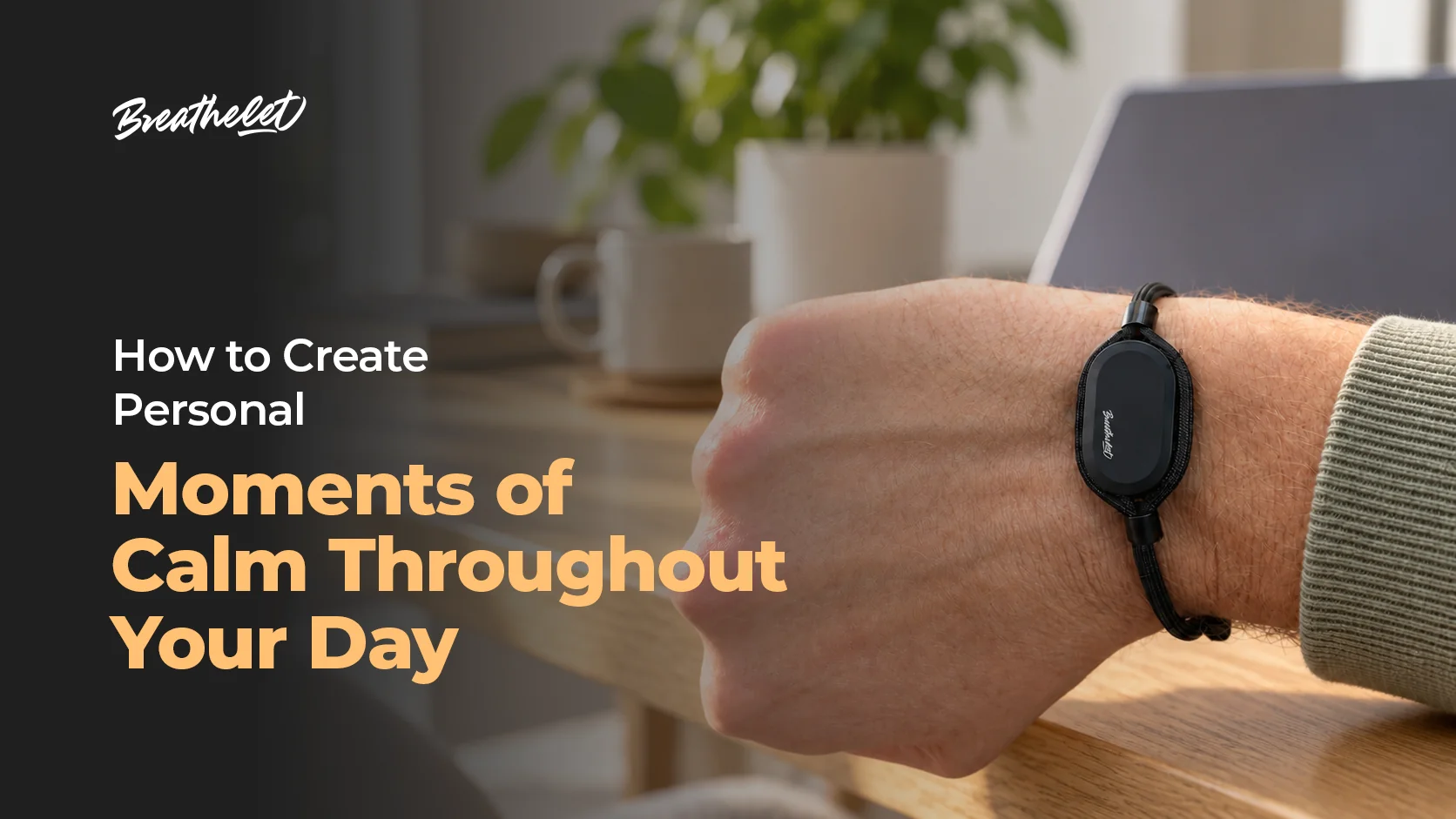
For example, Breathelet is designed around this idea of gentle interruption. Rather than demanding attention through another screen or constant stream of notifications, its vibration cues can serve as a quiet reminder to pause during the day.
The reminder itself does not create calm.
What you do after noticing it matters.
You might take one breath.
Relax your shoulders.
Look away from your screen.
Notice your surroundings.
Ask yourself how you are feeling.
Then continue.
The technology is simply the cue.
The moment belongs to you.
The Goal Isn't to Escape Every Stressful Moment
Life will still contain pressure.
There will still be deadlines, traffic, difficult conversations, unexpected problems, and afternoons when your carefully planned schedule collapses with impressive efficiency.
The goal is not to create a life without stress.
It is to become better at noticing when you need a moment.
Before the meeting.
During the commute.
In the middle of a busy afternoon.
After a difficult conversation.
Before responding to something emotionally.
A small cue can create just enough space to pause and respond more intentionally.
Sometimes that space lasts thirty seconds.
Sometimes it is one breath.
It still counts.
Create an Afternoon Reset
Afternoons often bring a combination of mental fatigue and accumulated stimulation.
Instead of immediately reaching for another coffee or opening another browser tab, create a short reset.
Stand up.
Stretch.
Drink some water.
Walk away from your workspace.
Look outside.
Take several comfortable breaths.
Then decide what actually deserves your attention next.
This last step can be particularly valuable.
When we are mentally tired, everything can start to feel equally urgent. A brief pause gives you an opportunity to separate what genuinely needs attention from what is simply making noise.
Make the Commute a Transition
If you commute, the journey home can become a useful boundary between work and personal life.
Instead of carrying the entire working day mentally into your evening, create a deliberate transition.
If you drive, spend part of the journey without additional audio.
If you use public transport, consider putting your phone away for several minutes.
Notice what is around you.
Let your attention settle.
You might ask yourself:
What am I ready to leave behind from today?
This does not mean pretending difficult experiences did not happen.
It simply acknowledges that work does not need unlimited access to your attention.
Create an Arrival Ritual at Home
The moment you arrive home is another useful opportunity.
Instead of immediately moving into chores, entertainment, or another screen, pause briefly.
Put your belongings down.
Change clothes.
Wash your hands or face.
Drink some water.
Sit quietly for a minute.
These ordinary actions can become signals that one part of the day has ended and another is beginning.
Small rituals create boundaries, and boundaries can make it easier to be present in whichever part of life you are currently living.
End the Day With Less Input
Calm becomes harder when stimulation continues until the moment you fall asleep.
Consider creating a short period at night with less digital input.
It does not need to involve an extreme digital detox.
Even ten or twenty minutes can become a useful transition.
Lower the lights.
Put your phone somewhere less accessible.
Stretch.
Read.
Prepare something for tomorrow.
Sit quietly.
Or reflect on the day.
One simple question can be enough:
When did I feel most present today?
You may begin noticing patterns.
Perhaps it was during your morning coffee.
During a walk.
While cooking.
When talking to someone without checking your phone.
Those observations can help you intentionally create more of those moments tomorrow.
Build Your Own Calm Routine
There is no universal schedule for mindfulness.
Your moments of calm should fit your life rather than becoming another routine you feel guilty about failing to maintain.
Start with three natural points in your day.
For example:
-
Morning: One minute before checking your phone.
-
Afternoon: A short pause after lunch or between major tasks.
-
Evening: Several screen-free minutes before bed.
Keep the practice deliberately small.
Once those pauses become familiar, you can add others naturally.
Consistency is often more useful than intensity.
A few intentional moments repeated regularly may fit real life better than an ambitious routine that disappears after three days.
Your Calm Does Not Have to Look Like Anyone Else's
One of the problems with modern wellness culture is that calm can start looking like something you need to perform correctly.
The perfect morning.
The perfect meditation space.
The perfect routine.
The perfect collection of wellness products.
Real life is rarely that tidy.
Your personal moment of calm might happen in a parked car before an appointment.
It might happen while waiting for the kettle.
It might be a quiet walk around the block.
It might be noticing a gentle vibration on your wrist and remembering to take one intentional breath.
What matters is not how impressive the moment looks.
What matters is that you noticed it.
Final Thoughts
You do not need to escape your daily life to create more calm within it.
You need moments that interrupt autopilot.
A breath before opening another email.
A screen-free coffee.
A short walk between tasks.
A quiet commute.
A physical reminder that brings your attention back to the present.
Individually, these moments may seem small.
But that is precisely what makes them practical.
Calm does not always arrive because the world suddenly becomes quiet.
Sometimes you create it yourself, one small pause at a time.

 English
 Arabic
 French
 Spanish
 Portuguese
 Deutsch
 Turkish
 Dutch
 Italiano
 Romaian
 Portuguese (Brazil)
 Greek
