


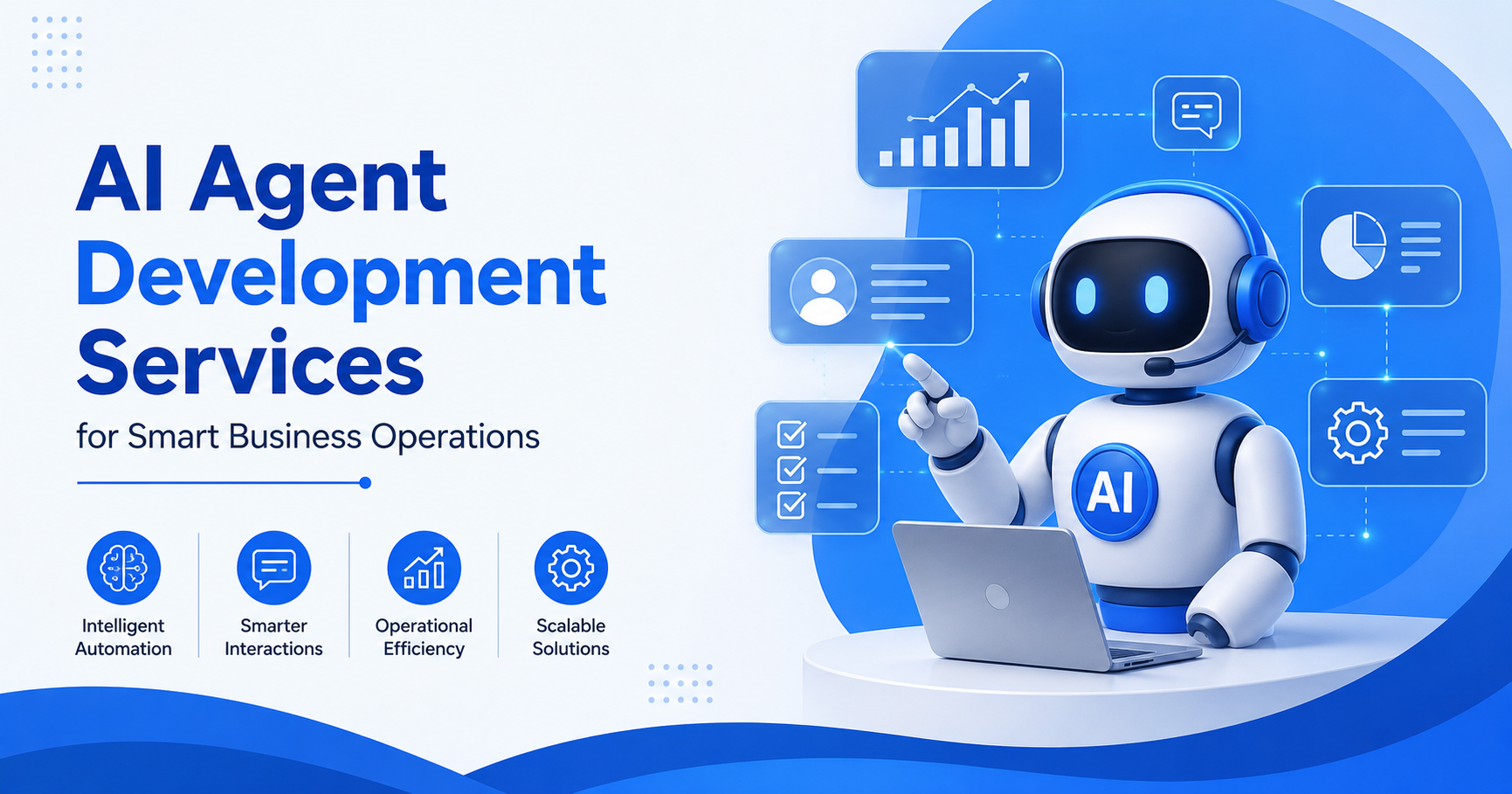
AI Agent Development Services for Smart Business Operations
Running a business today means competing against companies that never sleep — chatbots answering queries at 3 AM, voice systems closing deals over the weekend, and automated workflows quietly cutting costs while everyone else is asleep. If that sounds like science fiction, it isn't. It's what happens when a business partners with the right AI agent development company and stops treating automation as an afterthought. This blog walks through what these services actually look like, why they matter, and how a business owner — not a technologist — should think about adopting them.
Why "Smart Operations" Isn't Just a Buzzword Anymore
Every business owner has heard the phrase "work smarter, not harder," but few have seen it translated into something concrete. AI agents change that equation because they don't just automate a single task — they observe, decide, and act across an entire workflow without constant human supervision. A support ticket gets triaged, answered, or escalated in seconds. A lead gets qualified and nudged toward a purchase before your sales team even wakes up. Inventory gets reordered the moment stock dips below a threshold. None of this requires a person watching a dashboard all day, which is precisely why AI agent development services have moved from "nice to have" to "competitive necessity" in the span of a couple of years.
- Reduced dependency on manual, repetitive decision-making
- Faster response times across customer-facing touchpoints
- Consistent execution of business rules, 24 hours a day
- Data-driven insights generated as a byproduct of daily operations
What Does an AI Agent Development Company Actually Build?
People often assume "AI agent" means a single chatbot bolted onto a website, but that's a narrow and slightly outdated picture. A capable AI agent development company builds systems that combine language understanding, decision logic, memory, and integrations with your existing software — CRMs, ERPs, payment gateways, scheduling tools — so the agent can genuinely act on your behalf rather than just chat. These agents are trained to understand context, follow business-specific rules, and hand off to a human only when a situation truly requires judgment. The engineering effort behind this goes far beyond writing a script; it involves architecture design, testing across edge cases, and continuous refinement based on real usage data.
Think of it less like installing software and more like hiring a digital employee who needs onboarding, feedback, and occasional retraining. That mindset shift is exactly what separates businesses that get real ROI from AI from those that end up with a gimmicky chatbot nobody uses after week two.
The Core AI Agent Development Solutions Businesses Are Adopting
Not every business needs the same kind of agent, and a good partner will tell you that upfront instead of selling a one-size-fits-all package. The most in-demand AI agent development solutions right now span customer engagement, internal operations, and revenue generation — each solving a distinct bottleneck that used to require a dedicated team or an expensive software license.
- Customer support agents that resolve queries, process refunds, and escalate complex cases intelligently
- Internal workflow agents that manage scheduling, approvals, document processing, and reporting
- Data and analytics agents that summarize performance trends and flag anomalies before they become problems
- Voice and sales agents (covered in detail below) that handle conversations that used to require a live person
- Multi-agent systems where several specialized agents coordinate on a larger task, like onboarding a new client end-to-end
The right combination depends on where your business is losing the most time or money — and a thoughtful development partner will usually start with an audit before writing a single line of code.
Why US Businesses Are Prioritizing Local Expertise
There's a reason so many companies specifically search for AI agent development services USA rather than outsourcing blindly to the lowest bidder overseas. Compliance requirements, data privacy expectations, and customer communication norms differ significantly across regions, and an agent that works flawlessly in one market can misfire badly in another. A provider familiar with US business practices understands things like time-zone-aligned support, familiarity with American English nuances in voice and chat interactions, and regulatory considerations around data handling that matter to US-based customers and regulators alike.
- Better alignment with US data privacy expectations and industry-specific compliance
- Communication and tone tuned to American customer expectations
- Overlapping working hours for faster iteration and support
- Easier legal and contractual clarity when disputes or updates arise
This doesn't mean overseas development is inherently bad — plenty of excellent engineering talent exists globally — but for business owners who want tighter feedback loops and fewer cultural translation issues, working with a provider offering AI agent development services USA often removes friction that shows up later in the project.
How to Hire AI Agent Developers Without Getting Burned
This is usually the part where business owners feel most out of their depth, and understandably so — most owners aren't equipped to evaluate a technical portfolio the way an engineer would. When you decide to hire AI agent developers, the goal isn't to find the cheapest option or the flashiest sales pitch; it's to find a team that can explain, in plain language, how they'll measure success and what happens after launch. A developer or agency worth hiring will ask about your existing tools, your customer volume, your failure tolerance, and your long-term goals before proposing a single technical solution.
- Ask for case studies in your specific industry, not generic demos
- Confirm who owns the code, data, and models once the project ends
- Clarify how the agent will be monitored, retrained, and improved over time
- Understand pricing structure — fixed project cost versus ongoing subscription
- Check whether support includes handling failures gracefully, not just happy-path scenarios
A common mistake is hiring based purely on speed of delivery. An agent built in two weeks without proper testing often causes more damage — wrong answers to customers, missed escalations — than the manual process it replaced.
AI Voice Agent Development: Giving Your Business a 24/7 Voice
Phone calls remain one of the most trusted channels for customers, especially for anything involving money, bookings, or urgent issues — and that's exactly where AI voice agent development has made the biggest leap forward recently. Modern voice agents don't sound like the robotic IVR systems of a decade ago; they understand natural speech, handle interruptions, pick up on tone, and can carry a genuinely useful conversation. For a business owner, this means calls can be answered instantly, appointments booked without hold music, and routine questions handled without pulling a staff member away from higher-value work.
- Appointment scheduling and rescheduling handled entirely by voice
- Order status updates and basic troubleshooting without human intervention
- After-hours call handling so no lead or customer is ever left waiting
- Seamless handoff to a human agent when the conversation needs empathy or judgment
The technical challenge here is significant — latency has to feel near-instant, and the agent has to gracefully manage accents, background noise, and unexpected phrasing. That's precisely why voice agent projects need engineers who specialize in speech recognition and real-time processing, not just general chatbot developers.
AI Sales Agent Development: Closing Deals While You Sleep
Sales teams are expensive, and even the best reps can't personally follow up with every lead the moment interest is shown. This is the gap that AI sales agent development is built to close. A well-designed sales agent doesn't just send generic follow-up emails — it qualifies leads based on your criteria, answers product questions accurately, handles objections using approved talking points, and books meetings directly onto your sales team's calendar. Because it operates continuously, leads get engaged within minutes instead of days, which research consistently shows dramatically improves conversion rates.
- Lead scoring and prioritization based on real buying signals
- Personalized outreach at a scale no human team could sustain manually
- Objection handling using approved, brand-consistent responses
- Automatic calendar booking and CRM updates without manual entry
The best sales agents are trained on your actual sales conversations, not generic scripts pulled from the internet — which is where experienced engineering teams add real value over templated tools.
The Machine Learning Engineer Behind the Curtain
None of this works without solid engineering underneath it, and this is where the role of a machine learning engineer becomes central rather than incidental. These engineers are responsible for selecting the right underlying models, fine-tuning them on business-specific data, building the guardrails that prevent embarrassing or incorrect responses, and setting up the monitoring systems that catch problems before customers do. It's not glamorous work most business owners ever see, but it's the difference between an agent that quietly improves your operations and one that generates awkward customer complaints within its first week.
- Selecting and fine-tuning models suited to the specific business use case
- Building evaluation pipelines to catch errors before deployment
- Designing fallback logic for situations the agent isn't confident about
- Continuously retraining agents as business processes or products evolve
A skilled machine learning engineer also acts as a translator between your business goals and the technical implementation — turning "we lose too many leads over the weekend" into an actual system that solves it.
Bringing It All Together
AI agents aren't a replacement for good business judgment — they're an extension of it, handling the repetitive, time-sensitive work so your team can focus on what actually needs a human touch. Whether you're exploring AI agent development solutions for internal efficiency, considering AI voice agent development to never miss another call, or looking into AI sales agent development to keep your pipeline moving around the clock, the underlying principle stays the same: start with a clear business problem, then find engineering partners who ask good questions before offering solutions. Business owners who treat this as a strategic decision — not a quick tech purchase — are the ones seeing real, measurable returns from their investment.

 English
 French
 Spanish
 Portuguese
 Deutsch
 Turkish
 Dutch
Dutch
 Italiano
 Russian
 Romaian
 Portuguese (Brazil)
 Greek
Greek
