


Motorcycle Vest vs. Jacket: Which One Do You Actually Need?
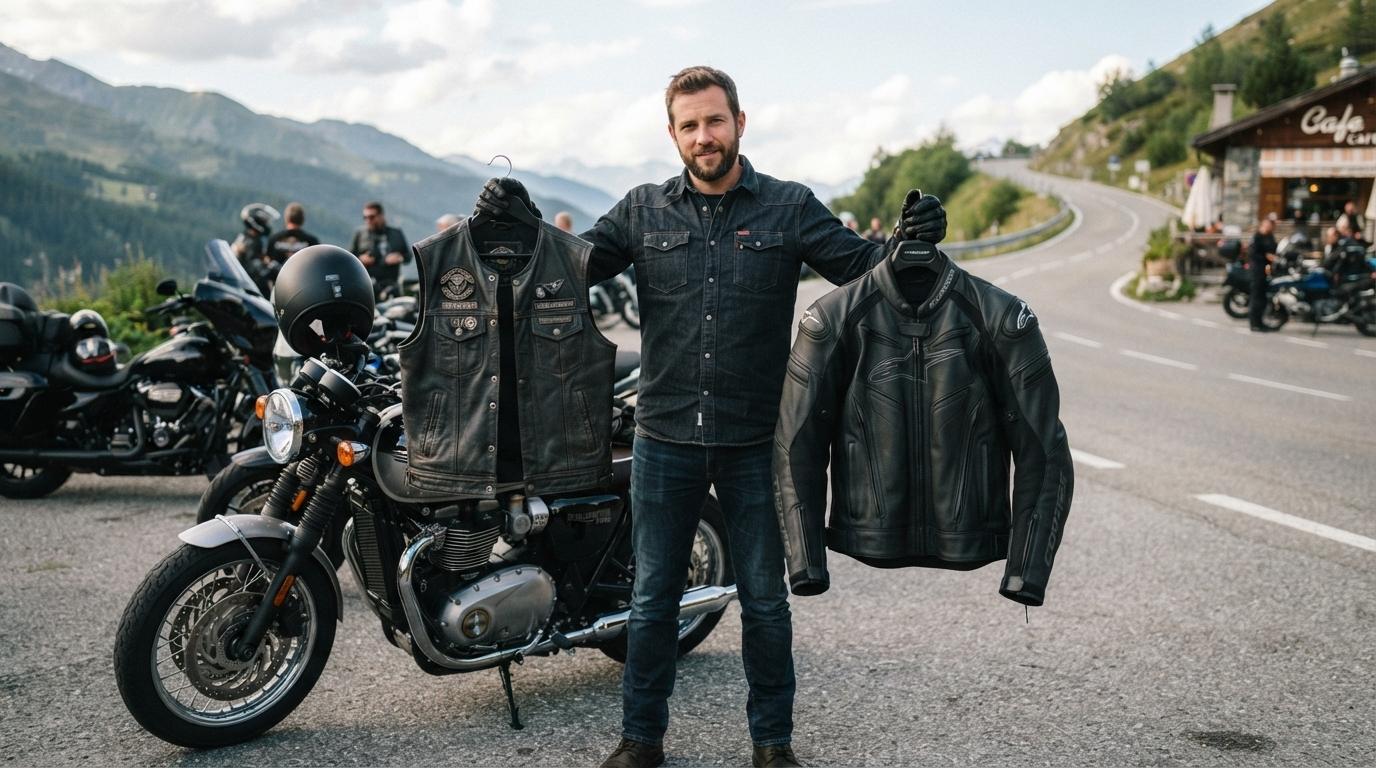
Choosing between a full motorcycle jacket and a lighter vest is one of the most common gear decisions riders face. Each option trades protection, airflow, weather coverage, and style differently. Whether you are considering a highway ready men's twill jacket or a men's leather biker vest, the right answer depends on how and where you actually ride.
Vest or Jacket: What's Different?
A motorcycle jacket typically covers the torso, shoulders, elbows, and forearms. Purpose-built versions may include:
-
Shoulder and elbow armor
-
Back-protector provision
-
Ventilation and thermal liners
-
Waterproof membranes
A motorcycle vest covers the chest, sides, and back while leaving the arms fully exposed. Vest categories vary widely, and a leather club vest, an armored protective vest, a heated vest, and a cooling vest are not the same product. The comparison only makes sense when you evaluate the specific garment and its construction, not merely the general category.
Which One Gives More Coverage?
A full-sleeve jacket can protect the shoulders, elbows, forearms, torso, and back with abrasion-resistant shell material and reinforced zones. A sleeveless vest primarily covers the chest, abdomen, sides, and back. A vest may protect the areas it covers, but it cannot provide shell coverage to skin that remains exposed. Even a high-quality leather vest does not create abrasion resistance over bare elbows and forearms during a road slide. That said, not every jacket is automatically protective either. A fashion jacket may offer less motorcycle-specific performance than a purpose-built protective garment. Real coverage depends on the specific construction and materials, not just the garment type.
How Does Motorcycle Armor Differ?
A jacket can integrate shoulder armor, elbow armor, and a back protector. A protective vest may accommodate back and chest protection depending on its design. Impact protectors are tested under EN 1621 standards:
-
Level 1 meets the first defined impact-performance threshold
-
Level 2 allows lower transmitted forces for higher tested attenuation
These levels describe individual protectors, not the garment class. Also check whether armor is actually included or merely armor-ready. An armor pocket is not armor, and torso protection does not replace the missing elbow and forearm coverage of a sleeveless garment.
Is a Vest Better in Hot Weather?
Riders often choose vests in warm weather because sleeveless designs allow direct airflow to the arms, reduce bulk around the shoulders, and improve overall mobility. However, greater airflow comes partly from reducing protective coverage. Riders wanting cooling with more body protection can also consider mesh motorcycle jackets, perforated leather, lightweight textile options, or a motorcycle-specific twill jacket. Hot-weather riding does not create only two choices. A vest offers maximum openness, while mesh and lightweight full-sleeve jackets offer different balances between airflow and actual coverage.
Where Does Twill Fit In?
A men's twill jacket can serve as a practical middle ground between a heavy leather jacket and a sleeveless vest. Motorcycle-oriented twill designs may include reinforced shoulders and elbows, armor pockets, action backs, pre-curved sleeves, secure cuffs, and mesh lining, all in a lighter, workwear-inspired package. Twill describes a weave, not a motorcycle safety classification, so evaluates the finished garment's construction. If a rider wants a vest mainly because a heavy leather jacket feels too warm, a lighter twill option may offer full-sleeve coverage without the bulk.
Why Do Riders Choose Leather Vests?
A handcrafted men's leather biker vest offers practical and cultural strengths that full jackets do not easily replicate. Vests provide unrestricted arm movement, easy layering, additional pockets, and a natural platform for patches, rockers, rally patches, and embroidery. Many club-style vests use single-panel backs specifically to accommodate large artwork and cleaner patch placement without seam interference. A jacket is often selected around weather and protection. A leather vest can also be selected around identity, customization, and the way a rider prefers to layer across different riding conditions and occasions.
Can You Wear a Vest Over a Jacket?
The decision does not have to be vest or jacket. Many riders layer a vest over a motorcycle jacket for patches, extra storage, visibility, or club identity. An armored vest worn under or over a jacket can supplement torso impact protection where the system is designed for it. A vest over a casual hoodie may work for style but should not automatically be considered motorcycle PPE. Sometimes the best setup comes from giving each layer one clear job instead of expecting a single garment to do everything.
Which Is Better for Bad Weather?
A motorcycle jacket can include waterproof membranes, thermal liners, storm flaps, secure cuffs, and high collars to manage rain, wind, and cold. A vest leaves the arms dependent on whatever layer sits underneath.
-
Warm and dry: A vest may be perfectly convenient
-
Cold or windy: Full-sleeve coverage becomes significantly more useful
-
Rain: A purpose-built waterproof jacket has the stronger advantage
Leather itself should not be described as waterproof. The farther conditions move away from warm and dry, the more valuable full-sleeve weather protection generally becomes.
Which Fits Your Riding Style?
-
Cruiser riding: A leather biker vest works well for warm-weather cruising, rallies, patches, and casual recreational rides
-
Commuting: A men's twill jacket or textile jacket provides full sleeves, pockets, casual appearance, and easy off-bike wear
-
Touring: Jackets generally offer better weather management, armor options, ventilation, and all-day coverage
-
Highway riding: Full sleeves help with wind exposure, debris, insects, and changing temperatures
-
Summer riding: Consider a vest, mesh jacket, perforated leather, or lightweight twill depending on your coverage priorities
The better garment depends on where, how long, and in what conditions you ride.
How Should Each One Fit?
For a vest, check chest, waist, armholes, back length, and layering room. For a jacket, check shoulders, chest, sleeve length, cuffs, back coverage, and elbow armor position. Always test fit in a riding posture with arms forward, elbows bent, and shoulders relaxed. A garment that fits perfectly while standing may behave very differently on the motorcycle. For armored garments, protectors should remain aligned with the body areas they are designed to cover.
Final Thoughts
Choose a jacket when coverage, armor, and weather protection matter most. Choose a vest when airflow, layering, patches, or personal identity take priority. Brands like First Manufacturing Co. offer riders a variety of men's twill jackets and men's leather biker vests that complement different riding styles and preferences. Whether you prefer the full coverage of a riding jacket or the classic appeal of a leather vest, choose gear that matches your riding conditions, comfort, and personal style.

 English
 Arabic
 French
 Spanish
 Portuguese
 Deutsch
 Turkish
 Dutch
 Italiano
 Russian
 Portuguese (Brazil)
 Greek
