


Does a Modular Cardiac OT Turnkey Project Company Install Medical Gas Pipeline Systems?
Introduction
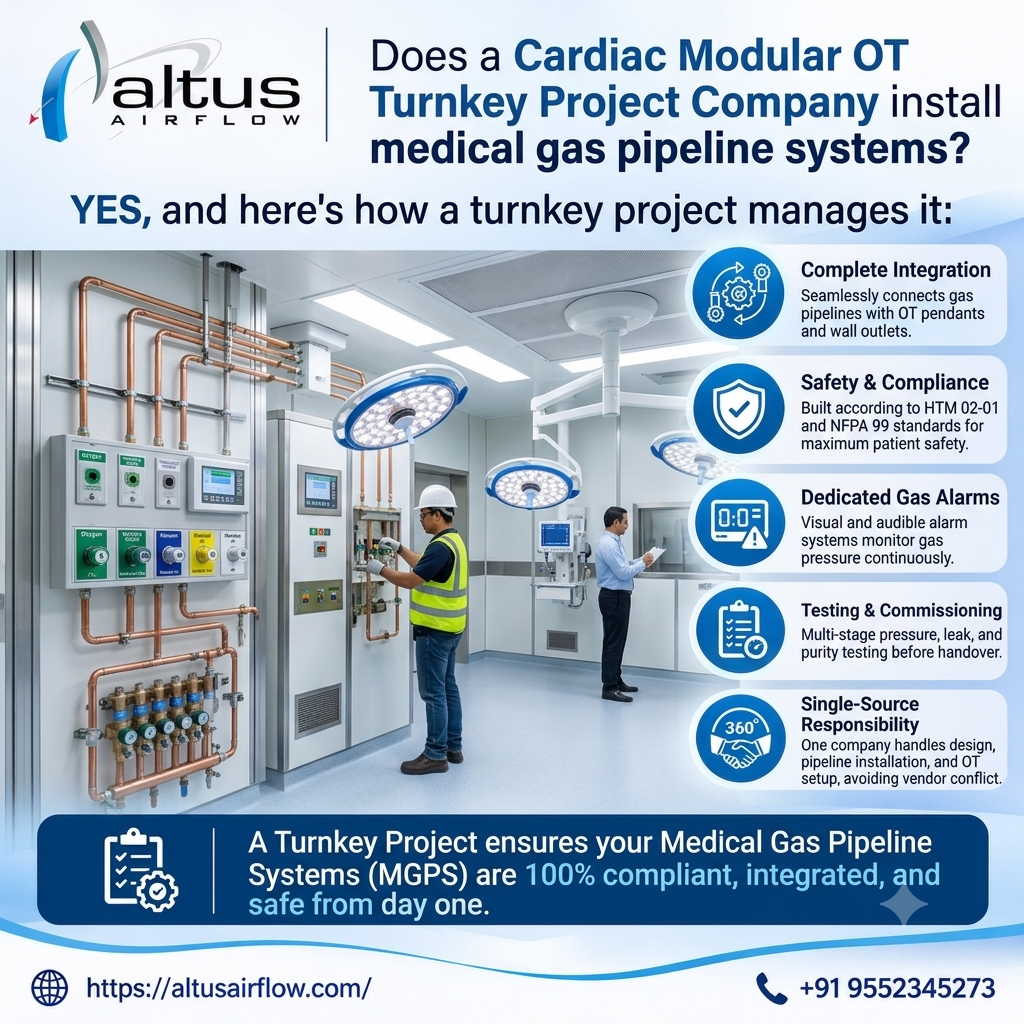
Altus Airflow provides specialised modular infrastructure solutions for hospitals developing or upgrading cardiac operating theatres. A Modular Cardiac OT Turnkey Project Company can coordinate medical gas pipeline systems as part of an integrated operating theatre project, including planning, service routing, outlet positioning, and coordination with ventilation and electrical infrastructure. These systems are essential for supplying medical gases to surgical equipment and patient-care devices. Their installation requires qualified professionals, appropriate materials, safety controls, testing, and compliance with applicable healthcare standards to support reliable operation.
1. Understanding Medical Gas Pipeline Systems in Cardiac OTs
Medical gas pipeline systems are essential infrastructure in modern cardiac operating theatres. They provide a centralised supply of medical gases to designated outlets, allowing clinical teams to connect approved equipment without relying entirely on individual gas cylinders.
Depending on the hospital's clinical requirements, a cardiac OT may require oxygen, medical air, vacuum, and other specified services. The exact gases and outlet arrangements must be determined through consultation with the hospital's clinical and engineering teams.
A medical gas pipeline system generally includes a central supply source, distribution pipelines, isolation valves, pressure regulators, alarms, and terminal outlets. Each component has a specific function in maintaining the supply and supporting safe clinical use.
A turnkey project can coordinate these services with the room layout, medical pendants, equipment locations, and other building systems.
2. How Turnkey Project Planning Includes Medical Gas Infrastructure
Medical gas planning should begin during the initial design stage rather than after the operating theatre construction is complete. Early coordination helps avoid conflicts between pipelines, electrical conduits, HVAC ductwork, ceiling supports, and other services.
A Modular Cardiac OT Turnkey Project Company can coordinate the medical gas requirements with the broader project design. This may include reviewing the hospital's equipment list, identifying required gas types, estimating demand, and planning the location of outlets.
The project team also needs to consider pipeline routes, accessibility for maintenance, isolation arrangements, and future expansion requirements.
The actual pipeline design and installation must be undertaken by appropriately qualified and authorised medical gas specialists. The turnkey coordinator should ensure that responsibilities, technical specifications, testing requirements, and documentation are clearly defined.
3. Identifying the Medical Gases Required
The medical gases required in a cardiac OT depend on the procedures performed, equipment used, and hospital policies.
Common services may include:
-
Medical oxygen: Used for patient respiratory support and compatible clinical equipment.
-
Medical air: Supplies suitable medical devices and respiratory applications requiring compressed medical air.
-
Medical vacuum: Supports suction applications used during clinical procedures.
-
Other specified gases: Additional services may be required depending on the hospital's clinical scope and equipment specifications.
Not every operating theatre requires the same combination of services. The hospital's clinical team, biomedical engineering department, and medical gas specialists should confirm the required gases and outlet quantities.
Correct identification is essential because each gas must have compatible pipelines, terminal units, labels, and connections. Clear identification helps reduce the risk of incorrect connections during clinical operations.
4. Planning Pipeline Routes and Layouts
Pipeline routing is a major part of medical gas infrastructure planning. The routes should connect the central supply system to the operating theatre outlets while maintaining accessibility and avoiding interference with other building services.
During design coordination, the project team evaluates available ceiling spaces, service shafts, wall cavities, and technical areas. The routing should minimise unnecessary bends and support inspection, maintenance, and future modifications.
Pipelines must be installed using materials and methods approved for the intended medical gas service. They should be adequately supported, protected from damage, and separated from incompatible services according to applicable requirements.
The design must also account for isolation valves and access points. These allow authorised personnel to isolate designated sections during maintenance or emergencies without unnecessarily affecting the entire facility.
5. Integrating Medical Gas Outlets with Pendants
Medical pendants are commonly used to organise essential services around the operating table. They can provide access to medical gas outlets, electrical connections, data points, and equipment support systems.
The number and position of medical gas outlets should be determined by the surgical workflow and the equipment expected to be used. Outlet locations should allow clinical teams to connect equipment conveniently without creating cable or hose obstructions.
A turnkey project team coordinates pendant positions with ceiling supports, surgical lights, ventilation outlets, and the operating table arrangement.
The installation should consider the pendant's structural loading, movement range, service connections, and maintenance access. Medical gas terminal units must be compatible with the designated gas service and should be clearly identified.
6. Coordinating Medical Gas Systems with Modular Wall and Ceiling Panels
Modular wall and ceiling systems provide organised spaces for integrating operating theatre services. However, medical gas pipeline connections require careful coordination with panel layouts and structural arrangements.
Wall panels may accommodate selected medical service outlets, while ceiling-mounted pendants can provide connections above the operating area. The design should ensure that pipelines remain properly supported and accessible where required.
Openings through modular panels must be finished appropriately to maintain the intended hygienic surfaces. Unsealed gaps around service outlets can create cleaning and maintenance difficulties.
The project team should coordinate panel manufacturing with the final approved service drawings. This helps avoid unnecessary cutting, modifications, and installation delays at the site.
7. Installing Isolation Valves and Alarm Systems
Isolation valves are important safety components in medical gas pipeline systems. They allow authorised personnel to control the supply to specific sections of the facility when maintenance or emergency intervention is required.
Valve locations should be planned so that they are accessible, clearly labelled, and protected from accidental operation. The isolation arrangement should reflect the hospital's approved zoning and operational requirements.
Medical gas alarm systems provide notifications when monitored conditions, such as pressure or supply status, move outside specified limits. Depending on the design, alarms may be installed at source equipment locations and designated clinical or technical areas.
Alarm systems should be tested during commissioning, and hospital personnel should receive appropriate instructions on alarm response procedures.
8. Ensuring Compatibility with HVAC and Other OT Services
Medical gas pipelines are only one part of a cardiac operating theatre's technical infrastructure. Their installation must be coordinated with ventilation, electrical systems, fire safety arrangements, medical equipment, and other utilities.
For example, pipeline routes should not obstruct HVAC ducts, filtration housings, or access to ventilation equipment. Electrical and data cabling should be coordinated to maintain safe separation and service accessibility according to applicable requirements.
The ceiling layout must accommodate medical pendants, surgical lights, air supply outlets, and other suspended equipment. Proper coordination helps prevent clashes and reduces the need for costly changes during installation.
A combined services layout provides a clearer view of how different systems interact within the available space.
9. Following Medical Gas Safety and Quality Requirements
Medical gas pipeline systems require strict attention to safety and quality. Materials, installation procedures, identification, testing, and commissioning should follow the applicable national standards, technical specifications, and hospital requirements.
The installation team must use approved components suitable for medical gas service. Procedures for cleanliness, brazing or joining, pressure testing, and system verification should be followed by qualified personnel.
Pipelines must be clearly identified according to the relevant gas service. Terminal outlets should be designed to prevent incompatible connections and support safe use with approved medical equipment.
The hospital should verify that the installation has been completed by appropriately qualified specialists and that the required test certificates and handover records are available.
10. Conducting Testing and Commissioning
Testing is essential before a medical gas pipeline system is made available for clinical use. It helps verify that the installed network is suitable for its intended application.
Depending on the system and applicable requirements, testing and commissioning may include:
-
Pipeline pressure and leakage testing.
-
Verification of pipeline cleanliness.
-
Confirmation of gas identity and cross-connection checks.
-
Testing of terminal units and outlet connections.
-
Verification of pressure and flow performance.
-
Testing of alarm and isolation arrangements.
-
Review of system documentation and certification.
Testing must be conducted by qualified personnel using approved procedures. The hospital should not use the system clinically until all required verification and commissioning activities have been completed and accepted.
11. Providing Documentation and Handover Support
Proper documentation helps hospital teams operate and maintain medical gas infrastructure safely. The project handover should include approved drawings, pipeline identification details, equipment specifications, test reports, commissioning records, and maintenance instructions.
As-built drawings are particularly important because they show the actual pipeline routes and locations of valves, outlets, and other components. These records support future repairs and modifications.
The hospital's engineering and maintenance teams should also receive information about routine inspection requirements, alarm response procedures, and the authorised personnel responsible for system maintenance.
A coordinated handover helps ensure that the medical gas installation remains traceable and maintainable after the construction project is complete.
12. Supporting Future Expansion and Maintenance
Hospitals may introduce new equipment or modify surgical workflows over time. Medical gas infrastructure should therefore be planned with reasonable future requirements in mind.
The project team can review available pipeline capacity, service access, isolation arrangements, and the possibility of adding approved outlets in the future. However, any expansion must be supported by engineering assessment and formal verification.
Preventive maintenance should include inspections of accessible pipeline sections, valves, alarms, terminal units, and source equipment. Maintenance work must be carried out by authorised specialists following approved safety procedures.
Maintaining accurate records of inspections, repairs, and system modifications helps hospitals manage the infrastructure throughout its operational life.
13. Benefits of Integrated Turnkey Project Coordination
Coordinating medical gas systems within a complete cardiac OT project offers several practical advantages.
First, it allows medical gas requirements to be considered alongside the room layout and equipment arrangement. This can reduce installation conflicts and improve service accessibility.
Second, coordinated planning helps align medical gas outlets with pendants, surgical tables, and clinical workflows. This supports an organised operating environment.
Third, a clearly defined project scope can improve coordination between the hospital, modular infrastructure provider, medical gas specialist, HVAC contractor, and electrical team.
Finally, integrated documentation and commissioning planning help ensure that the hospital receives the information needed for safe operation and maintenance.
A turnkey approach does not mean that every specialist activity is performed by one company. It means that responsibilities and interfaces are coordinated across the project.
14. Choosing the Right Project Partner
Hospitals should evaluate a project partner's experience in modular operating theatre infrastructure, technical coordination, project management, and integration of specialised services.
It is important to confirm who is responsible for medical gas pipeline design, installation, testing, certification, and maintenance. These activities should be assigned to qualified and authorised specialists.
The project partner should also demonstrate the ability to coordinate medical gas requirements with HVAC, electrical systems, modular panels, ceiling equipment, and surgical workflow.
Clear specifications, approved drawings, quality checks, realistic timelines, and complete handover documentation are important indicators of a well-managed project.
Conclusion
Medical gas pipeline systems are an essential part of cardiac operating theatre infrastructure. Their successful installation requires careful planning of gas requirements, pipeline routes, terminal outlets, isolation valves, alarms, safety procedures, and commissioning activities. A turnkey project can coordinate these services with modular walls, ceilings, HVAC, electrical systems, and medical equipment.
A Modular Cardiac OT Turnkey Project Company can manage the overall integration of medical gas infrastructure while ensuring that specialised design, installation, testing, and certification are handled by qualified professionals. Altus Airflow focuses on coordinated modular healthcare infrastructure and specialised operating theatre planning. With appropriate technical coordination and documented verification, Altus Airflow can support hospitals in developing cardiac OTs with organised and maintainable medical utility systems.
Frequently Asked Questions
1. Does a Modular Cardiac OT Turnkey Project Company install medical gas pipeline systems?
A Modular Cardiac OT Turnkey Project Company can coordinate medical gas pipeline installation as part of the complete project, with specialist installation and testing performed by qualified professionals.
2. Which medical gases are commonly required in a cardiac OT?
Common services include medical oxygen, medical air, and medical vacuum. Additional gases depend on clinical and equipment requirements.
3. Are medical gas outlets integrated into OT pendants?
Yes. Medical gas outlets can be integrated into compatible pendants according to the approved equipment layout and service requirements.
4. Who should install medical gas pipelines?
Medical gas pipelines should be designed, installed, tested, and certified by appropriately qualified and authorised specialists.
5. Why are isolation valves required?
Isolation valves allow authorised personnel to control the gas supply to designated sections during maintenance or emergencies.
Read Our Previous Blog ---------------> Can a Modular Cardiac OT Setup Company upgrade an existing operation theatre?

 English
 Arabic
 French
 Spanish
 Portuguese
 Deutsch
 Turkish
 Italiano
 Russian
 Romaian
 Portuguese (Brazil)
 Greek
