


What Communication Systems Are Integrated by an Andrology Room Design Company?
Introduction
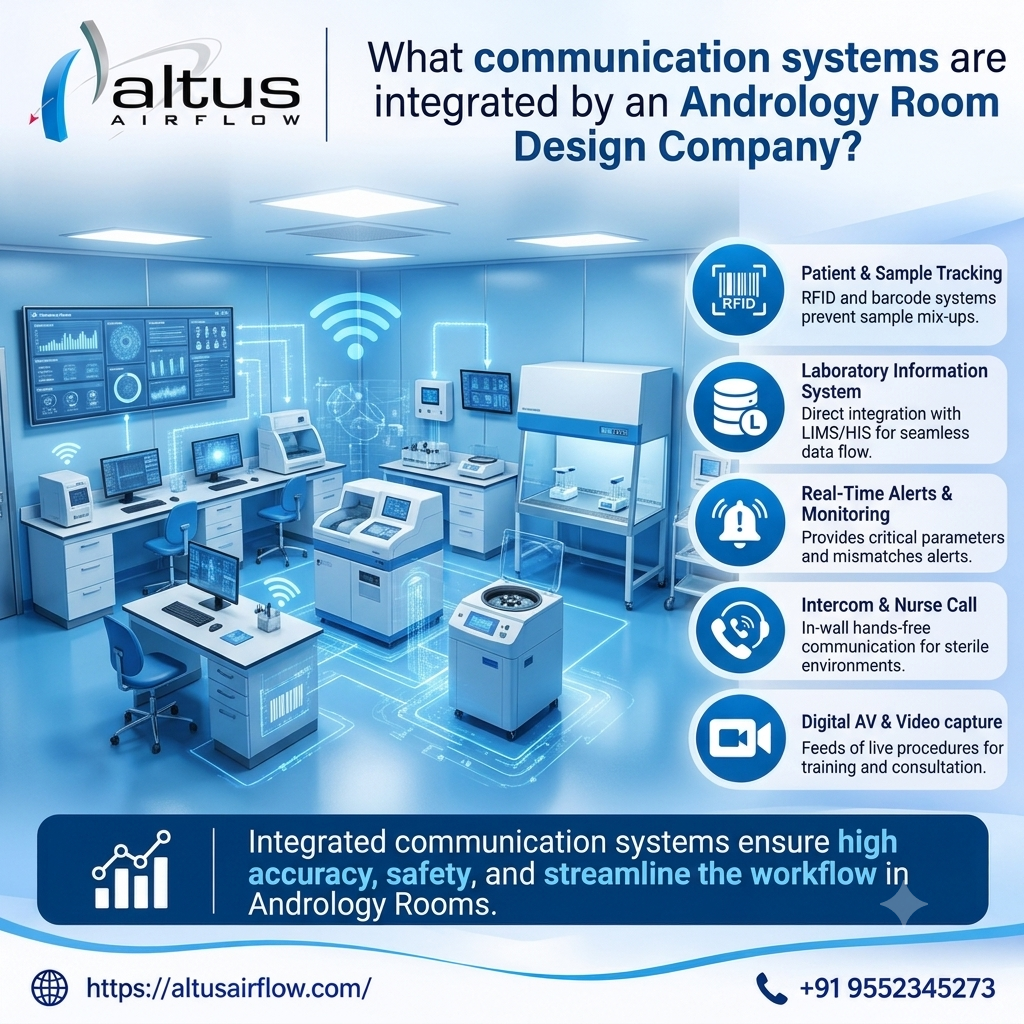
Altus Airflow provides specialised modular infrastructure solutions for fertility clinics, diagnostic laboratories, and reproductive healthcare facilities. An Andrology Room Design Company considers communication systems an essential part of an efficient laboratory environment. These systems help laboratory professionals coordinate procedures, exchange information, monitor equipment, and maintain accurate records. Proper communication infrastructure also supports staff safety, operational continuity, and workflow management while ensuring that sensitive patient information remains protected.
1. Importance of Communication Systems in an Andrology Room
An andrology laboratory handles important reproductive health procedures, including semen analysis, sperm preparation, sample evaluation, and cryopreservation-related activities. These processes require coordination between laboratory technicians, embryologists, doctors, administrative personnel, and other healthcare professionals.
Communication systems help different teams exchange information without unnecessary movement or disruption. For example, laboratory staff may need to communicate with clinicians about sample status, request additional information, or report equipment-related concerns.
A well-planned communication infrastructure can support:
-
Faster coordination between laboratory and clinical teams.
-
Timely communication about sample processing.
-
Efficient reporting of equipment issues.
-
Better coordination of daily laboratory activities.
-
Secure exchange of patient-related information.
-
Improved management of laboratory operations.
Communication facilities should be integrated during the planning stage rather than added after the laboratory is completed.
2. Intercom Systems for Internal Communication
Intercom systems are among the basic communication facilities considered during andrology room planning. They allow staff members to communicate between designated laboratory areas, reception spaces, consultation rooms, and administrative sections.
In controlled laboratory environments, unnecessary entry and exit should be minimised. Intercom communication can help staff request assistance or share routine updates without repeatedly leaving their workstations.
Depending on the facility's requirements, intercom systems may include:
-
Wall-mounted communication units.
-
Desk-based intercom devices.
-
Hands-free communication facilities.
-
Multi-room communication networks.
-
Centralised communication panels.
The placement of intercom units should be planned carefully. Devices must be accessible without interfering with laboratory equipment, work surfaces, or hygienic design requirements.
3. Telephone and Internal Calling Infrastructure
Telephone systems provide another important communication channel within fertility clinics. Internal calling infrastructure allows laboratory personnel to contact doctors, nurses, reception teams, and management departments.
A structured telephone network can reduce delays when staff members need to discuss appointments, laboratory schedules, sample-related queries, or operational requirements.
The infrastructure may include:
-
Internal extension lines.
-
Central telephone exchange systems.
-
Dedicated laboratory extensions.
-
Reception and administrative calling facilities.
-
External communication connections.
Telephone points should be positioned according to the laboratory layout. Their placement should not interfere with clean work areas or create unnecessary cable exposure.
A well-planned network also allows clinics to expand their communication facilities when additional rooms or departments are introduced.
4. Computer Networks and Data Communication Systems
Modern andrology laboratories rely on computer networks to manage patient information, laboratory records, test reports, and equipment-related data. A reliable network infrastructure helps authorised personnel access relevant digital information when required.
Structured data communication systems may connect laboratory computers, printers, diagnostic equipment, servers, and authorised clinical workstations.
Important infrastructure considerations include:
-
Structured network cabling.
-
Secure Ethernet connections.
-
Wireless network coverage where appropriate.
-
Network switches and communication cabinets.
-
Dedicated data points.
-
Reliable internet connectivity.
-
Network access management.
An Andrology Room Design Company should coordinate these requirements with the clinic's IT team. Network points must be planned around equipment locations and workstations to minimise cable clutter and avoid interference with laboratory activities.
5. Laboratory Information Management Systems
Laboratory Information Management Systems (LIMS) help organise and manage laboratory data. Depending on the software and equipment compatibility, a LIMS can support sample identification, workflow tracking, result documentation, and laboratory record management.
In an andrology laboratory, digital information systems may help authorised personnel manage:
-
Patient and sample identification.
-
Test requests and processing status.
-
Laboratory observations.
-
Result entry and reporting.
-
Sample tracking records.
-
Quality control documentation.
-
Audit trails and authorised access.
Integration should be planned according to the clinic's operational procedures. The system must support accurate data entry and appropriate access permissions.
LIMS integration does not replace professional verification. Laboratory personnel remain responsible for reviewing results, confirming sample identity, and following approved documentation procedures.
6. Communication Between Laboratory Equipment and Monitoring Systems
Certain laboratory instruments support digital communication with computers or laboratory management software. This can help transfer equipment readings, test information, operating status, or maintenance alerts, depending on the manufacturer's specifications.
Equipment communication may be useful for incubators, microscopes with digital imaging facilities, analysers, environmental monitoring devices, and other compatible instruments.
Integration planning should consider:
-
Available communication ports and protocols.
-
Software compatibility.
-
Data transfer requirements.
-
Equipment access permissions.
-
Manufacturer installation guidelines.
-
Maintenance and technical support.
Not every laboratory instrument can connect directly to a central network. Compatibility must be confirmed before specifying the communication infrastructure.
7. Environmental Monitoring and Alert Communication
Maintaining suitable environmental conditions is important in an andrology laboratory. Temperature, humidity, ventilation performance, and other relevant parameters may require routine monitoring according to the facility's procedures and equipment requirements.
Environmental monitoring systems can communicate readings to designated displays, control panels, or authorised personnel. Some systems also support alerts when monitored values move outside configured limits.
Common monitoring and alert features include:
-
Temperature monitoring.
-
Relative humidity monitoring.
-
HVAC operating status.
-
Equipment temperature alerts.
-
Power failure notifications.
-
Remote monitoring for authorised users.
-
Data logging and reporting.
These systems help laboratory personnel identify potential problems and respond according to established procedures. Alert thresholds should be configured by qualified professionals based on the laboratory's validated requirements.
8. Public Address and Emergency Communication Systems
Emergency communication is another consideration when planning a reproductive healthcare facility. Staff may need to receive instructions during power interruptions, equipment failures, fire alarms, or other unexpected situations.
Public address systems can communicate announcements across designated areas. Emergency notification facilities may include audible alarms, visual indicators, and communication links to authorised facility personnel.
The design may consider:
-
Public address speakers in appropriate common areas.
-
Emergency announcement controls.
-
Visual alert indicators.
-
Fire alarm communication interfaces.
-
Emergency contact arrangements.
-
Backup power for essential communication equipment.
The exact arrangement should comply with applicable building, fire safety, and healthcare facility requirements. Emergency communication devices should remain accessible and should not interfere with the laboratory's controlled environment.
9. Video Conferencing and Consultation Communication
Some fertility clinics use video conferencing to support consultations, internal discussions, staff training, and communication with external specialists. These facilities can be useful when clinicians or laboratory experts are working across different locations.
Video conferencing infrastructure may include:
-
Secure video communication software.
-
Cameras and microphones.
-
Display screens.
-
Dedicated network connections.
-
Meeting room communication equipment.
-
Access-controlled consultation facilities.
Patient consultations involving confidential medical information must use suitable privacy and security measures. Video conferencing should be arranged in designated consultation spaces rather than disrupting sensitive laboratory work.
10. Data Security and Patient Confidentiality
Communication systems in reproductive healthcare facilities may process sensitive patient and treatment information. Protecting this information is essential for maintaining confidentiality and supporting responsible clinical operations.
The communication infrastructure should incorporate appropriate security measures, including:
-
Role-based user access.
-
Strong authentication.
-
Secure network configuration.
-
Data encryption where supported.
-
Regular software updates.
-
Backup and recovery arrangements.
-
Activity logs and access monitoring.
Wireless networks should be configured securely, and guest access should remain separate from systems used for clinical or laboratory operations.
Clinics should also establish policies for data retention, information sharing, and staff access. Technical safeguards must work alongside staff training and documented procedures.
11. Planning Communication Systems During Laboratory Design
Communication infrastructure should be considered alongside electrical systems, HVAC, lighting, medical equipment placement, and modular room construction.
Early planning helps avoid changes after installation and supports better coordination between contractors, IT professionals, equipment suppliers, and laboratory management.
Important planning steps include:
-
Assess communication requirements: Identify how laboratory staff, clinicians, and administrative teams exchange information.
-
Prepare a room-wise layout: Mark the locations of computers, telephones, intercoms, displays, and network points.
-
Coordinate cable routing: Plan concealed or organised cable pathways without compromising hygiene or maintenance access.
-
Check equipment compatibility: Confirm the communication interfaces supported by laboratory instruments.
-
Plan power backup: Identify essential communication devices that require uninterrupted power.
-
Establish security requirements: Define user permissions and network access controls.
-
Test the installed systems: Verify connectivity, alerts, communication quality, and data transfer before operational use.
This coordinated approach helps create a practical communication environment that supports the laboratory's daily activities.
12. Benefits of Integrated Communication Infrastructure
A properly planned communication network offers several operational advantages for an andrology laboratory.
Improved staff coordination: Intercoms, telephones, and digital platforms allow laboratory and clinical teams to exchange information efficiently.
Better workflow management: Digital records and laboratory information systems can help staff monitor sample processing and documentation.
Timely alerts: Environmental monitoring systems can notify authorised personnel about selected equipment or environmental conditions.
Reduced unnecessary movement: Internal communication facilities may reduce the need for staff to leave designated work areas for routine updates.
Improved record management: Compatible digital systems support organised documentation and easier retrieval of authorised information.
Scalable infrastructure: Structured cabling and planned network capacity can make future technology upgrades easier.
These benefits depend on suitable system selection, correct installation, staff training, and ongoing maintenance.
Conclusion
Communication infrastructure is an important part of a modern andrology laboratory because it connects laboratory personnel, clinical teams, digital records, equipment, and monitoring systems. Intercoms, telephone networks, structured data cabling, LIMS platforms, environmental alerts, and emergency communication facilities can support organised daily operations.
Altus Airflow considers communication requirements alongside modular room planning, electrical coordination, ventilation, and equipment positioning. By integrating suitable systems during the design stage, Altus Airflow helps healthcare facilities develop functional laboratory environments that support efficient coordination, secure information handling, and future expansion.
Frequently Asked Questions
1. What communication systems are integrated by an Andrology Room Design Company?
An Andrology Room Design Company may integrate intercoms, telephone networks, structured data cabling, LIMS connectivity, equipment communication interfaces, environmental monitoring alerts, and emergency communication systems.
2. Why are intercom systems useful in an andrology laboratory?
Intercom systems allow staff to communicate between laboratory areas and other departments without unnecessary movement.
3. Can laboratory equipment connect to digital communication systems?
Yes. Compatible equipment can connect to computers or laboratory software for data transfer and monitoring, depending on manufacturer specifications.
4. What is the role of LIMS in an andrology laboratory?
LIMS helps manage sample information, test records, workflow tracking, and laboratory documentation.
5. Are environmental monitoring alerts important?
Yes. Alerts can notify authorised staff about selected temperature, humidity, HVAC, or equipment conditions that require attention.
Read Our Previous Blog ---------------> Can existing laboratories be upgraded with Andrology Room Design?

 Arabic
 French
 Spanish
 Portuguese
 Deutsch
 Turkish
 Dutch
 Italiano
 Russian
 Romaian
 Portuguese (Brazil)
 Greek
