


Slip Ring Market Forecast to Reach USD 2.52 Billion by 2035, with Top Players Cobham, Moog and Moflon Technology in Focus
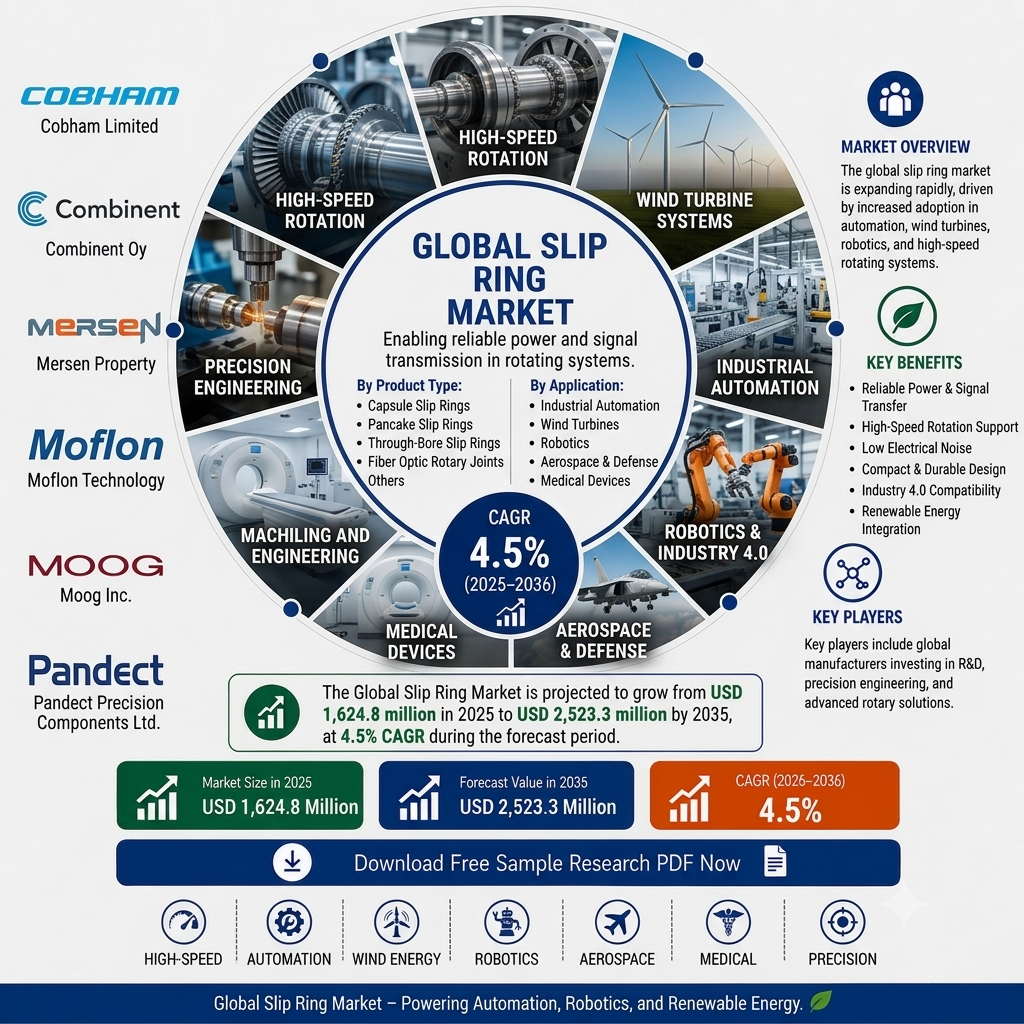
November 18, 2026 — Rockville, MD: The global slip ring market is projected to grow from USD 1.62 billion in 2025 to USD 2.52 billion by 2035, expanding at a 4.5% CAGR during the forecast period, according to Fact.MR. Increasing use of slip rings in industrial automation, wind turbines, robotics, medical imaging, aerospace, and defense applications is supporting market growth.
Slip rings enable continuous transmission of electrical power and signals between stationary and rotating components. Their role in automated machinery, high-speed rotating systems, and renewable energy equipment is becoming increasingly important as industries adopt advanced technologies and improve operational efficiency.
Request full Report Pricing and sample Report: https://www.factmr.com/connectus/sample?flag=S&rep_id=5208
Slip Ring Market Outlook
The rapid adoption of industrial automation is one of the key factors driving demand for slip rings. Manufacturing, packaging, robotics, and other automated systems require reliable power and signal transmission during continuous rotation. The expansion of Industry 4.0 and smart factories is further increasing the need for advanced rotary connection technologies.
Wind energy is another major growth driver. Slip rings are essential for transferring power and communication signals between stationary nacelles and rotating turbine components. Rising investments in onshore and offshore wind projects across China, Germany, the United States, and other markets are creating opportunities for manufacturers of durable, high-performance slip rings.
Medical imaging is also supporting market expansion. CT and MRI systems rely on precision slip rings to maintain high-speed data and power transmission during rotation. Growing investment in advanced diagnostic equipment is therefore creating demand for reliable and low-noise rotary transmission solutions.
Aerospace and defense applications are contributing to demand as well. Slip rings are used in radar systems, turrets, satellite tracking equipment, and other rotating platforms that require dependable performance in demanding environments. Manufacturers are increasingly developing hybrid, fiber-optic, and non-contact solutions to address requirements for higher data speeds, longer service life, and lower maintenance.
Pancake Slip Rings Gain Traction in Space-Constrained Applications
Pancake slip rings are gaining prominence in applications where vertical space is limited. Their flat, disc-shaped configuration allows integration into compact rotating systems used in robotics, medical diagnostics, radar antennas, automated machinery, and precision equipment.
The growing adoption of compact industrial equipment is supporting demand for pancake designs. Their ability to accommodate multiple channels for power and data transmission also makes them suitable for rotating platforms, turntables, sensors, and robotic systems.
Manufacturers are improving material durability, noise reduction, and wear resistance to extend operating life. These developments are strengthening the suitability of pancake slip rings for high-performance applications where space efficiency and reliability are critical.
Automation, Wind Energy and Medical Imaging Create Opportunities
Factory automation, wind energy, medical imaging, and packaging machinery are among the important end-use areas supporting slip ring demand. Robotic arms, rotary tables, CNC machines, and automated production systems increasingly depend on continuous power and signal transfer during movement.
The expansion of offshore wind farms is also creating demand for durable slip rings capable of operating under demanding environmental conditions. Medical equipment manufacturers, meanwhile, require precision rotary transmission systems for CT and MRI scanners where signal accuracy and reliable high-speed rotation are essential.
However, conventional slip rings face challenges from mechanical wear, brush degradation, heat generation, electrical noise, and maintenance requirements. The growing availability of wireless power transmission, rotary transformers, and fiber-optic rotary joints is creating competitive pressure in applications where maintenance reduction and extended service life are priorities.
Asia Pacific Leads as Industrial Automation and Wind Energy Expand
Asia Pacific leads the global slip ring market, supported by rapid industrialization, expanding manufacturing hubs, automation investments, and large-scale wind energy development. China and India are important contributors, while Japan and South Korea are driving demand through robotics, semiconductor manufacturing, and precision medical equipment.
China is strengthening its position through its dominant role in wind energy and expanding industrial automation sector. The country's smart factory development and manufacturing capabilities are increasing demand for compact, high-performance slip rings across robotics, electronics, CNC machining, and renewable energy applications.
Japan is also witnessing growing demand as automation expands across automotive, semiconductor, and industrial sectors. Increasing adoption of wind energy and advanced medical equipment is supporting opportunities for compact, low-maintenance slip ring technologies.
In North America, the United States is benefiting from established aerospace and defense industries, industrial automation modernization, wind energy investments, and demand for advanced medical imaging systems.
Competitive Landscape
The global slip ring market is becoming increasingly competitive, with manufacturers focusing on precision engineering, customization, reliability, signal quality, and application-specific solutions.
Key companies profiled by Fact.MR include Cobham Limited, Combinent Oy, MERSEN Property, Moflon Technology, Moog Inc., and Pandect Precision Components Ltd.
Moog Inc. is strengthening its position through aerospace and wind energy applications, while Cobham Limited continues to focus on aerospace-grade rotary solutions for radar and satellite communication systems. Moflon Technology is expanding customizable solutions for industrial automation, surveillance, and robotics, while Pandect Precision Components is focusing on compact, low-noise solutions for medical and semiconductor applications.
In 2025, Moog Inc. was awarded a USD 28 million U.S. Navy contract to repair slip ring assemblies on V-22 Osprey tiltrotor aircraft. In 2024, the company also introduced a next-generation slip ring integrated with a fiber-optic rotary joint for GE wind turbines, targeting 2.5 MW and larger models.
To View Related Reports
Life Sciences and Laboratory Equipment Market https://www.factmr.com/report/life-sciences-and-laboratory-equipment-market
Education Hardware Market https://www.factmr.com/report/education-hardware-market
Dry Grinding Ball Mill Market https://www.factmr.com/report/dry-grinding-ball-mill-market
E-Cloth Market https://www.factmr.com/report/e-cloth-market
About Fact.MR
Fact.MR is a market research and competitive intelligence provider delivering market intelligence, competitive analysis, and forecasting across global industries. Its research helps businesses evaluate market demand, understand competitive developments, and identify growth opportunities.

 English
 Arabic
 French
 Spanish
 Portuguese
 Deutsch
 Turkish
 Dutch
 Russian
 Romaian
 Portuguese (Brazil)
 Greek
