


Matcha Market Growth, Revenue, Key Factors, Major Companies, Forecast Analysis By Fact.MR
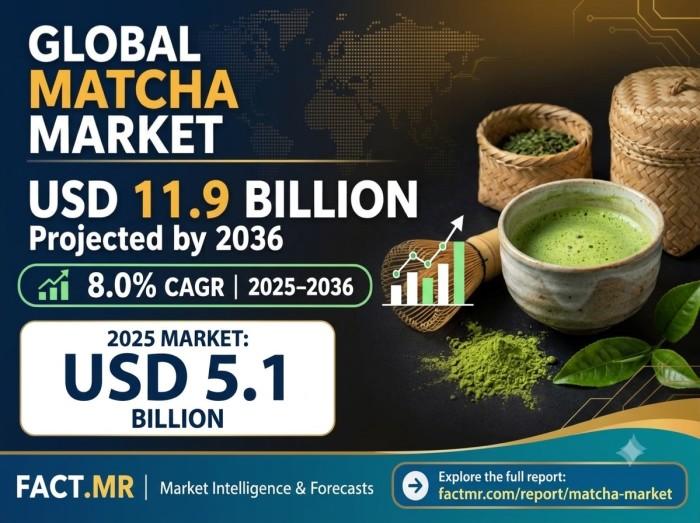
Rockville, Maryland — November 17, 2026 — According to Fact.MR research, the global matcha market is estimated at USD 5.1 billion in 2025 and is forecast to expand at a CAGR of 8.0% to reach USD 11.9 billion by 2036. The industry is expected to generate an absolute dollar opportunity of USD 6.4 billion between 2026 and 2036. Growing adoption of health-conscious beverages, expanding cafe culture, and increasing use of matcha in food manufacturing are supporting demand across traditional tea preparation, specialty beverages, bakery, confectionery, cosmetics, and nutraceutical applications.
The findings indicate that matcha is developing beyond its traditional positioning as a Japanese tea product. Its adoption as a functional ingredient, natural coloring component, and specialty beverage ingredient is broadening commercial opportunities. India is projected to record the fastest country-level growth at 9.1% CAGR through 2036, followed by China at 8.5%, South Korea at 7.7%, and the United States at 7.2%.
Request for PDF Report Sample Pages: https://www.factmr.com/connectus/sample?flag=S&rep_id=12134
Market Background: Health-Conscious Consumption and Industrial Applications Support Growth
Matcha is a finely ground powder produced from shade-grown green tea leaves. The market encompasses ceremonial, culinary, premium, and industrial grades, with products distributed across powder, liquid extract, capsules, and supplements. Its applications extend from traditional tea preparation to food and beverage manufacturing, cosmetics, personal care, and nutraceutical formulations.
According to Fact.MR, increasing consumer awareness of matcha's antioxidant content and L-theanine properties is supporting its adoption as a functional tea and ingredient. The expansion of specialty cafes is also creating additional consumption occasions through matcha lattes, smoothies, and other specialty beverages.
Food manufacturers are contributing to the market's broader demand base by incorporating matcha into bakery, confectionery, and dairy products. Its positioning as a natural coloring and flavor ingredient aligns with growing interest in clean-label formulations and alternatives to synthetic colorants and flavor additives.
E-commerce and direct-to-consumer distribution are further improving access to premium and ceremonial-grade matcha. These channels allow consumers to purchase specialty products for home preparation, extending market access beyond traditional tea retailers and specialty establishments.
However, the market faces several structural constraints that industry participants must consider:
- Supply concentration: Dependence on Japanese production and limited shade-grown tea cultivation capacity can create pricing pressure and supply risks during periods of strong demand.
- Grade inconsistency: Differences in quality classification across suppliers create challenges for consumers and food manufacturers seeking standardized products.
- Price premiums: Matcha's higher prices compared with conventional green tea can restrict adoption among price-sensitive consumers and mass-market food manufacturers.
- Production capacity: Maintaining consistent quality while expanding production is becoming increasingly important as international demand grows.
These factors make supply chain transparency, grade standardization, and dependable sourcing important considerations for companies operating across the matcha value chain.
Product, Form and Application Analysis: Culinary Grade and Powder Lead Key Segments
Fact.MR's analysis identifies distinct growth opportunities across product grades, commercial forms, and end-use applications.
Culinary-grade matcha accounts for 28% of the product segment in 2026. Its position is supported by food and beverage manufacturers using matcha as a functional and coloring ingredient. The segment benefits from applications in bakery, confectionery, dairy formulations, and specialty beverages, where ingredient suitability and cost-effectiveness at scale influence purchasing decisions.
Ceremonial-grade matcha represents 35% of the grade segment in 2026, reflecting demand from premium consumers and traditional tea preparation. Produced from younger tea leaves and processed into a fine powder, this grade is valued for its vibrant color, smooth taste, and umami profile. Authenticated Japanese-origin products and specialty retail distribution are important features of this premium category.
Powder remains the dominant commercial form, accounting for 72% of the form segment in 2026. Its position reflects its suitability for traditional tea preparation and industrial ingredient applications. Liquid extracts support concentrated formulations and ready-to-drink beverage manufacturing, while capsules and tablets serve specialized dietary supplement applications.
Food and beverages represent 60% of the application segment in 2026, making this the most significant end-use category. Demand is supported by cafe matcha lattes, smoothies, bakery products, confectionery, and dairy formulations.
Other applications are also expanding:
- Nutraceuticals: Matcha's EGCG, L-theanine, and catechin content supports its use in dietary supplements and antioxidant-focused formulations.
- Cosmetics and personal care: Matcha extracts are finding applications in skincare products positioned around antioxidant and anti-inflammatory benefits.
- Industrial food ingredients: Natural coloring and flavoring applications are extending matcha adoption beyond direct beverage consumption.
Ready-to-drink matcha beverages in canned and bottled formats represent an emerging growth opportunity. Although they are not currently the largest product sub-segment, their potential expansion could extend matcha distribution beyond cafes and specialty retail into mainstream convenience and grocery channels.
Regional Outlook: India and China Lead Growth Through 2036
Regional demand patterns highlight the growing importance of markets outside traditional Japanese tea consumption.
India is projected to register the highest country-level CAGR at 9.1% through 2036. Emerging specialty tea adoption, expanding urban cafe culture, and increasing awareness of matcha's health-related properties are supporting this outlook. E-commerce is identified as an important discovery and purchasing channel for matcha products in the country.
China follows with an anticipated CAGR of 8.5%. Expanding domestic cultivation, growing functional beverage demand, and increasing use of matcha in food manufacturing are supporting its market development.
Other important country-level growth projections include:
- South Korea: 7.7% CAGR
- United States: 7.2% CAGR
- Japan: 6.8% CAGR
- United Kingdom: 6.3% CAGR
- Germany: 5.9% CAGR
East Asia remains the largest regional market and an important production center, with Japan maintaining its position as the primary production origin. China is developing as both a producer and a growing consumption market.
Meanwhile, North America and Europe are recording strong demand growth as matcha-based cafe beverages and packaged products gain wider distribution. In the United States, established specialty coffee and tea culture, cafe distribution, and increasing availability of ready-to-drink and packaged matcha products are supporting adoption.
Japan's market continues to benefit from traditional tea culture, export production, and industrial food and beverage applications.
Analyst Perspective: Supply Transparency and Grade Standardization Will Shape Competition
Fact.MR's analysis highlights the convergence of traditional Japanese tea culture with international health beverage trends and functional ingredient demand. As matcha consumption expands across different markets and commercial applications, companies must address the requirements of both premium consumers and industrial buyers.
The findings suggest that future competitive positioning will depend increasingly on securing reliable shade-grown tea supplies, maintaining consistent product grades, and establishing transparent sourcing practices.
For food manufacturers, the expansion of culinary-grade matcha applications creates opportunities to incorporate the ingredient into multiple product categories. For specialty tea companies, ceremonial-grade positioning and authenticated Japanese origin remain important competitive considerations. Beverage manufacturers also have opportunities to explore canned and bottled matcha formats as distribution moves beyond cafe environments.
Analyst commentary based on the Fact.MR report findings (not a verbatim executive quotation): The projected expansion of the matcha market highlights the importance of aligning product quality, sourcing strategies, and distribution capabilities with changing consumption patterns. Companies that address supply consistency while developing applications across beverages, packaged foods, and specialty products will be better positioned to participate in the market's projected expansion.
Future Outlook and Research Methodology
Fact.MR forecasts the global matcha market from 2026 to 2036, with the market expected to increase from USD 5.5 billion in 2026 to USD 11.9 billion in 2036. The projected 8.0% CAGR represents an absolute dollar opportunity of USD 6.4 billion over the ten-year forecast period.
The research evaluates market developments across product type, form, grade, source, application, and geographical region. Its scope includes market sizing, pricing analysis, supply chain assessment, grade classification, distribution channel dynamics, and competitive benchmarking.
Fact.MR's research methodology combines secondary research, primary interviews, and forecast modelling. The study draws on more than 80 secondary sources and benchmarks over 35 company and brand profiles. Market sizing covers more than 30 countries through a demand-side model supported by top-down validation.
Key forecasting inputs include specialty tea consumption, cafe penetration, functional food ingredient demand, and premium tea pricing. The model also cross-checks demand estimates against production volumes, trade flows, and retail distribution data.
Primary research includes more than 20 interviews with tea producers, importers, distributors, cafe operators, and food manufacturers. Final estimates undergo trade-flow checks, sales-pattern reviews, and sensitivity testing.
This research framework provides industry participants with a structured view of market demand, regional opportunities, competitive positioning, and the factors influencing long-term growth.
Gain Full Access to Market Forecasts and Key Drivers: https://www.factmr.com/report/matcha-market
Access the Complete Fact.MR Matcha Market Report
Food and beverage manufacturers, specialty tea producers, ingredient suppliers, distributors, investors, and procurement professionals can use the findings to evaluate market opportunities and understand the factors influencing matcha demand through 2036.
The complete study provides detailed forecasts, segment-level analysis, country-level growth projections, competitive benchmarking, supply chain assessments, and market opportunities across food and beverages, nutraceuticals, cosmetics, and other applications.
Read the complete Fact.MR Matcha Market Analysis and Forecast, 2026–2036 to explore the market's projected valuation, leading product categories, regional growth outlook, competitive landscape, and research methodology.
Explore Trending Reports & Related Report:
Adaptogenic Mushrooms Market- https://www.factmr.com/report/adaptogenic-mushrooms-market
Low Calorie Nutella Market- https://www.factmr.com/report/low-calorie-nutella-market
Cold Press Juice Market- https://www.factmr.com/report/cold-press-juice-market
Canned Fruits Market- https://www.factmr.com/report/canned-fruits-market
Egg Products Market- https://www.factmr.com/report/egg-products-market
About Fact.MR
Fact.MR is a market research and consulting organization providing industry analysis, market intelligence, and strategic research across multiple business sectors. Its research covers market sizing, demand forecasts, competitive landscapes, segment analysis, regional developments, and industry trends.
Through its market research publications, Fact.MR supports business professionals, manufacturers, investors, and decision-makers seeking structured information for strategic planning and commercial evaluation.
The Red Wine Market report provides a detailed assessment of the global market from 2025 to 2035, covering product varieties, distribution channels, price tiers, regional markets, and key industry participants.
Media Contact
Organization: Fact.MR
Department: Media Relations
Email: sales@factmr.com
Media Kit: Contact Fact.MR through its official website for media resources and additional information.

 English
 Arabic
 French
 Spanish
 Portuguese
 Deutsch
 Turkish
 Dutch
 Italiano
 Russian
 Romaian
 Greek
