


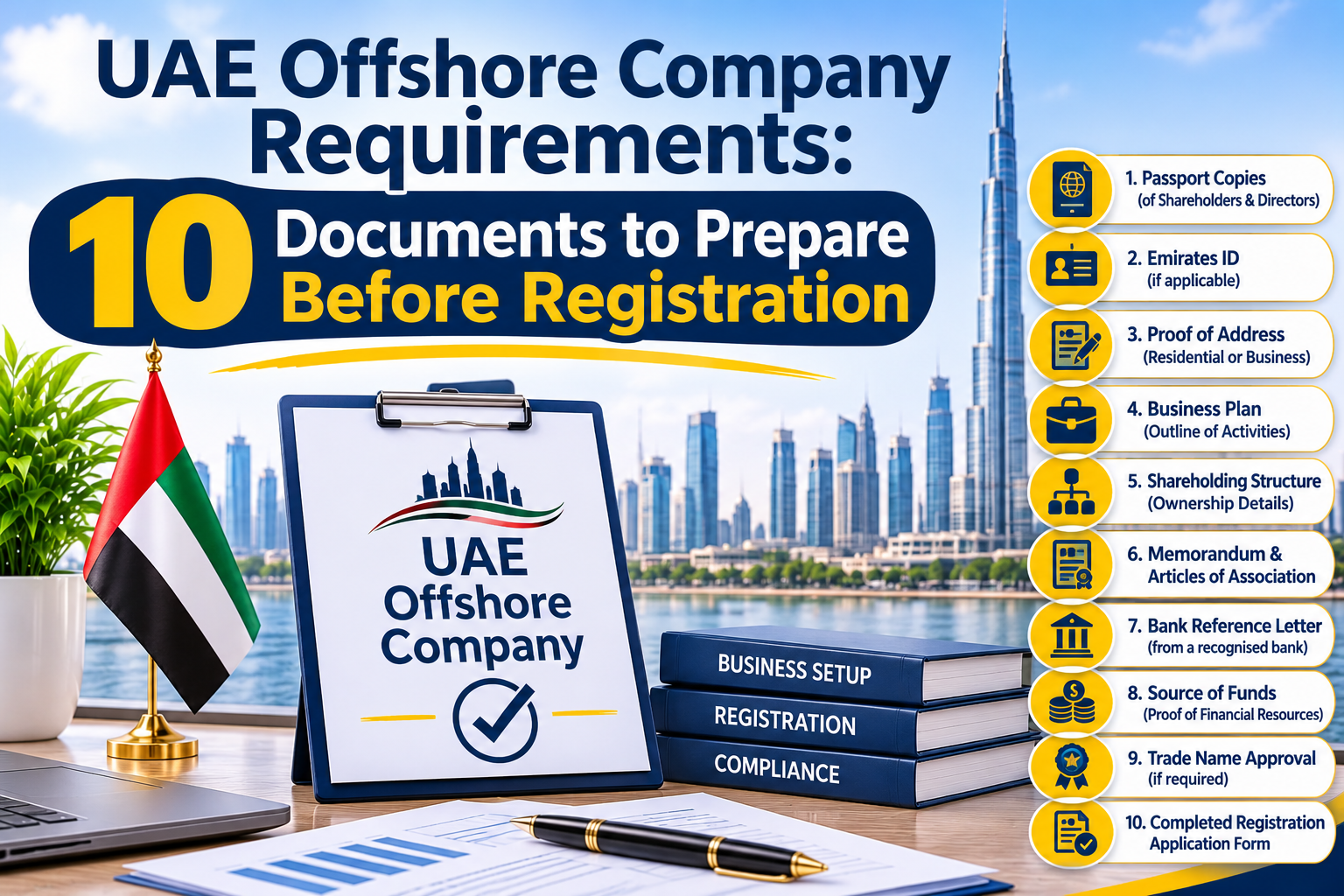
UAE Offshore Company Requirements: 10 Documents to Prepare Before Registration
Setting up an offshore company in the UAE can be a useful option for international investors, holding companies and business owners who want to manage assets or investments through a UAE-based structure. However, registration involves more than choosing a company name and submitting an application.
Applicants must prepare identity documents, ownership details and company records for review. The exact requirements depend on the offshore registry, the proposed company structure and whether the shareholders are individuals or existing companies.
The main UAE offshore registration options include RAK ICC and JAFZA Offshore. Each has its own procedures and document requirements. A document accepted by one registry may need different certification or attestation for another.
Preparing the right paperwork in advance can help reduce delays and make the registration process easier. Here are 10 important documents to prepare before applying.
1. Valid Passport Copies of Shareholders and Directors
A valid passport copy is one of the main documents required for UAE offshore company registration. The registry and registered agent use it to verify the identity of the people involved in the company.
You should prepare clear copies of the passports of:
-
All proposed shareholders.
-
All proposed directors.
-
The company secretary, where required.
-
Authorised representatives involved in the application.
-
Ultimate beneficial owners, where requested.
Check that every passport is valid and that the personal details are easy to read. If a passport is close to expiry, ask the registered agent whether it should be renewed before submitting the application.
Some registries may also request additional identity documents. For example, applicants who live in the UAE may need to provide their Emirates ID or visa details.
2. Proof of Residential Address
Passport copies confirm identity, but they do not always confirm where a person lives. This is why proof of residential address is another important part of the UAE offshore company requirements.
Shareholders, directors and beneficial owners may need to provide a recent document showing their current home address.
Common examples include:
-
Recent utility bills.
-
Bank statements.
-
Tenancy agreements.
-
Government-issued residence documents.
-
Local authority tax bills, where accepted.
The document should show the person's name and full residential address. It should also meet the registry's requirements for how recently it was issued.
Avoid submitting an old bill or a document with an address that does not match the information in the application. If your address has recently changed, confirm which document the agent will accept.
3. Memorandum and Articles of Association
The Memorandum and Articles of Association, often called the MOA and AOA, set out the company's structure and internal rules.
These documents help explain how the offshore company will operate and how its ownership and management will be organised.
They generally cover matters such as:
-
The company's name and registered details.
-
Its objects and permitted activities.
-
Share capital and share structure.
-
Shareholder rights.
-
Director powers and responsibilities.
-
Rules for meetings and company decisions.
-
Procedures for transferring shares.
The MOA and AOA must reflect the proposed ownership and management arrangements. Errors in shareholder names, share allocations or other company details can create problems during registration.
The registered agent will usually help prepare the relevant documents for the selected registry. All required shareholders must sign them in line with the registry's procedure.
4. Registered Agent Appointment Letter
UAE offshore companies are generally incorporated through an approved or registered agent. Applicants should therefore prepare the appointment document required to authorise the agent to handle the registration.
The appointment letter confirms that the chosen agent is authorised to submit the application and deal with the relevant registry on the applicant's behalf.
It may cover:
-
The name of the proposed offshore company.
-
The identity of the applicant or shareholders.
-
The registered agent's details.
-
The agent's authority to submit registration documents.
-
The signatures required to confirm the appointment.
Do not assume that you can submit an offshore application directly to every registry. For example, JAFZA states that offshore registration must be processed through its registered agents.
Choose an agent who understands the selected registry and can explain the paperwork, certification and compliance steps before the application is submitted.
5. Certificate of Incorporation for a Corporate Shareholder
An offshore company may have an individual shareholder or an existing company as its shareholder. If another company will own shares in the proposed offshore business, additional corporate records are required.
One of the main documents is the parent company's Certificate of Incorporation or equivalent registration document.
This certificate confirms that the parent company was legally established in its home jurisdiction.
The registered agent may also request a copy of its current trade licence or another official registration record, depending on where it is incorporated.
Before submission, check that:
-
The company name matches its official records.
-
The registration number is clear.
-
The issuing authority is identifiable.
-
The document is current and properly certified.
-
Any required translation or legalisation has been completed.
If the parent company has changed its name or legal status, provide the supporting records as well. The information should give the registry a clear picture of the company that will become the shareholder.
6. Parent Company's Memorandum and Articles of Association
When a corporate shareholder is involved, its own constitutional documents may also be required.
The parent company's MOA and AOA help the registry understand its legal structure, ownership powers and authority to participate in another company.
These records can help establish whether the parent company is permitted to invest in or own shares in the proposed offshore entity.
The registered agent may review them to confirm details such as:
-
The parent company's legal name.
-
Its registered business activities.
-
Its shareholding structure.
-
Its directors and authorised representatives.
-
Its powers to invest in other companies.
Prepare the latest version of these documents. If the parent company has amended its constitutional documents, make sure the submitted copies reflect those changes.
Some registries may also require notarisation or embassy attestation for corporate documents. The exact process depends on the registry and the country where the parent company is registered.
7. Certificate of Good Standing
A Certificate of Good Standing is an official document that confirms a company remains active and meets the relevant status requirements in its jurisdiction.
It may be required when an existing company is applying to become a shareholder in a UAE offshore company.
The document helps the registry confirm that the corporate shareholder is not dissolved or otherwise inactive.
Before requesting the certificate, check which authority must issue it and whether the registry requires an original, certified copy or a document issued within a specific period.
A certificate that is too old may not meet the registry's requirements. It is better to coordinate its issue date with the registered agent so that it remains valid for the application.
This document is particularly important for international groups that want to use an existing overseas company as part of their UAE ownership structure.
8. Certificate of Incumbency or Current Company Register Extract
A Certificate of Incumbency or an official company register extract provides information about a company's current management and ownership.
It can help confirm who is authorised to act for the parent company and identify its directors, officers or shareholders.
The registry may use this information to understand the corporate ownership structure and identify the people behind the proposed offshore company.
Depending on the issuing jurisdiction, the document may contain:
-
The company's current directors.
-
Its shareholders.
-
Its registered office details.
-
The authorised signatories.
-
Other relevant company officers.
For corporate shareholders, this document is especially useful because the registry needs to understand who controls the existing company.
Make sure the details are up to date. If there has been a recent change in directors or shareholders, arrange for an updated register extract before submitting the application.
9. Board Resolution Approving the Offshore Company Formation
If an existing company will become a shareholder, it may need to pass a board resolution approving the investment or incorporation.
A board resolution is a formal record of the company's decision. It confirms that the appropriate people have authorised the proposed offshore company formation.
The resolution may cover:
-
Approval to establish or invest in the offshore company.
-
The proposed company name, where known.
-
The number or value of shares to be held.
-
Appointment of an authorised signatory.
-
Approval to appoint a registered agent.
-
Authority to sign and submit the required documents.
The resolution should follow the parent company's internal approval procedures. It must also identify the people who are authorised to act on its behalf.
For certain applications, a registry may require the resolution to be notarised and attested. JAFZA, for example, lists specific notarisation and UAE Embassy attestation requirements for corporate applicant documents.
10. Power of Attorney and Authorised Signatory Documents
A Power of Attorney (POA) gives a nominated person legal authority to act for another individual or company within the powers stated in the document.
It may be needed when a shareholder or corporate representative wants another person to handle specific registration activities.
For example, a company may authorise a representative to:
-
Sign relevant application documents.
-
Communicate with the registered agent.
-
Submit supporting paperwork.
-
Complete specified registration formalities.
-
Represent the company within the authority granted.
The POA should clearly identify the person granting authority and the appointed representative. It should also explain the powers being given.
The registered agent may request the authorised person's passport copy and specimen signature. Some registries also require the POA to be notarised and attested before accepting it.
Not every applicant needs a separate Power of Attorney. If the shareholder or authorised signatory can complete the process directly, the agent can confirm whether this document is necessary.
Additional Checks Before Submitting Your Documents
Preparing these 10 documents is a useful starting point, but a complete application also depends on the registry's review and the applicant's ownership structure.
Consider the following checks before submitting your paperwork.
Confirm the requirements of your chosen registry
RAK ICC and JAFZA Offshore have different application procedures. Their requirements for corporate documents, certification and attestation may not be the same.
For example, JAFZA publishes specific requirements for individual and non-individual applicants. RAK ICC's published incorporation checklist also separates documents for individual shareholders, corporate shareholders, directors and other ownership structures.
Do not use one registry's checklist as a complete guide for another.
Prepare your ownership and UBO information
The registry and registered agent need to understand who ultimately owns or controls the proposed company.
Prepare accurate details of shareholders and ultimate beneficial owners. If another company will hold the shares, be ready to explain the ownership chain and identify the individuals behind it.
Clear ownership information can help the agent complete the required due diligence.
Check certification, translation and attestation
Some documents may need to be certified, notarised or attested before submission. Documents issued in another language may also require an approved translation.
The requirements depend on the registry and the country where the documents were issued. Confirm the exact process before spending money on certification or legalisation.
Keep your information consistent
Names, passport numbers, company registration details and addresses should match across all documents.
Even small differences can lead to questions from the registered agent or registry. Review the complete application before submission rather than checking each document separately.
Common Mistakes That Can Delay Offshore Company Registration
Applicants can face delays when they submit incomplete or inconsistent paperwork. Some common mistakes include:
-
Providing expired passport copies.
-
Submitting outdated proof of address.
-
Using an old Certificate of Good Standing.
-
Missing corporate shareholder documents.
-
Failing to identify ultimate beneficial owners.
-
Providing an incomplete board resolution.
-
Submitting documents without required certification.
-
Choosing a registered agent without checking the registry's requirements.
A little preparation can help avoid repeated document requests and unnecessary delays.
Why Professional Support Matters for UAE Offshore Company Formation
The registration process can become more complex when the company has several shareholders, corporate ownership or an international structure.
Professional support can help applicants choose the appropriate registry, understand the required documents and organise the application before submission.
Dubai Business & Tax Advisors (DBTA) provides support for offshore company formation in the UAE, including guidance on company structure, documentation and registration requirements. Its team can help business owners understand the steps involved and prepare for the compliance responsibilities that follow incorporation.
However, company registration is only one part of setting up an offshore structure. Applicants should also consider their intended business activities, ownership arrangements, tax position and ongoing reporting duties.
Conclusion
Understanding the UAE offshore company requirements before applying can make the registration process more organised. Passport copies, proof of address, constitutional documents and corporate records are among the key items applicants may need to prepare.
The exact checklist depends on the chosen registry and whether the shareholders are individuals or companies. It is important to confirm certification, translation and attestation requirements with the registered agent before submitting any paperwork.
With the right preparation and professional guidance, applicants can reduce avoidable delays and move forward with a clearer understanding of the UAE offshore company registration process.

 English
 Arabic
 French
 Spanish
 Portuguese
 Deutsch
 Turkish
 Italiano
 Russian
 Romaian
 Portuguese (Brazil)
 Greek
