


Agricultural Sprayers Market Forecast 2026–2036: Trends, Growth and Opportunities
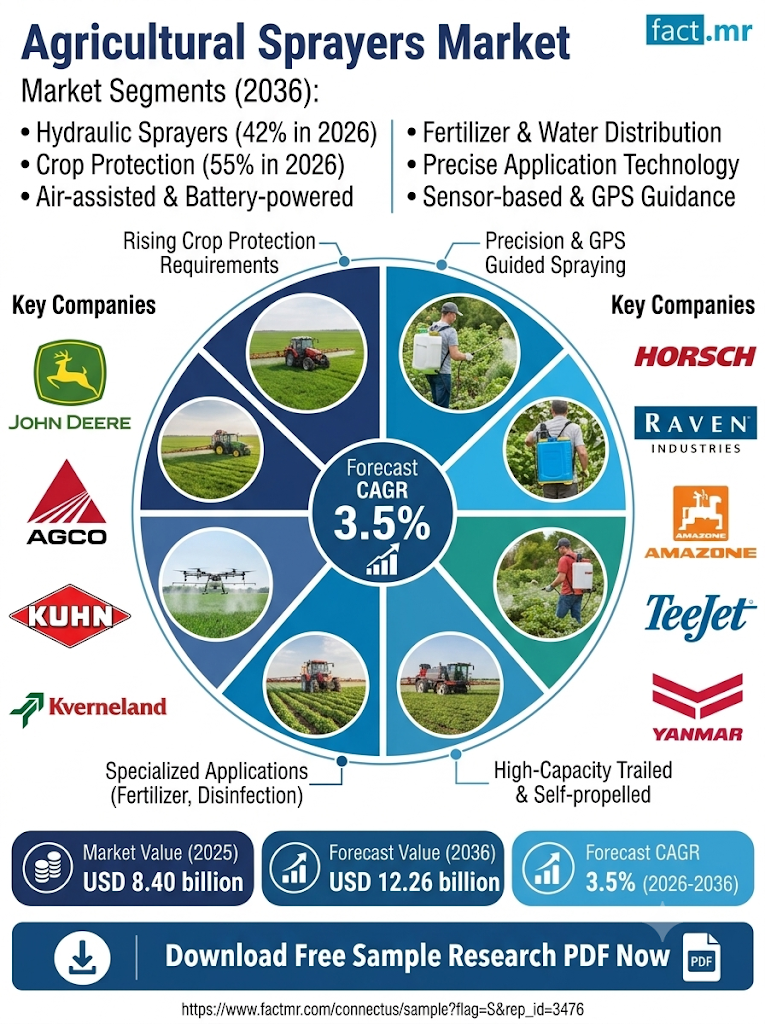
Rockville, MD, November 16, 2026 – The global agricultural sprayers market is projected to increase from US$ 8.69 billion in 2026 to US$ 12.26 billion by 2036, expanding at a compound annual growth rate (CAGR) of 3.5% during the forecast period, according to Fact.MR. The market was valued at US$ 8.40 billion in 2025 and is expected to generate an absolute dollar opportunity of US$ 3.57 billion between 2026 and 2036. Growing crop protection requirements, increasing farm mechanization across developing economies, and regulatory pressure to improve spraying accuracy are supporting demand for agricultural spraying equipment.
Get detailed market forecasts, competitive benchmarking, and pricing trends: https://www.factmr.com/connectus/sample?flag=S&rep_id=3476
Agricultural sprayers are equipment systems used to distribute crop protection chemicals, liquid fertilizers, growth regulators, and water across agricultural fields, orchards, vineyards, and plantations. Their applications are expanding beyond conventional pesticide spraying as farmers and agricultural service providers adopt equipment suited to more specialized operations. According to Fact.MR, hydraulic sprayers will account for 42% of the product segment in 2026, while crop protection will represent 55% of application demand.
Agricultural Sprayers Market Gains Support from Precision Farming Requirements
The agricultural sprayers market is experiencing changing procurement priorities as agricultural operations place greater emphasis on application accuracy and equipment efficiency. Regulatory pressure to reduce spray drift is encouraging the adoption of precision spraying systems equipped with GPS guidance, variable-rate application, and sensor-based targeting.
Farm mechanization is another important demand contributor. Developing economies across Asia, Latin America, and Africa are experiencing higher crop protection intensity alongside a gradual transition from manual operations to motorized equipment. These developments are creating demand across different price categories, particularly among smallholder and semi-commercial farmers.
The equipment is also finding applications in fertilizer distribution, irrigation and water spraying, disinfection, and public health programs. This wider application base is extending the addressable market beyond traditional crop protection activities.
However, affordability remains a constraint. Fact.MR identifies price sensitivity among smallholder farmers, seasonal procurement patterns, and fragmented rural distribution networks as factors that can restrict equipment adoption.
Hydraulic Sprayers Maintain Their Leading Market Position
Hydraulic sprayers are projected to hold 42% of the product segment in 2026. Their established use in mainstream agricultural applications, broad availability, and relatively cost-efficient operation support their leading position.
These systems are widely used for crop protection and fertilizer application. Buyers continue to consider reliability and operating costs when selecting equipment, supporting demand for conventional hydraulic configurations across new installations and replacement purchases.
Air-assisted sprayers represent a faster-growing product category. Their increasing relevance in specialized agricultural applications is expected to support a gradual expansion in market share. Battery-powered sprayers are also attracting attention, particularly among farmers transitioning from manual equipment to motorized alternatives.
Fact.MR identifies battery-powered knapsack and portable sprayers as an emerging opportunity. These products offer improvements in spray coverage, operator comfort, and application uniformity compared with hand-operated alternatives. Lower operating costs, reduced maintenance requirements, and quieter operation are additional factors supporting interest in electric-powered equipment.
Crop Protection Accounts for 55% of Application Demand
Crop protection is expected to represent 55% of the agricultural sprayers market by application in 2026. Demand from commercial and institutional buyers requiring consistent spraying operations supports the segment's leading position.
Fertilizer application remains another important category. Agricultural sprayers are increasingly used to distribute liquid fertilizers, micronutrients, and plant growth enhancers. Irrigation and water spraying, farm disinfection, equipment sanitization, and vector-control activities also contribute to overall equipment demand.
United States Leads Country-Level Growth
The United States is projected to register a CAGR of 4.1% through 2036, making it the fastest-growing country among those covered in Fact.MR's country-level comparison. A large installed equipment base, established distribution channels, and replacement demand support this outlook.
Mexico follows with projected growth of 3.8% during the forecast period. Industrial expansion, proximity to North American supply chains, and increasing domestic equipment demand contribute to its market prospects.
Germany is expected to expand at 3.5%, while France is projected to record a CAGR of 3.4%. The United Kingdom and South Korea are forecast to grow at 3.2% and 3.1%, respectively. Japan is expected to register a 3% CAGR through 2036.
North America currently remains the largest regional market, supported by established agricultural end-use industries and distribution infrastructure. Asia Pacific presents additional growth opportunities as farm mechanization and equipment accessibility expand.
Manufacturers Focus on Precision Technology and Equipment Capacity
Competition in the agricultural sprayers market includes established equipment manufacturers and specialized technology providers. Key companies identified by Fact.MR include John Deere, AGCO (Hardi and Fendt lines), Kuhn, Kverneland, Horsch, Raven Industries, Amazone, TeeJet, CropCare, and Yanmar.
Recent product developments illustrate the industry's movement toward higher-capacity and precision-oriented equipment. John Deere announced its See & Spray Gen 2 platform on January 22, 2026, expanding compatible crop coverage to wheat, barley, canola, peanuts, and sugar beets, alongside existing coverage for corn, soybeans, and cotton.
The platform also introduced variable-rate application and enhanced real-time weed detection capabilities.
Hardi introduced its Arex self-propelled sprayer at Agritechnica in November 2025, with tank capacities of 5,000 and 6,000 litres. Kuhn revealed its Karan high-capacity trailed sprayer range in 2025, offering tank capacities between 4,500 and 8,000 litres.
These developments highlight the importance of application technology and equipment capacity in product competition.
Analyst Perspective
Shambhu Nath Jha, Principal Consultant at Fact.MR, said, "The agricultural sprayers market is structurally underpinned by the non-discretionary nature of crop protection, which ensures baseline demand regardless of economic cycles."
He also highlighted an opportunity that equipment manufacturers may overlook. "The aftermarket for nozzles, pumps, and replacement parts is an underappreciated margin contributor that deserves more strategic attention from equipment companies focused primarily on new unit sales."
About Fact.MR
Fact.MR is a market research and consulting firm providing market intelligence, industry analysis, and strategic insights across various sectors. The company uses primary research, secondary research, and proprietary forecasting models to assess market size, competitive positioning, industry trends, and future growth opportunities.

 English
 Arabic
 French
 Spanish
 Deutsch
 Turkish
 Dutch
 Italiano
 Russian
 Romaian
 Portuguese (Brazil)
 Greek
