


Changing Drinking Habits and Premium Product Innovation Boost Non-Alcoholic Beer Market
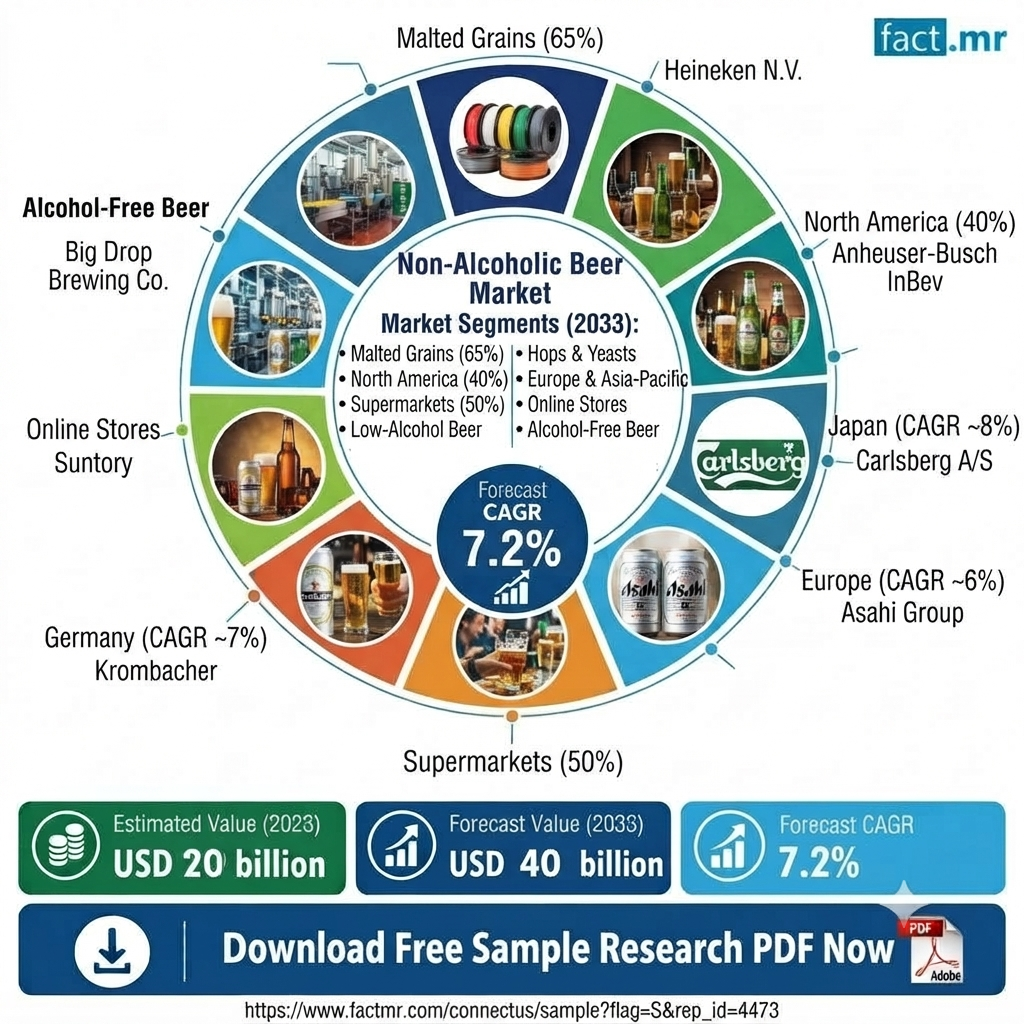
Rockville, MD, November 13, 2026 – The global non-alcoholic beer market is projected to increase from USD 20 billion in 2023 to USD 40 billion by 2033, registering a compound annual growth rate (CAGR) of 7.2% during the forecast period, according to Fact.MR. Market expansion is being supported by rising health consciousness, changing attitudes toward alcohol consumption, and growing consumer preference for beverages with reduced or no alcohol content. Increasing demand from millennials, wider availability of alcohol-free beer across retail and hospitality channels, and improvements in brewing and dealcoholization technologies are further supporting market growth.
Malted grains are estimated to account for approximately 65% of the material segment, supported by their role in starch conversion, fermentation, and flavor development. Supermarkets represent around 50% of total market value, reflecting their extensive product selections and availability of multiple brands. North America holds approximately 40% of the global market, supported by growing consumer interest in low-alcohol beverages and frequent product introductions. Japan is projected to register a CAGR of approximately 8% during the forecast period, driven by changing drinking preferences and increasing demand for healthier beverage alternatives.
Request a FREE Sample Report: https://www.factmr.com/connectus/sample?flag=S&rep_id=4473
Rising Health Consciousness Strengthens Demand for Non-Alcoholic Beer
Growing awareness of the health risks associated with excessive alcohol consumption is a major factor supporting the global non-alcoholic beer market. Consumers are increasingly exploring alternatives that allow them to participate in traditional social drinking occasions without consuming conventional alcoholic beverages.
Millennials and younger adult consumers are contributing significantly to this shift. Their preference for healthier lifestyles, lower-calorie beverages, and more conscious drinking habits is encouraging manufacturers to expand alcohol-free product portfolios. Improved product quality has also helped address earlier concerns about taste, aroma, and mouthfeel.
Non-alcoholic beer is increasingly positioned as an alternative for consumers seeking to moderate alcohol intake. The availability of different flavors, brewing styles, and specialty formulations is widening its appeal beyond consumers who abstain from alcohol entirely.
Premiumization is another factor supporting market development. Rising disposable incomes and changing consumer expectations are encouraging purchases of higher-quality alcohol-free beverages. Manufacturers are responding through craft-inspired offerings, improved formulations, and differentiated packaging.
Brewing Innovation and Dealcoholization Technologies Drive Market Development
Technological advancements in brewing and dealcoholization are creating new opportunities for non-alcoholic beer producers. Manufacturers are investing in production methods that reduce alcohol content while preserving the characteristic flavor and aroma of conventional beer.
Dealcoholization has become an important manufacturing approach as consumer interest in natural-tasting alcohol-free products increases. Vacuum-based processing and other alcohol-removal techniques allow producers to reduce alcohol levels while limiting the impact on flavor characteristics.
Product innovation is also expanding the range of available offerings. Manufacturers are experimenting with different malt combinations, hops, yeast formulations, and flavor profiles to attract consumers with varied preferences.
The growing popularity of non-alcoholic beer among athletes and health-conscious consumers is creating additional demand opportunities. Some consumers are also exploring alcohol-free malt beverages as alternatives to conventional carbonated drinks.
High Production Costs and Substitute Beverages Create Market Challenges
The availability of substitutes remains a significant challenge for non-alcoholic beer manufacturers. Natural beverages, flavored sparkling water, carbonated soft drinks, and other low-calorie alternatives compete for consumer spending within the broader beverage market.
Production costs also influence market expansion. Maintaining the flavor profile of conventional beer while reducing alcohol content requires specialized equipment, processing technologies, and quality-control procedures. These requirements can increase manufacturing expenses and affect retail pricing.
Smaller producers may face additional challenges in achieving economies of scale and establishing broad distribution networks. Higher product prices could restrict adoption among price-sensitive consumers, particularly in markets where non-alcoholic beer is still developing.
Manufacturers are therefore focusing on production efficiency, improved processing technologies, and broader distribution partnerships to strengthen their competitive positions.
Malted Grains and Supermarkets Maintain Leading Segment Positions
Malted grains are projected to account for approximately 65% of the global non-alcoholic beer market's material segment. Their high enzyme concentration supports starch conversion and fermentation, making them an important ingredient in beer production.
The availability of barley, millet, rice, wheat, and oats provides manufacturers with multiple sourcing options. Malted grains also contribute to sweetness, color, aroma, and other characteristics that influence finished-product quality.
Under the sales channel segment, supermarkets account for approximately 50% of total market value. Their extensive product selections, availability of multiple brands, and promotional activities make them an important purchasing destination for consumers.
Online stores are also gaining relevance as digital retail platforms and social media campaigns improve product visibility. Increasing availability through restaurants, bars, and convenience stores is further expanding consumer access to non-alcoholic beer.
Regional Growth Supported by Changing Beverage Preferences
North America accounts for approximately 40% of the global non-alcoholic beer market. Rising health awareness, growing interest in moderate drinking, and frequent product introductions by established beer manufacturers are supporting regional demand.
Consumers are increasingly seeking beverages with lower alcohol content and reduced calories. Established brewing companies are expanding their alcohol-free portfolios, while specialty producers are introducing differentiated products to attract younger consumers.
Europe remains an important market, supported by its established beer culture, growing popularity of craft beverages, and presence of major non-alcoholic beer manufacturers. Germany represents a significant opportunity as consumers increasingly explore specialty and craft-style alcohol-free products.
Asia Pacific is expected to offer attractive growth opportunities, with Japan projected to register a CAGR of approximately 8% through 2033. Growing interest in lighter beer varieties, changing consumer lifestyles, and the availability of diverse flavor profiles are supporting demand.
Country-wise Growth Outlook
Japan is projected to expand at a CAGR of approximately 8% through 2033. Increasing consumer preference for less-strong beer, rising health awareness, and demand for beverages with distinctive flavors are supporting market development. The country's established beverage manufacturing ecosystem also provides opportunities for producers to introduce innovative alcohol-free formulations.
Germany's market is benefiting from its longstanding beer-drinking culture and growing popularity of craft and specialty beverages. Increasing awareness of alcohol-related health concerns and the presence of established brewing companies are encouraging manufacturers to strengthen their non-alcoholic product portfolios.
The United States is witnessing a shift toward non-alcoholic beverages, supported by growing interest in moderation and the increasing availability of alcohol-free alternatives. The expansion of businesses offering mocktails and non-alcoholic cocktails reflects changing consumer preferences and creates opportunities for related beverage categories.
Competitive Landscape Focuses on Product Innovation and Brand Development
The global non-alcoholic beer market includes established brewing companies and emerging specialty beverage manufacturers. Key companies profiled include Heineken N.V., Suntory, Bernard Brewery, Moscow Brewing Company, Big Drop Brewing Co., Anheuser-Busch InBev, Krombacher Brauerei, Erdinger Weißbräu, Carlsberg A/S, and Arpanoosh Co.
Market participants are focusing on product development, flavor innovation, promotional campaigns, and distribution expansion to strengthen their market positions. Established manufacturers are incorporating alcohol-free malt beverages into their portfolios to address changing consumer preferences and reach new customer groups.
Start-ups are contributing through specialized product formulations and experimentation with ingredients, flavors, and brewing techniques. Outbound Brewing, a U.S.-based start-up, offers conventional and hemp-infused non-alcoholic beer products, reflecting the growing interest in differentiated alcohol-free beverages.
In 2021, UNLTD IPA introduced an alcohol-free beer containing 13 calories per bottle. The product is also vegan-friendly and gluten-free, illustrating how manufacturers are targeting consumers seeking specific dietary and lifestyle attributes.
Brand recognition remains an important competitive factor. Companies are investing in promotional activities, digital marketing, and social media campaigns to improve product awareness and encourage trial purchases. Partnerships with supermarkets, restaurants, and hospitality businesses are also helping manufacturers expand distribution.
Shambhu Nath Jha, Principal Consultant at Fact.MR, commented, "The non-alcoholic beer market is benefiting from a broader shift in consumer drinking habits, with health awareness and moderation becoming increasingly important purchasing considerations. Improvements in dealcoholization and brewing technologies are helping manufacturers deliver products that more closely match the taste expectations of conventional beer consumers. Companies that combine product quality with distinctive flavor development and wider retail availability are positioned to strengthen their presence as demand for alcohol-free beverages expands."
Fact.MR's Non-Alcoholic Beer Market Forecast
Fact.MR's assessment examines the global non-alcoholic beer market across product types, materials, sales channels, and geographic regions.
The product assessment covers alcohol-free and low-alcohol beer. The material analysis includes malted grains, hops, yeasts, enzymes, and other ingredients. The sales channel evaluation examines convenience stores, liquor stores, supermarkets, restaurants and bars, and online stores.
The regional assessment covers North America, Europe, Asia Pacific, Latin America, and the Middle East and Africa. The study also evaluates changing consumer preferences, production technologies, product innovation, competitive positioning, and emerging opportunities through 2033.
The findings provide manufacturers, investors, distributors, and other industry participants with insights into evolving beverage consumption patterns, the growing demand for alcohol-free alternatives, and the competitive outlook for the global non-alcoholic beer industry.
Fact.MR is a market research and consulting firm that provides industry intelligence, market forecasts, and strategic analysis to businesses across global markets. Its research combines primary interviews, secondary sources, and proprietary forecasting methodologies.

 English
 Arabic
 French
 Spanish
 Portuguese
 Deutsch
 Turkish
 Dutch
 Italiano
 Russian
 Romaian
 Greek
