


Laser Hair Removal: Treatment, Benefits, Cost, and Results
Introduction
Unwanted hair is a common concern for people who want smooth, clear, and well-maintained skin. Traditional hair removal techniques, including shaving, waxing, threading, and depilatory creams, can help remove unwanted hair temporarily. However, these methods require frequent repetition and may cause irritation, razor bumps, ingrown hairs, and skin discomfort.
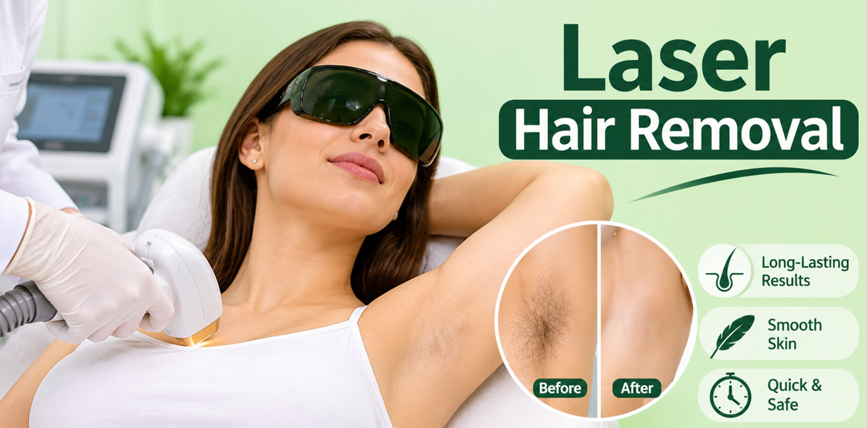
Laser hair removal is an advanced cosmetic treatment designed to reduce unwanted hair growth for an extended period. It uses concentrated light energy to target hair follicles and damage the structures responsible for hair production. With multiple treatment sessions, patients can achieve a noticeable reduction in hair thickness, density, and regrowth.
Today, laser hair removal is widely used by both men and women to treat unwanted facial and body hair. It can be performed on areas such as the upper lip, chin, underarms, arms, legs, chest, back, shoulders, and bikini line.
Modern laser technologies have also improved treatment options for individuals with different skin tones and hair characteristics. However, selecting the appropriate laser system and treatment settings is essential for achieving safe and effective results.
This article explores laser hair removal in detail, including its working mechanism, different technologies, benefits, treatment procedure, preparation, aftercare, possible side effects, costs, and frequently asked questions.
What Is Laser Hair Removal?
Laser hair removal is a non-invasive cosmetic procedure that uses concentrated beams of light to reduce unwanted hair. During treatment, laser energy passes through the skin and is absorbed by melanin, the natural pigment found in hair.
The absorbed energy produces heat, which damages the hair follicle and reduces its ability to generate new hair.
Unlike shaving, which cuts hair at the skin's surface, or waxing, which temporarily removes hair from the root, laser treatment targets the follicle responsible for hair growth.
The procedure can be customized according to the patient's skin tone, hair color, hair thickness, and treatment area.
Although commonly called permanent hair removal, the procedure is more accurately described as long-term or permanent hair reduction. Some treated hair follicles may recover, and new hair growth can occur due to hormonal changes or other factors.
How Does Laser Hair Removal Work?
Laser hair removal works through a scientific process called selective photothermolysis. This process uses specific wavelengths of light to target melanin in hair follicles while minimizing damage to surrounding skin.
The treatment generally involves five stages:
-
Laser energy delivery: A specialized device emits concentrated light pulses toward the treatment area.
-
Melanin absorption: The pigment within the hair absorbs the laser energy.
-
Heat generation: Absorbed light energy is converted into heat.
-
Follicle damage: The heat damages structures within the hair follicle responsible for producing hair.
-
Reduced regrowth: Following repeated treatments, hair becomes thinner, lighter, and less dense.
Hair grows in different stages, including anagen (active growth), catagen (transition), and telogen (resting). Laser treatment works most effectively when hair is in the active growth stage.
Because not every hair follicle is active at the same time, several sessions are necessary to achieve satisfactory results.
Types of Laser Hair Removal
Different laser technologies are available for reducing unwanted hair. Each technology has unique characteristics and is selected according to skin type, hair characteristics, and treatment requirements.
1. Diode Laser Hair Removal
Diode laser technology is one of the commonly used systems for hair reduction. It typically operates at wavelengths around 800–810 nm and targets melanin within hair follicles.
Advantages:
-
Effective for many individuals with dark, coarse hair.
-
Can be used on several body areas.
-
Suitable for a range of skin tones with appropriate settings.
-
Often incorporates integrated cooling systems.
-
Offers customizable treatment parameters.
2. Alexandrite Laser Hair Removal
The Alexandrite laser operates at approximately 755 nm. It is particularly effective for treating dark hair in individuals with lighter skin tones.
Advantages:
-
Effective for reducing pigmented hair.
-
Suitable for treating large body areas.
-
Provides relatively fast treatment.
-
Can deliver noticeable results over multiple sessions.
Because it is more readily absorbed by epidermal melanin, extra caution is necessary when treating darker skin tones.
3. Nd Laser Hair Removal
The Nd laser operates at a wavelength of approximately 1064 nm. Its longer wavelength allows deeper penetration and lower absorption by epidermal melanin compared with shorter-wavelength lasers.
Advantages:
-
Often preferred for darker skin tones.
-
Can target deeper hair follicles.
-
Suitable for different body areas.
-
Can reduce the risk of epidermal injury when correctly selected and operated.
4. Intense Pulsed Light (IPL)
IPL is another technology used for reducing unwanted hair. However, it is not technically a laser because it uses broad-spectrum light rather than a single specific wavelength.
IPL can provide hair reduction in suitable candidates, but results depend on the device, skin tone, hair color, and treatment settings.
A professional consultation helps determine which technology is most appropriate.
Areas That Can Be Treated With Laser Hair Removal
Laser hair removal can treat unwanted hair on numerous areas of the body.
Facial Hair
Facial laser hair removal is commonly performed on the:
-
Upper lip.
-
Chin.
-
Cheeks.
-
Sideburns.
-
Jawline.
-
Neck.
Facial treatment requires careful planning because the skin is often sensitive and certain areas are close to the eyes.
Underarms
Underarm laser hair removal is popular among people who want to reduce frequent shaving and waxing. It may also help minimize shaving-related irritation and ingrown hairs.
Arms
Laser treatment can reduce unwanted hair on the upper arms, forearms, and full arms.
Legs
Both full legs and smaller areas can be treated. Many people choose this option to reduce the need for regular shaving.
Bikini Area
Laser hair removal can reduce unwanted hair along the bikini line and selected external intimate areas. Treatment boundaries should be discussed before the procedure.
Chest and Abdomen
Men and women may choose treatment to reduce unwanted hair on the chest and abdomen.
Back and Shoulders
Laser treatment can help reduce thick or dense hair on the back, shoulders, and upper body.
Top Benefits of Laser Hair Removal
Laser hair removal offers several advantages over conventional hair removal techniques.
1. Long-Lasting Hair Reduction
One of the most important advantages is the ability to reduce unwanted hair for an extended period. After completing an appropriate treatment course, many individuals experience significantly less hair growth.
2. Smoother Skin Texture
Repeated shaving and waxing can cause roughness, irritation, and visible bumps. Reducing hair growth may help the skin feel smoother.
3. Fewer Ingrown Hairs
Laser hair reduction can help individuals who frequently experience ingrown hairs, particularly those with thick or curly hair.
4. Reduced Shaving Requirements
After completing multiple sessions, many people find that they need to shave less frequently.
5. Convenient Treatment
Laser technology can treat relatively large areas of the body during a single appointment, making it a convenient option for people with extensive unwanted hair.
6. Improved Skin Appearance
Reducing shaving-related bumps and irritation may improve the overall appearance of treated skin.
7. Customizable for Different Body Areas
Laser settings can be adjusted according to the treatment area, skin tone, hair density, and individual response.
8. Less Dependence on Waxing
People who regularly spend time and money on waxing may benefit from long-term hair reduction.
Who Is a Suitable Candidate for Laser Hair Removal?
Laser hair removal may be appropriate for adults who want to reduce unwanted hair on their face or body.
Historically, people with light skin and dark hair have responded particularly well because the difference in pigmentation makes it easier to target the hair.
Modern laser systems, including Nd and diode technologies, have expanded treatment options for people with darker skin tones.
Suitable candidates generally:
-
Have unwanted facial or body hair.
-
Want long-term hair reduction.
-
Have realistic expectations.
-
Can attend multiple treatment sessions.
-
Are willing to follow preparation and aftercare instructions.
-
Do not have an active infection in the treatment area.
People with white, grey, very blonde, or red hair may not respond well to conventional laser hair removal because these hair colors contain less of the pigment targeted by most laser systems.
A professional evaluation is recommended before beginning treatment.
Who Should Avoid Laser Hair Removal?
Although laser hair removal is generally safe when properly performed, some individuals may need to postpone treatment or undergo additional evaluation.
Treatment may be unsuitable or require extra caution in people with:
-
Active skin infections.
-
Open wounds or severe irritation.
-
Recent sunburn or tanning.
-
Certain photosensitizing medications.
-
Specific skin conditions.
-
A history of abnormal scarring.
-
Certain pigment-related disorders.
Elective laser hair removal is generally postponed during pregnancy because adequate safety evidence is unavailable.
Patients should disclose their medical history, current medications, and previous skin reactions during the consultation.
How to Prepare for Laser Hair Removal
Preparation is important for reducing complications and improving treatment outcomes.
Avoid Sun Exposure
Avoid tanning and excessive sun exposure before your appointment. Tanned skin may increase the risk of burns and pigmentation changes.
Apply broad-spectrum sunscreen to exposed treatment areas.
Avoid Waxing and Plucking
Stop waxing, threading, and plucking for several weeks before treatment, according to your practitioner's instructions.
These techniques remove the hair root, which is needed for laser targeting.
Shave Before Treatment
Shaving is generally recommended approximately 12–24 hours before the appointment.
This removes visible hair above the skin while leaving the follicle intact.
Avoid Irritating Skincare Products
Your practitioner may advise temporarily stopping retinoids, exfoliating acids, and other irritating products around the treatment area.
Discuss Medications
Inform your practitioner about prescription medicines, over-the-counter products, and supplements that you use.
Some medications can increase sensitivity to light.
Attend a Consultation
A professional consultation allows the practitioner to evaluate your skin tone, hair type, medical history, and treatment goals.
A patch test may also be recommended.
Step-by-Step Laser Hair Removal Procedure
Laser hair removal is generally performed as an outpatient cosmetic treatment. The procedure is relatively straightforward and usually does not require significant recovery time.
Step 1: Skin and Hair Assessment
The practitioner examines the treatment area and evaluates the patient's skin tone, hair color, hair density, and medical history.
Step 2: Cleaning the Skin
The area is cleaned to remove makeup, deodorant, lotions, oils, and other products.
Step 3: Protective Eyewear
Both the patient and practitioner wear appropriate protective eyewear to prevent potential eye damage.
Step 4: Laser Application
The practitioner applies the laser handpiece to the treatment area and delivers controlled light pulses.
Patients may experience a snapping or tingling sensation.
Step 5: Cooling
Cooling systems, gels, or other appropriate methods may be used to improve comfort and protect the skin.
Step 6: Post-Treatment Care
The practitioner examines the treated area and provides instructions regarding skincare, sun protection, and the next appointment.
Most patients can resume normal activities immediately.
How Many Sessions Are Needed?
Laser hair removal requires several sessions because hair follicles are not all active at the same time.
Many people need approximately 6–8 sessions, although the number can vary.
Factors influencing the number of sessions include:
-
Hair thickness.
-
Hair color.
-
Skin tone.
-
Treatment area.
-
Hormonal activity.
-
Laser technology.
-
Individual response to treatment.
Appointments are commonly scheduled several weeks apart. Facial areas may require different intervals from larger body areas.
Maintenance sessions may be recommended after completing the initial course.
How Long Does a Laser Hair Removal Session Take?
Treatment time depends on the size of the selected area and the equipment being used.
| Treatment Area | Estimated Time |
|---|---|
| Upper lip | 5–10 minutes |
| Chin | 5–15 minutes |
| Underarms | 10–20 minutes |
| Bikini line | 15–30 minutes |
| Full face | 15–30 minutes |
| Arms | 20–40 minutes |
| Half legs | 20–40 minutes |
| Full legs | 45–90 minutes |
| Chest | 20–40 minutes |
| Back | 30–60 minutes |
These durations are approximate and may vary between clinics.
Does Laser Hair Removal Hurt?
The level of discomfort depends on individual pain tolerance, hair thickness, treatment area, and laser settings.
Most patients describe the sensation as a brief snapping or rubber-band-like feeling.
Areas with thicker hair or greater sensitivity may feel more uncomfortable.
Modern laser systems often include cooling mechanisms that help minimize discomfort.
Patients should inform their practitioner if they experience excessive pain during treatment.
When Will You See Results?
Results develop gradually rather than immediately.
Treated hair typically sheds over approximately one to three weeks after the session.
Some individuals notice reduced hair growth following the first treatment, while others require several appointments before experiencing significant changes.
With repeated sessions, the hair generally becomes:
-
Finer.
-
Lighter.
-
Less dense.
-
Slower growing.
The final outcome depends on individual hair characteristics, hormonal influences, and treatment consistency.
Is Laser Hair Removal Permanent?
Laser hair removal can produce long-lasting reductions in unwanted hair, but it does not guarantee the complete and permanent removal of every follicle.
Some follicles may recover over time, and hormonal changes can stimulate additional hair growth.
This is why occasional maintenance treatments may be required.
The most accurate description of the procedure is long-term hair reduction rather than guaranteed permanent hair removal.
Side Effects of Laser Hair Removal
Laser hair removal is generally well tolerated, but temporary side effects can occur.
Redness and Swelling
Mild redness and swelling around treated follicles are common. These effects generally improve within hours or a few days.
Temporary Skin Irritation
Some patients experience itching, tenderness, or mild discomfort.
Pigmentation Changes
The skin may temporarily become lighter or darker following treatment. This risk increases when unsuitable settings are used or the skin is recently tanned.
Burns and Blisters
Improper technique or excessive laser energy can cause burns and blisters.
Scarring
Scarring is uncommon but may occur following significant skin injury.
Eye Injury
Direct exposure to laser light can damage the eyes. Appropriate protective eyewear is essential.
Paradoxical Hair Growth
Rarely, laser treatment can stimulate increased hair growth in or around the treated area, particularly on the face and neck.
Choosing a qualified practitioner and appropriate laser equipment helps reduce the risk of complications.
Aftercare Tips Following Laser Hair Removal
Proper aftercare helps the skin recover and reduces the possibility of irritation.
-
Use sunscreen: Apply broad-spectrum SPF 30 or higher to exposed treated areas.
-
Avoid excessive heat: Avoid hot showers, saunas, and steam rooms for approximately 24–48 hours if advised.
-
Avoid exfoliation: Do not scrub or aggressively exfoliate the treated area immediately after treatment.
-
Wear loose clothing: Reduce friction around sensitive treatment areas.
-
Use gentle moisturizers: Choose mild, fragrance-free skincare products if recommended.
-
Avoid waxing: Do not wax, thread, or pluck between laser sessions.
-
Avoid scratching: Do not pick at or scratch irritated skin.
-
Follow professional advice: Contact your practitioner if you develop severe pain, blisters, or worsening skin reactions.
Laser Hair Removal vs. Shaving vs. Waxing
People often compare laser hair removal with shaving and waxing when deciding which method is best.
| Comparison | Laser Hair Removal | Shaving | Waxing |
|---|---|---|---|
| Duration of results | Long-term reduction | Short-term | Several weeks |
| Pain | Mild to moderate | Usually minimal | Moderate to high |
| Ingrown hair risk | May reduce it | Possible | Possible |
| Maintenance | Occasional sessions | Frequent | Regular appointments |
| Initial expense | Higher | Low | Moderate |
| Hair regrowth | Often finer and slower | Usually unchanged | Usually unchanged |
| Long-term convenience | High for suitable candidates | Lower | Moderate |
Laser treatment has a higher initial cost but may reduce the need for frequent hair removal over time.
Laser Hair Removal Cost
The cost of laser hair removal varies according to the treatment area, technology, clinic location, and number of sessions.
Smaller areas, such as the upper lip and chin, generally cost less than full legs, chest, or back treatments.
Important factors affecting treatment prices include:
-
Size of the treatment area.
-
Number of sessions.
-
Type of laser device.
-
Hair thickness and density.
-
Practitioner experience.
-
Clinic facilities.
-
Availability of package discounts.
-
Maintenance requirements.
Before booking, ask the clinic for a detailed price breakdown. Confirm whether the quoted price covers one session or a complete treatment package.
Laser Hair Removal for Men
Laser hair removal is not limited to women. Many men choose this procedure to reduce thick and unwanted body hair.
Common treatment areas include:
-
Chest.
-
Back.
-
Shoulders.
-
Abdomen.
-
Arms.
-
Legs.
-
Neck.
-
Beard line.
Because men's hair can be thicker and denser, treatment may require customized settings and additional sessions.
The procedure can also help reduce recurring ingrown hairs and shaving-related irritation.
Laser Hair Removal for Women
Women frequently choose laser hair removal for unwanted facial and body hair.
Popular areas include the upper lip, chin, sideburns, underarms, arms, legs, and bikini line.
Women experiencing excessive facial hair or unusual hair growth may benefit from a medical evaluation to investigate possible hormonal causes.
Laser treatment can reduce existing unwanted hair, but it does not correct an underlying hormonal imbalance.
Laser Hair Removal for Different Skin Types
Laser hair removal can be performed on different skin tones, provided the technology and settings are selected appropriately.
Light skin: Alexandrite and diode lasers may provide effective results for dark hair.
Medium skin: Diode and other suitable laser systems can be considered following an assessment.
Dark skin: Nd laser technology is often preferred because its longer wavelength is less readily absorbed by epidermal melanin.
Regardless of skin tone, proper cooling, professional experience, and careful treatment settings are important.
Common Myths About Laser Hair Removal
Myth 1: Laser Hair Removal Removes Every Hair Forever
Fact: It provides long-term hair reduction, but some hair may regrow and maintenance sessions may be necessary.
Myth 2: Laser Treatment Is Only for Women
Fact: Men and women can both benefit from laser hair reduction.
Myth 3: One Session Is Enough
Fact: Several sessions are generally required because hair follicles grow in different cycles.
Myth 4: Dark Skin Cannot Be Treated
Fact: Suitable laser systems, including Nd lasers, can treat darker skin tones when operated correctly.
Myth 5: Laser Hair Removal Causes Cancer
Fact: Hair removal lasers use non-ionizing light, unlike ionizing radiation such as X-rays. There is no established evidence that properly performed laser hair removal causes cancer.
Myth 6: Laser Hair Removal Always Damages Skin
Fact: Most side effects are temporary. However, burns, pigmentation changes, and other complications are possible.
Myth 7: All Hair Colors Respond Equally
Fact: Conventional laser hair removal works best on pigmented hair. White, grey, blonde, and red hair may respond poorly.
Frequently Asked Questions About Laser Hair Removal
1. What is the main purpose of laser hair removal?
Its main purpose is to reduce unwanted hair growth by targeting and damaging hair follicles using concentrated light energy.
2. How many sessions are required?
Most individuals require approximately 6–8 sessions, although some may need additional treatments.
3. Is laser hair removal safe?
It is generally safe when performed by trained professionals using suitable equipment and settings. Temporary irritation and pigmentation changes are possible.
4. Can laser hair removal treat facial hair?
Yes. It can be used on the upper lip, chin, cheeks, sideburns, and other selected facial areas.
5. Can I shave after laser hair removal?
Shaving is generally acceptable once the skin is comfortable. Follow your practitioner's instructions.
6. Does laser hair removal cause dark spots?
Temporary pigmentation changes can occur, especially following sun exposure or inappropriate laser settings.
7. Can people with sensitive skin undergo treatment?
Yes, some people with sensitive skin may be suitable candidates. However, they require an individual assessment and carefully selected settings.
8. Does laser hair removal help with ingrown hairs?
Yes. By reducing hair growth, laser treatment may decrease recurring ingrown hairs.
9. Is the procedure suitable for men?
Yes. Men commonly undergo laser hair removal on the chest, back, shoulders, abdomen, neck, and beard line.
10. How long do results last?
Results can last for years, although some hair may regrow and occasional maintenance sessions may be required.
11. Can I undergo laser treatment in summer?
Yes, but careful sun protection is essential. Treatment may need to be postponed if the skin is recently tanned or sunburned.
12. Is laser hair removal safe during pregnancy?
Elective laser hair removal is generally postponed during pregnancy because there is insufficient safety evidence.
13. Does laser hair removal cause infertility?
There is no established evidence that properly performed laser hair removal causes infertility. The treatment targets hair follicles within the skin.
14. Can laser treatment remove white or grey hair?
Conventional laser hair removal is generally ineffective on white and grey hair because these hairs contain little or no melanin.
15. Is laser hair removal worth the cost?
For individuals who regularly shave or wax, laser treatment may be a worthwhile investment because it can substantially reduce unwanted hair growth and maintenance requirements.
Conclusion
Laser hair removal is a popular cosmetic procedure for people seeking smoother skin and long-term reduction of unwanted facial and body hair. By targeting melanin within hair follicles, it helps reduce hair density, thickness, and regrowth over multiple treatment sessions.
The procedure offers several advantages, including fewer ingrown hairs, reduced shaving requirements, improved skin comfort, and long-lasting results. Modern laser technologies also provide treatment options for different skin tones and hair characteristics.
However, successful treatment depends on choosing appropriate technology, consulting an experienced practitioner, completing the recommended sessions, and following proper aftercare instructions.
Anyone considering laser hair removal should begin with a professional consultation to determine the most suitable treatment approach for their individual skin and hair type.

 English
 Arabic
 French
 Spanish
 Portuguese
 Turkish
 Dutch
 Italiano
 Russian
 Romaian
 Portuguese (Brazil)
 Greek
