


Surfboard Market Projected to Reach USD 9.02 Billion by 2033
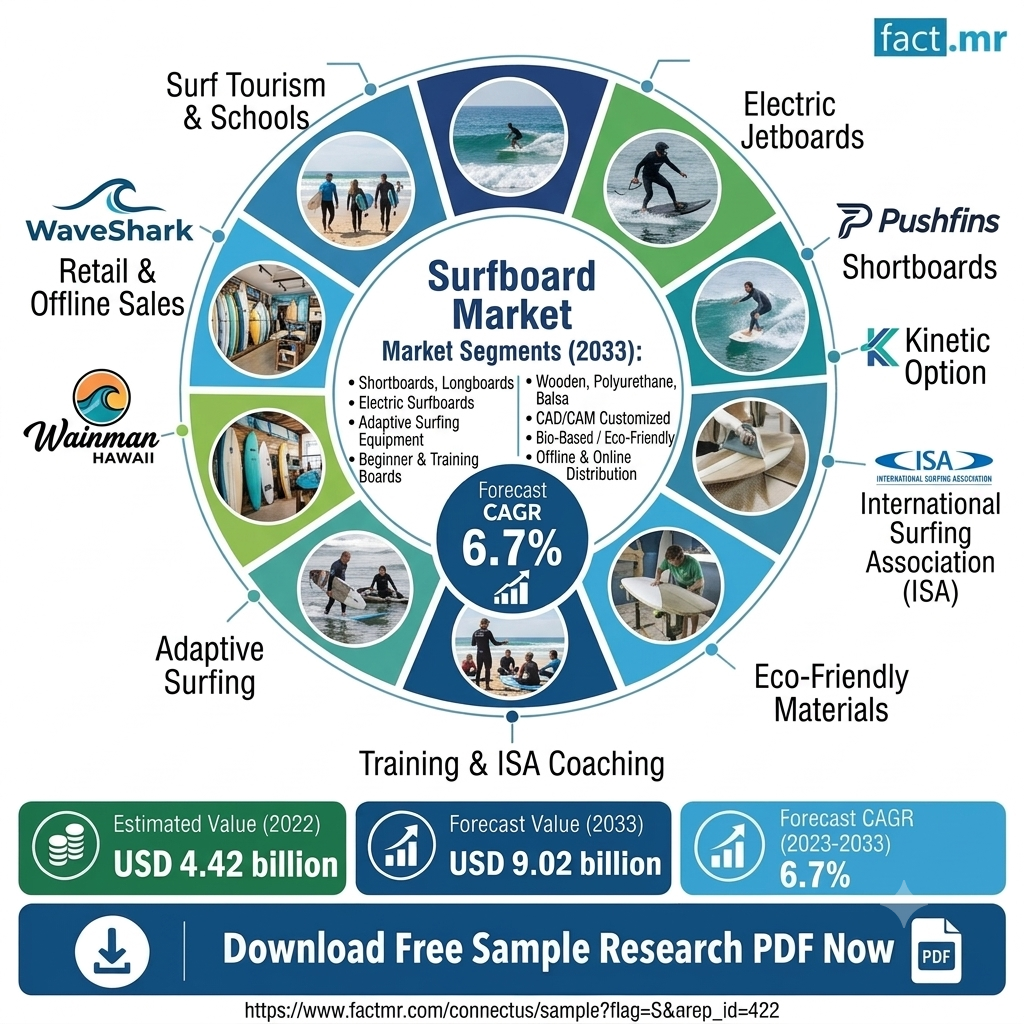
The global surfboard market is projected to reach USD 9.02 billion by 2033, expanding at a compound annual growth rate (CAGR) of 6.7% from 2023, according to Fact.MR. The market was valued at USD 4.42 billion in 2022 and is expected to reach USD 4.71 billion in 2023. Growing surf tourism, increased participation in recreational water sports, and technological developments in board manufacturing are among the factors supporting this market outlook.
Demand is also being shaped by changing consumer preferences. Electric surfboards, adaptive surfing equipment, and environmentally conscious manufacturing practices are creating additional product opportunities. North America accounted for more than 48% of the global surfboard market in 2022, while the region is projected to expand at a CAGR of 6.6% through 2033. These figures highlight the importance of established surfing destinations and expanding recreational participation.
Request a FREE Sample Report : https://www.factmr.com/connectus/sample?flag=S&rep_id=422
Surfboard Market Growth Supported by Tourism and Product Innovation
Surf tourism remains a major demand driver. International travel involving coastal recreation has encouraged interest in surfing, while the expansion of surf schools is introducing the activity to new participants. Fact.MR identifies growing participation in adventure activities and the increasing acceptance of surfing as a lifestyle sport among different age groups as important contributors to market demand.
The industry is changing at the product level, too. Electric surfboards are attracting attention because their propulsion systems allow users to ride without depending on natural waves. These products provide powered movement and greater accessibility to locations where conventional surfing conditions may be unavailable.
Manufacturers are also exploring sustainable materials. According to the Fact.MR analysis, companies are introducing surfboards made with eco-friendly materials to reduce the carbon footprint associated with production. Computer-aided design and computer-aided manufacturing (CAD/CAM) systems are helping manufacturers develop customized boards according to individual specifications.
[LINK: Surfboard Market report]
Surfing Education Creates a Wider Customer Base
Training programs are helping bring more participants into the sport. The International Surfing Association (ISA), the global governing authority for surfing and several other wave-riding disciplines, has introduced educational courses to improve coaching standards and support participation.
The figures offer a closer look at this development. In 2021, approximately 3,000 surfing and stand-up paddleboarding instructors received certification through 150 ISA-certified educational courses conducted across nearly 75 countries. The ISA has certified more than 10,500 coaches and instructors globally.
These programs provide structured instruction and support consistent safety practices. Their expansion can also create demand for beginner-friendly equipment, training boards, and specialized products used by surfing schools.
[LINK: International Surfing Association]
North America and Europe Remain Important Regional Markets
North America held more than 48% of the global surfboard market in 2022, according to Fact.MR. The region is forecast to register a CAGR of 6.6% between 2023 and 2033. Extensive coastlines across the United States and Canada, established surfing communities, and strong recreational water-sports participation support its market position.
The United States represents the largest national surfing market in the region. Its extensive coastline and established beach destinations provide opportunities for equipment manufacturers and independent sports retailers.
Europe is another important market. Fact.MR projects the regional surfboard market to expand at a CAGR of 6.5% during the forecast period. France is a prominent surfing destination, with approximately 650,000 surfers recorded in a 2021 poll cited in the analysis. Tourism activity, disposable income, and interest in established surfing brands contribute to regional demand.
Across other regions, Fact.MR projects Asia Pacific to grow at 6.0% CAGR, Latin America at 6.3%, and the Middle East and Africa at 5.7% from 2023 to 2033.
Shortboards Lead Board-Type Demand
The shortboard segment is projected to grow at a CAGR of 6.6% through 2033. Shortboards appeal to surfers because their compact design supports maneuverability, speed, and sharper turns. Their customizable characteristics also make them attractive to experienced participants seeking specific performance features.
Offline distribution is expected to remain relevant. Fact.MR projects offline surfboard sales to expand at a CAGR of 6.5%. Independent sports equipment stores allow buyers to inspect board construction, compare materials, and evaluate products before making a purchase. The availability of wooden, polyurethane, and balsa boards also supports in-store product comparisons.
Electric Technology and Startups Reshape Competition
Product innovation is becoming a central competitive factor. In May 2022, WaveShark announced its Jetboard 2 and Foil 2 product lines. The company stated that the products could reach speeds of 60 kilometers per hour, with continuous operating time of up to 180 minutes, respectively.
In October 2022, Singapore-based Kinetic Option introduced the TKO 001 electric surfboard. The approximately six-foot-long board uses carbon fiber and weighs under 40 pounds without its battery. The product was designed to support surfing without ocean waves or boat towing.
Startups are also exploring alternative materials. Pushfins, established in 2015, produces surfboard fins using bio-based epoxy resins and waste materials sourced from the surf and skateboard industries. Wainman Hawaii, founded in 2013, develops surfboards across its MAGNUM, GAMBLER, and Passport product categories.
Market Challenges and Future Opportunities
DIY surfboard manufacturing presents a challenge for established producers. Consumers who build their own boards may reduce purchases of commercially manufactured products. Affordability also remains a concern in lower-income markets, where premium surfboards can represent a substantial discretionary expense.
Fact.MR is a market research and consulting company that provides industry analysis, market forecasts, and strategic insights across global business sectors.
A Fact.MR analysis published with an update dated December 21, 2022, provides the underlying 2023–2033 surfboard market estimates presented in this release.
About Fact.MR
Fact.MR is a global market research and consulting firm providing comprehensive market intelligence, industry analysis, and strategic insights. The company supports businesses, investors, and industry stakeholders through research covering market size, growth projections, competitive developments, and emerging industry trends.

 English
 Arabic
 French
 Spanish
 Portuguese
 Deutsch
 Dutch
 Italiano
 Russian
 Romaian
 Portuguese (Brazil)
 Greek
