


What Is an Anechoic Cyst? Causes, Symptoms, Diagnosis, and Treatment
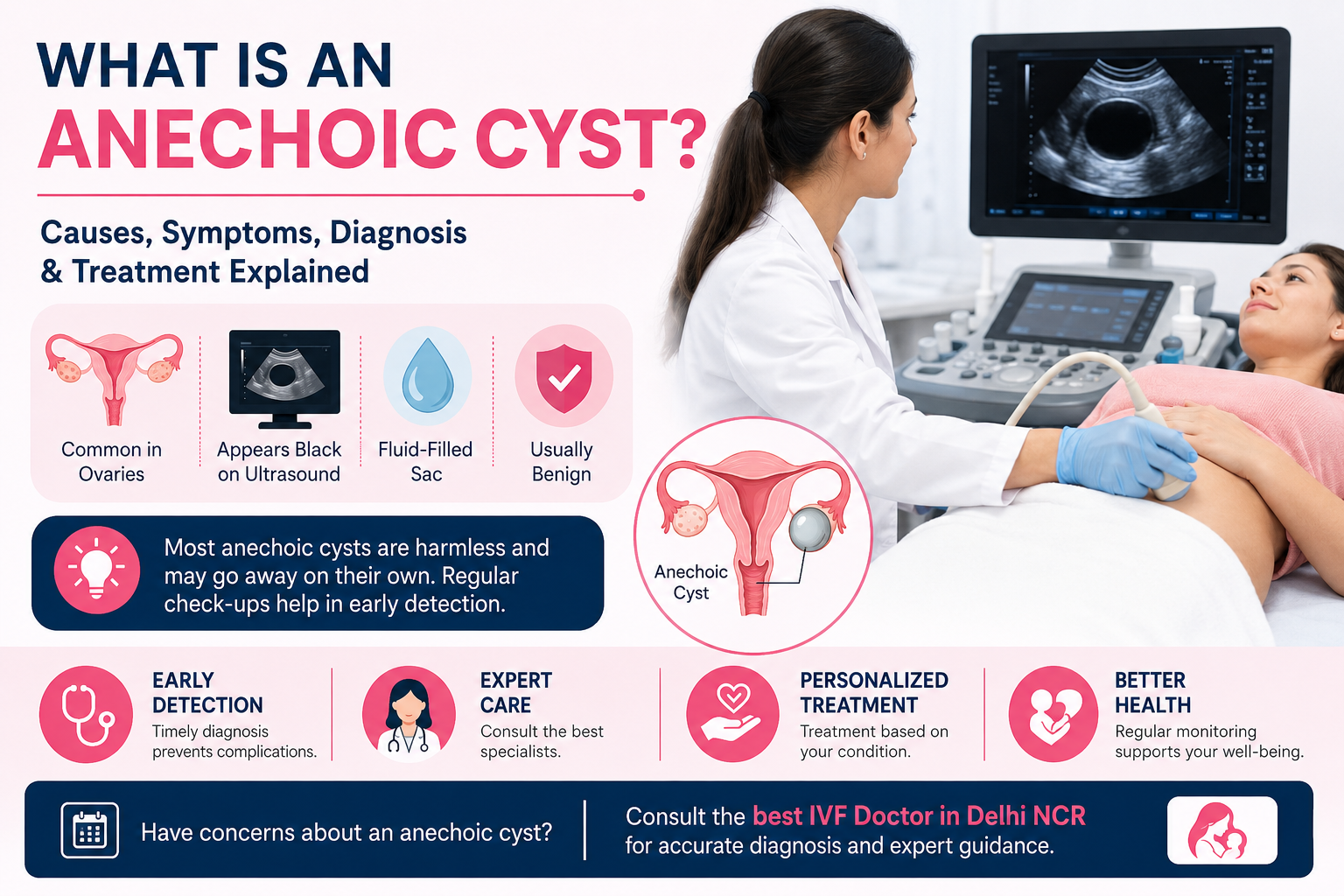
An anechoic cyst is a term you may come across during an ultrasound scan, especially if you're undergoing a routine health check-up or fertility evaluation. Seeing this term in your report can be worrying, but in many cases, an anechoic cyst is harmless and does not require treatment.
Think of an anechoic cyst like a clear water balloon. It is filled with fluid, and because ultrasound waves pass through fluid easily, the cyst appears completely black on the scan. This characteristic often indicates that the cyst contains only fluid and is more likely to be benign.
However, not all cysts are the same. Their significance depends on where they develop, their size, and whether they cause symptoms. Understanding anechoic cysts can help you make informed decisions and know when medical attention is necessary.
If you're planning a pregnancy or undergoing fertility treatment, consulting the best IVF Doctor in Delhi NCR can help determine whether an ovarian cyst may affect your reproductive health.
## What Is an Anechoic Cyst?
When conducting an ultrasound, an anechoic cyst appears as a fully black regions. These are fluid filled cysts that do not reflect sound waves.
Most anechoic cysts are classified as simple cysts. Unlike other cysts, simple cysts only contain fluid. These cysts can be found in:
- Ovaries
- Kidneys
- Liver
- Breasts
- Thyroid
- Soft tissues
A significant number of people find these cysts because other imaging tests are being done for entirely different reasons.
## What Does "Anechoic" Mean?
The word anechoic means “without echoes.”
When an ultrasound is done, fluid:
- Does not reflect sound waves
- Is black
This indicates to doctors that the structure is fluid filled.
When comparing to other structures:
- Solid tissues are gray
- Bones are white
Mixed cysts contain both solid components and fluid. As a general guideline, if a structure has a fully anechoic appearance, the cyst is most likely simple and benign.
## Where Can Anechoic Cysts Develop?
Anechoic cysts can develop in various parts of the body. Commonly, these include:
#### Ovaries
These are the most frequently found anechoic cysts in women. Ovarian cysts develop normally and are present in women during their menstrual cycle, disappearing without the need for treatment.
#### Kidneys
Simple cysts in the kidneys are usually benign and develop as people age.
#### Liver
Most liver cysts are discovered incidentally during imaging and are harmless.
#### Breasts
Fluid filled breast cysts develop in women, most commonly in the age range of 35 - 50 years
#### Thyroid
Thyroid cysts are generally benign; however, they do need to be evaluated if these cysts increase in size.
## Common Causes of Anechoic Cysts
There are many reasons an anechoic cyst can form.
Functional Ovarian Cysts
Functional ovarian cysts are a normal part of the menstrual cycle. They usually disappear on their own.
Hormonal Changes
Hormone changes can lead to the development of cysts.
Blocked Glands or Ducts
Some cysts develop when the ducts or glands become blocked.
Congenital Conditions
Some cysts develop in the womb and are present at birth.
Benign Growths
Some benign conditions may also form cysts that are fluid filled.
Pregnancy
Ovarian cysts in early pregnancy are used to produce the pregnancy hormones.
5. What Are The Symptoms of An Anechoic Cyst?
Many people with simple cysts do not experience symptoms.
Those that do experience symptoms may have:
Pelvic pain
Discomfort or bloating in the abdomen
A feeling of fullness
Pain during sex
Anxiety or nervousness
Frequent urges to go to the bathroom if the cyst is pressing on the bladder
Symptoms are usually based on the size and location of the cyst.
6. Are Anechoic Cysts Safe?
In general, yes.
Anechoic cysts are usually harmless and disappear spontaneously.
However, doctors are more concern if the cysts are:
Thick
Have solid parts
Have internal sections
Are vascular (have blood flowing to them)
Grow quickly
Are large.
These may require more imaging and other tests.
7. What is The Process For Diagnosing An Anechoic Cyst?
Usually, the process starts with the ultrasound.
Ultrasound
This is the primary diagnostic imaging tool.
Doctors look to see:
The size
The outline
The thickness of the walls
The flow of blood
CT Imaging
This is done to gain more information.
MRI
These give high quality images of complex cysts.
Blood work
In some situations, blood work may help rule out other conditions.
The ultrasound is done again.
Simple cysts that are small often require more imaging to be done after some months.
8. What Can Be Done About Them?
The approach to treatment is based on many factors.
Observation
Most uncomplicated cysts can just be watched over.
Medication
Pain medication can be given when there is pain.
Hormonal medications may decrease some ovarian cysts.
Aspiration
Some cysts can be aspirated.
Surgery
Surgery is needed when:
The cyst is large.
The cyst is painful.
The cyst twists.
The cyst ruptures.
There is concern for cancer.
9. Anechoic Ovarian Cysts and Fertility
Many women find they have ovarian cysts when they start to try to have a baby.
The good news is simple ovarian cysts likely won’t decrease your chance to have a baby.
Cysts from the following can decrease your chance to have a baby:
Endometriosis
Polycystic Ovary Syndrome (PCOS)
Large ovarian tumors
Getting the best IVF treatment in Delhi NCR will be very helpful for women wanting to get pregnant and have recurring cysts, and especially if they have cysts associated with infertility.
The cyst may need to be treated before IVF, and other options may be considered.
10. When Should You Seek Medical Attention?
You should get medical attention immediately if:
You have extreme pain in your abdomen.
You have pain in your pelvis that does not go away.
You have a fever and pain in your pelvis.
You are vomiting.
You feel dizzy.
You have pain in your abdomen that is swelling quickly.
You have heavy bleeding from your vagina.
All of these symptoms are a sign that there may be a serious problem like a ruptured cyst.
11. How to Keep Your Reproductive System Healthy
Even though it may not be possible to prevent the development of cysts, certain lifestyle choices may help improve your reproductive system.
Maintain Your Weight
Having a healthy weight can improve your hormone levels and decrease the risks of reproductive issues.
Exercise
Staying active helps improve and regulate your hormones.
Diet
Your diet should help in keeping you healthy.
Whole grains
Lean meats
Fruits
Vegetables
Good fats
Stay Hydrated
Health is supported by good hydration.
Go For Check-Ups
Regular check-ups help spot troubles with your health.
Prevention and Regular Monitoring
While health professionals cannot entirely prevent cysts from forming, they are able to find cysts early through proactive health checks.
Doctors can suggest monitoring cysts through ultrasounds at different stages of life:
- Large cysts
- Cysts that don’t go away
- Women who are getting fertility treatments
- Women who have finished menopause.
Monitoring cysts early helps to avoid future problems.
Myths and Facts About Anechoic Cysts
Myths: All cysts are cancer, All cysts need to be surgically removed.
Facts: Most cysts, including anechoic cysts, are non-cancerous and some cysts go away on their own.
Myths: Ovarian cysts, in general, cause infertility, and all cysts are symptomatic.
Facts: Simple ovarian cysts don’t cause infertility, and a lot of people don’t even know that they have cysts because they are symptomless.
Myth: Cysts are caused by exercise.
Fact: Regular exercise doesn’t cause cysts.
Key Takeaways
Anechoic cysts are clear on ultrasounds and are mostly non-cancerous and symptomless. Their treatment ranges from observation to surgery.
Ultrasounds are the most effective way to diagnose cysts and help to monitor ovarian anechoic cysts that are mostly non-cancerous and won’t impede pregnancy.
Women who are worried about their fertility should seek the best IVF Doctor in Delhi NCR to get specialized treatment.
Conclusion
Anechoic cysts usually are not a threat. They are mostly benign cysts that won’t be a worry for your doctor over time. Better imaging helps to monitor cysts that are benign and helps to identify cysts that are of greater concern.
The main thing to remember is to never ignore symptoms. You should never intentionally miss follow-ups. Try to get symptoms evaluated without delay, especially if they're unusual pain, abnormal bleeding, or are related to your ability to conceive. For women who wish to conceive, the top IVF specialist in Delhi NCR will examine the need to evaluate ovarian cysts prior to pregnancy or other fertility treatments. Proper and timely evaluation is critical.
The good news is that with the proper evaluation, follow-ups, and care, many people with an anechoic cyst lead everyday normal and healthy lives.
1. What does an anechoic cyst mean on an ultrasound?
An anechoic cyst is simply a fluid-filled cyst that does not reflect ultrasound sound waves. These cysts will likely present as black on the ultrasound due to the sound waves and liquid not interacting.
2. Can an anechoic cyst become malignant?
In general, many simple anechoic cysts are benign. There are many exceptions, such as if the cyst is rapidly enlarging, or has solid components or irregular walls.
3. Do anechoic ovarian cysts have an effect on fertility?
In general, a simple ovarian cyst does not impact fertility; however, there are many exceptions. If a cyst is part of a wider diagnosis such as PCOS or endometriosis, fertility may be impacted.
4. Can an anechoic cyst resolve on its own?
Yes. Many simple cysts and even functional ovarian cysts resolve on their own over time, typically weeks to months, without treatment.
5. When does an anechoic cyst become a concern?
Seek urgent medical attention if there is any new onset of symptoms (especially severe), if there is rapid enlargement, bleeding, and fever or a cyst that is reported to have complex features that warrants urgent attention.

 English
 Arabic
 French
 Spanish
 Portuguese
 Deutsch
 Turkish
 Dutch
Dutch
 Italiano
 Russian
 Portuguese (Brazil)
 Greek
Greek
