


The Easy Way to Clean Circuit Boards: PCB Cleaner Machine Guide
Quick Answer
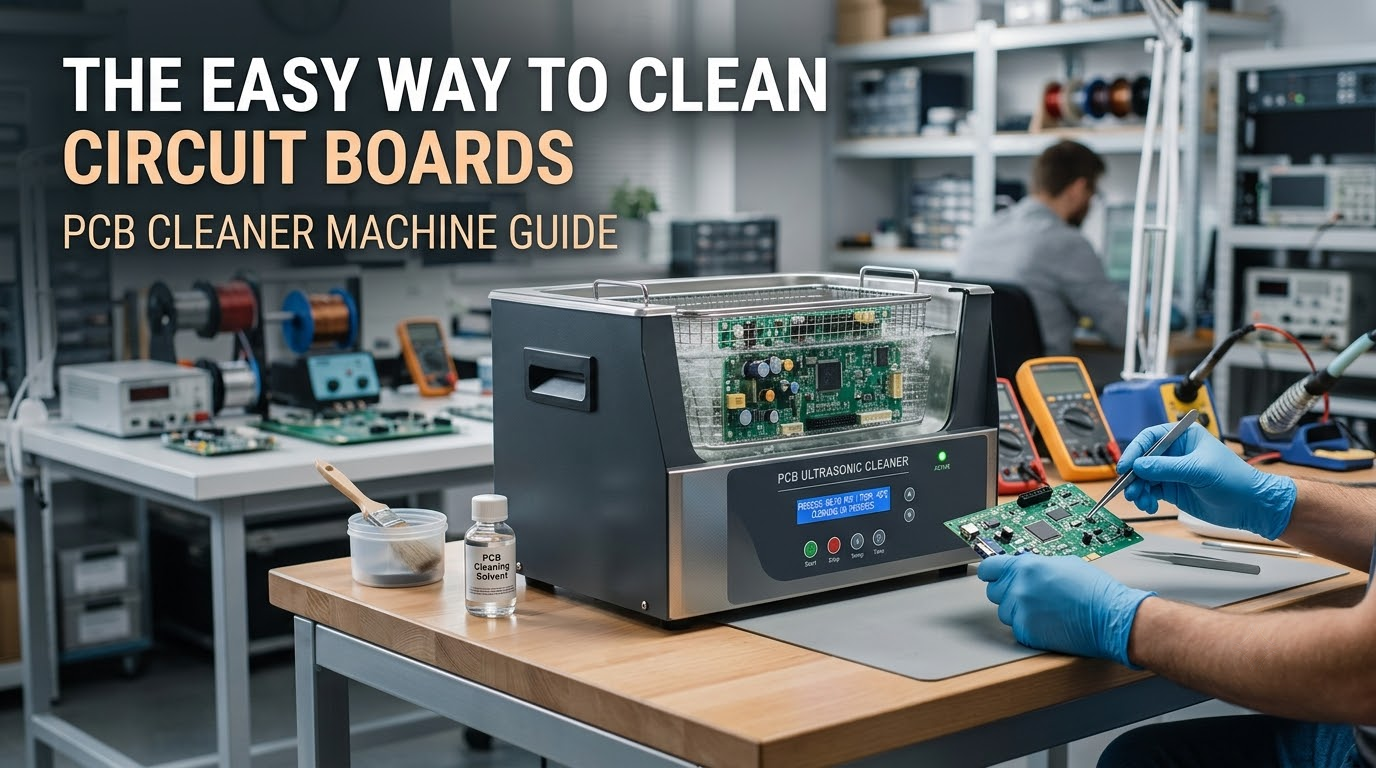
A PCB cleaner machine uses ultrasonic cavitation—high-frequency sound waves in a cleaning solution—to remove flux, dust, oil, and solder residue from circuit boards without scrubbing or damaging delicate components. It's the fastest, safest, and most consistent way to clean PCBs at scale, cutting manual cleaning time by up to 70% while improving board reliability.
Why Circuit Boards Need Proper Cleaning
If you work with electronics manufacturing, repair, or assembly, you already know that a dirty PCB is a ticking time bomb. Flux residue, dust, and moisture left behind after soldering can cause short circuits, corrosion, and premature component failure.
Manual cleaning with brushes or sprays often misses tight spaces between components, connectors, and under chips. That's exactly where a PCB cleaner machine solves the problem—reaching every crevice with precision, without the physical contact that risks damaging fragile parts.
This guide breaks down how PCB cleaning machines work, why ultrasonic technology is the industry's preferred method, and how to choose the right one for your production line.
What is a PCB Cleaner Machine?
A PCB cleaner machine is industrial equipment designed to remove contaminants—flux, grease, dust, ionic residue, and solder splatter—from printed circuit boards. Most modern machines rely on ultrasonic cleaning technology, where transducers generate high-frequency sound waves that create millions of microscopic bubbles in a cleaning solution. These bubbles collapse (cavitate) against the board's surface, lifting away dirt from even the smallest gaps.
Unlike manual wiping or aerosol sprays, ultrasonic PCB cleaning is:
-
Non-contact – no physical friction that could damage traces or components
-
Uniform – cleans every surface, edge, and hidden corner evenly
-
Fast – full cleaning cycles typically take 5–15 minutes
-
Repeatable – consistent results across every batch
How Does Ultrasonic PCB Cleaning Work?
Here's the process, step by step:
-
Loading – PCBs are placed in a basket or fixture and lowered into the cleaning tank.
-
Ultrasonic cavitation – Transducers generate sound waves (typically 28–40 kHz) through the cleaning solution, forming microscopic bubbles.
-
Contaminant removal – The bubbles implode near the board's surface, dislodging flux, oil, and particulate residue.
-
Rinsing – Boards move to a rinse stage (in multi-stage systems) to remove leftover cleaning agent.
-
Drying – Hot air or vacuum drying removes moisture completely before boards move to the next production step.
Multi-stage systems—cleaning, rinsing, and drying combined—are increasingly popular in electronics manufacturing because they reduce handling and eliminate cross-contamination between stages.
Key Benefits of Using a PCB Cleaner Machine
|
Benefit |
Why It Matters |
|
Deep, uniform cleaning |
Reaches under components and in tight gaps that manual methods miss |
|
Reduces board failure |
Removes ionic contamination that causes corrosion and short circuits |
|
Saves labor time |
Cuts manual scrubbing time significantly, freeing up staff for other tasks |
|
Improves consistency |
Every board gets the same cleaning cycle—no variation between operators |
|
Extends component life |
Clean boards run cooler and last longer in the field |
|
Eco-friendly options |
Water-based and biodegradable cleaning agents reduce chemical waste |
Industry data consistently shows that ionic contamination is one of the leading causes of field failures in electronics assemblies, which is why cleanliness verification has become standard in high-reliability manufacturing (medical devices, automotive electronics, and aerospace components in particular).
What Contaminants Can a PCB Cleaner Machine Remove?
-
Rosin and no-clean flux residue
-
Solder paste and splatter
-
Dust and airborne particulates
-
Oils and fingerprint oils from handling
-
White residue from certain flux chemistries
-
Light oxidation on component leads
Choosing the Right PCB Cleaner Machine
Not every production line has the same needs. Here's what to evaluate before buying:
1. Production volume Low-volume repair shops may only need a compact table-top ultrasonic unit, while high-volume manufacturers benefit from multi-stage aqueous systems with automated loading.
2. Board sensitivity Boards with sensitive components need controlled frequency, temperature, and cleaning agent to avoid damage—this is where a customized system outperforms a generic off-the-shelf machine.
3. Cleaning chemistry Water-based, saponifier, or solvent-based agents each suit different flux types. A supplier who understands chemistry, not just hardware, will help you avoid compatibility issues.
4. Automation level IoT-enabled systems with programmable cycles reduce operator error and give you traceable cleaning records—useful for quality audits.
5. After-sales support Ultrasonic equipment needs occasional servicing (transducers, generators, filtration). A manufacturer with strong technical support saves downtime later.
Why Manufacturers Trust Hisashi Industries for PCB Cleaning
At Hisashi Industries, we've spent over two decades engineering industrial ultrasonic cleaning systems for electronics, automotive, and medical applications. Our PCB Cleaner Machines are custom-built around your board design, contamination type, and production volume—not sold as one-size-fits-all boxes.
What sets our approach apart:
-
Customized multi-stage cleaning systems designed around your specific component and flux requirements
-
Precision-engineered transducers and generators, built in-house for consistent cavitation performance
-
IoT-enabled monitoring for traceable, repeatable cleaning cycles
-
Strong after-sales support, from installation to ongoing maintenance
We've helped manufacturers across electronics, automotive, and precision engineering industries replace inconsistent manual cleaning with dependable ultrasonic systems that hold up to daily production demands.
FAQs
1. What is the best way to clean a PCB board?
The best method is ultrasonic cleaning. It uses sound waves to create cleaning bubbles that reach into tight spaces and remove flux, dust, and residue without physically touching or scrubbing the board.
2. Is ultrasonic cleaning safe for circuit boards?
Yes, when the frequency, solution, and cycle time are correctly matched to the board type. Non-contact cleaning avoids the risk of scratching traces or dislodging small components that manual cleaning can cause.
3. How long does it take to clean a PCB with an ultrasonic machine?
Most cleaning cycles take between 5 and 15 minutes, depending on the level of contamination and the number of boards being cleaned in a batch.
4. Can a PCB cleaner machine remove flux residue completely?
Yes. Ultrasonic cavitation is highly effective at breaking down and lifting flux residue, including rosin and no-clean flux, from surfaces and under components.
5. What is the difference between a single-stage and multi-stage PCB cleaning system?
A single-stage system only cleans the board. A multi-stage system adds rinsing and drying stages in sequence, producing a completely clean, moisture-free board ready for the next production step.
Conclusion
Clean circuit boards aren't just about appearance—they directly affect reliability, performance, and product lifespan. A PCB cleaner machine built on ultrasonic technology removes flux, dust, and residue faster and more thoroughly than any manual method, while giving you consistent, repeatable results across every batch.
If you're ready to move away from unreliable manual cleaning and want a system engineered around your exact board requirements, Hisashi Industries can help.
Get a customized PCB cleaning solution built for your production line — Talk to our team today.
Call Now – +91 9871013815
Visit Us – https://hisashiultrasonic.com/

 English
 Arabic
 French
 Spanish
 Portuguese
 Deutsch
 Turkish
 Dutch
Dutch
 Italiano
 Russian
 Romaian
 Greek
Greek
