


Global Homeware Market Set for Strong Growth, with Oneida Group, Groupe SEB and IKEA in Focus
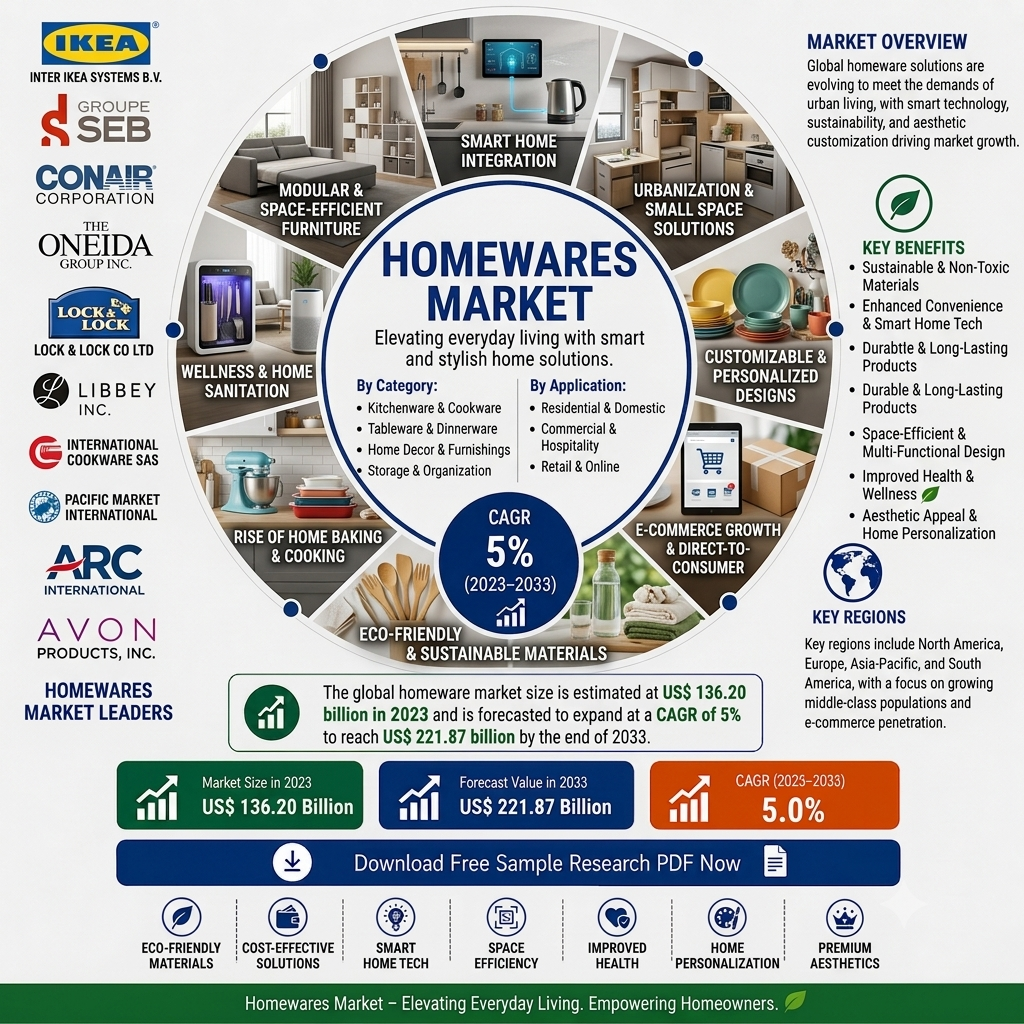
The global homeware market is estimated at USD 136.2 billion in 2023 and is projected to reach USD 221.87 billion by 2033, expanding at a 5% CAGR during the forecast period, according to Fact.MR. Demand is being supported by changing consumer preferences for comfortable and stylish living spaces, growing adoption of sustainable home products, and increasing use of e-commerce for furniture and household purchases.
Homeware encompasses a broad range of products used for home decoration, furnishing, renovation, and improvement. Furniture, kitchenware, soft furnishings, lighting, appliances, storage solutions, bathroom accessories, tableware, and hardware are all contributing to market opportunities as consumers invest in improving the functionality and appearance of their homes.
Request full Report Pricing and sample Report: https://www.factmr.com/connectus/sample?flag=S&rep_id=241
Homeware Market Outlook
Urbanization and changing lifestyles are creating sustained demand for homeware products. Fact.MR notes that 68% of the global population is expected to live in urban areas by 2050, supporting demand for residential accommodation and products designed for changing living environments.
Furniture remains a major category, with sales expected to expand at a 4.3% CAGR from 2023 to 2033. Consumers are increasingly looking for furniture that combines comfort, durability, and visual appeal. Manufacturers are responding with customized products and personalized shopping experiences that allow buyers to select designs, colors, and configurations suited to their homes.
Sustainable and Space-Efficient Products Gain Ground
Sustainability is becoming a stronger consideration in homeware purchasing decisions. Consumers are showing greater interest in furniture and soft furnishings made from bamboo, recycled textiles, rattan, and other sustainable materials.
Demand for sustainable furniture is also benefiting from changing consumer search behavior. eBay reported a 171% increase in searches for “sustainable furniture” in the United Kingdom in 2020 compared with 2019, highlighting growing interest in environmentally conscious home products.
Compact and multifunctional furniture is another important opportunity. Smaller apartments and single-person households are encouraging consumers to seek products that maximize available space. In South Korea, for example, the growth of single-person households and compact living spaces is increasing demand for multifunctional homeware, decorative products, bedding, and lighting.
E-Commerce Expands Market Access
Online distribution is changing how consumers discover and purchase homeware. E-commerce platforms allow manufacturers and retailers to reach broader audiences without relying exclusively on physical stores. Consumers can compare products, prices, materials, and designs from home, supporting greater adoption of online purchasing.
Digital retail also provides manufacturers with access to consumer behavior data, enabling them to refine product offerings and marketing strategies. This creates opportunities for emerging brands to enter the market with sustainable, customized, or design-focused products.
United Kingdom Shows Strong Growth Potential
The United Kingdom homeware market is projected to expand at a 5.4% CAGR, reaching USD 9.02 billion by 2033. Online shopping and work-from-home trends are supporting demand for textile home décor, smart kitchen appliances, interior lighting, and other homeware categories.
South Korea is projected to grow at a 5.3% CAGR, supported by demand for compact and multifunctional products. China is expected to expand at 5% CAGR, while Japan and the United States are projected to grow at 4.8% and 4.4% CAGR, respectively.
Competitive Landscape
The global homeware market includes established consumer brands competing through product innovation, customization, distribution expansion, and sustainable product development. Key companies profiled by Fact.MR include The Oneida Group Inc., Groupe SEB, Pacific Market International, Lock & Lock Co Ltd, Libbey Inc., International Cookware SAS, Inter IKEA Systems B.V., Conair Corporation, Avon Products, Inc., and Arc International.
Companies are developing products tailored to changing household needs. Inter IKEA Systems introduced its IVAR storage system with space-saving shelves, while Samsung unveiled a Wi-Fi-enabled smart induction built-in cooktop designed to improve cooking efficiency and reduce energy consumption.
Market Challenges
High raw-material costs remain a major constraint for manufacturers. Rising prices for wood, leather, cotton, and silk can increase production expenses and force vendors to raise prices, potentially limiting consumer purchases. Fluctuating material costs can also affect revenue growth across regional markets.
To View Related Reports
https://afgbfh.blogspot.com/2026/11/global-toothcare-market-heads-toward.html
https://social.art-inpa.com/blogs/48409/Toothcare-Market-to-Attain-USD-40-88-Billion-by-2033
https://sportgalax.com/read-blog/27488
About Fact.MR
Fact.MR is a market research and competitive intelligence provider delivering market intelligence, competitive analysis, and forecasting across global industries. Its research helps businesses evaluate market demand, understand competitive developments, and identify growth opportunities.

 Arabic
 French
 Spanish
 Portuguese
 Deutsch
 Turkish
 Dutch
 Italiano
 Russian
 Romaian
 Portuguese (Brazil)
 Greek
