


Top Factors for Selecting a Humidity Test Chamber Manufacturer
Quick Answer
The right humidity test chamber manufacturer should offer precise temperature and humidity control (typically 5–95% RH with ±2% accuracy), corrosion-resistant build quality (SS 304 inner chamber), safety features like over-temperature protection, calibration support, and after-sales service. Always verify manufacturing experience, in-house R&D, and real client references before purchasing, since chamber accuracy directly affects your test data and regulatory compliance.
If you test materials, pharmaceuticals, electronics, or coatings for humidity resistance, the manufacturer you choose matters as much as the chamber itself. A poorly built unit gives inconsistent readings, fails mid-cycle, or drifts out of calibration — and that can throw off months of research or compliance data. This guide breaks down exactly what to look for before you sign a purchase order.
What is a Humidity Test Chamber Used For?
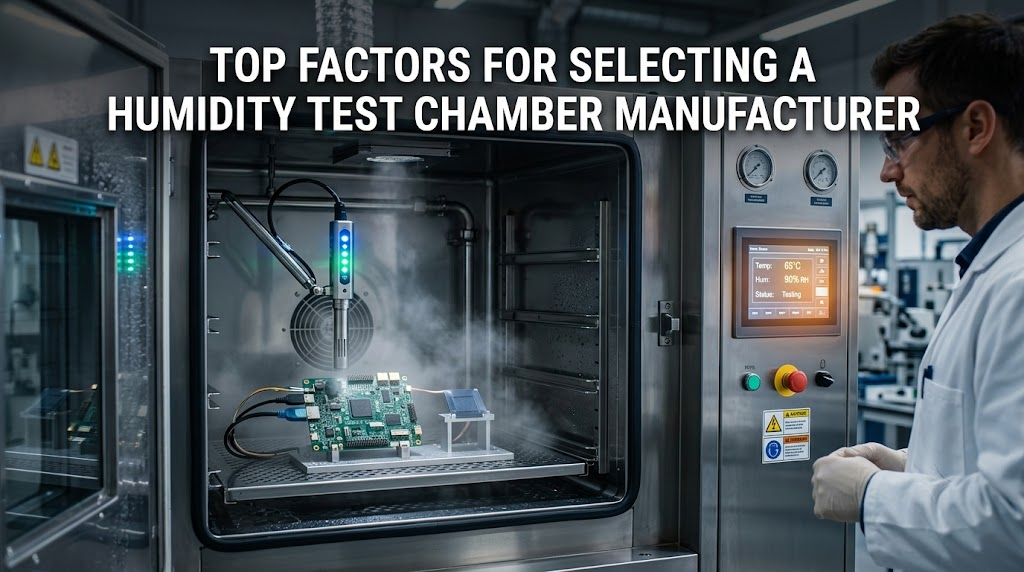
A humidity test chamber simulates high and low humidity environments to check how materials, coatings, electronics, and pharmaceutical products react to moisture over time. Petroleum and chemical industries commonly use these chambers to test the rust-preventing capacity of oils and greases, while pharma and electronics manufacturers use them for shelf-life and reliability testing. Because the chamber directly influences your test outcomes, manufacturer quality is not optional — it's foundational.
1. Build Quality and Material Standards
The chamber's construction determines its durability and test accuracy over years of use. Look for:
-
Inner chamber in SS 304 stainless steel — resists corrosion from repeated humidity cycles
-
Outer body in plastic-coated A3 steel or powder-coated MS — protects against external wear
-
3-inch thick PUF or glass-fiber insulation between double walls for thermal efficiency
-
Silicone rubber door gaskets to seal out contamination and temperature loss
-
Observation windows so you can monitor samples without opening the chamber
A chamber that skimps on insulation or uses thinner-gauge steel will struggle to hold uniform conditions, which shows up as inconsistent test results down the line.
2. Temperature and Humidity Accuracy
Accuracy is the single biggest differentiator between manufacturers. Ask for the exact specifications in writing, not just marketing claims.
|
Parameter |
Industry Benchmark |
|
Temperature Range |
-20°C to 70°C (varies by model) |
|
Temperature Accuracy |
± 0.2°C |
|
Temperature Uniformity |
± 2.0°C |
|
Humidity Range |
Ambient +5% to 95% RH |
|
Humidity Accuracy |
± 2.0% RH |
|
Humidity Uniformity |
± 3.0% RH |
A reputable manufacturer will share these figures upfront and back them with calibration certificates, not vague statements like "high precision."
3. Control System and Automation
Modern chambers should use digital or PLC-based controllers with 0.1°C readability, auto-tuning, and programmable ramp-and-soak profiles for multi-step test cycles. Practical features to confirm include:
-
Door-open alarms
-
Temperature and humidity deviation alarms
-
Water-input failure alerts
-
Audible-visual alarm systems for unattended operation
These aren't luxury add-ons — they prevent a failed test cycle from going unnoticed for hours.
4. Safety Features
Since humidity chambers run heating elements, water reservoirs, and electrical components together, safety engineering matters. Check for adjustable over-temperature protection, temperature fuse wire, motor and fan overheating prevention, and phase-reversal protection. A manufacturer that documents these safeguards clearly is signaling engineering maturity, not just assembling parts.
5. Manufacturing Experience and In-House Capability
Ask how long the company has actually been manufacturing — not just trading — test chambers. Manufacturers with an in-house facility and engineering team can customize chamber size, temperature range, and control systems to your specific test protocol, rather than offering only fixed catalog models. Getrus International, for example, has been engineering laboratory and environmental test equipment since 2002, with a dedicated manufacturing unit in Bahadurgarh, Haryana, and an in-house R&D team that supports both standard and custom chamber configurations.
6. Compliance and Certifications
Your chamber's test data may need to satisfy pharmaceutical, industrial, or export compliance standards. Ask which certifications the manufacturer holds and whether the equipment is designed to align with relevant testing protocols used in your industry. If your lab is ISO-accredited or GMP-regulated, confirm the manufacturer can provide calibration traceability documents alongside the equipment.
7. Customization Options
Not every lab needs the same chamber. A manufacturer that only sells one fixed configuration limits your options as your testing needs grow. Look for flexibility in:
-
Chamber capacity and tray configuration
-
Single-setpoint vs. ramp-and-soak (up to 8 steps) programming
-
Optional glass viewing doors and adjustable-height stainless steel trays
-
Voltage and phase configuration for your facility
8. After-Sales Support and Spare Parts
A humidity chamber runs continuously for years, so breakdowns are a question of "when," not "if." Before purchasing, ask directly:
-
Is technical support available locally or only remotely?
-
How quickly can spare parts (heaters, sensors, gaskets) be sourced?
-
Is there a warranty period, and what does it cover?
-
Does the manufacturer offer on-site installation and calibration?
Manufacturers offering 24/7 customer support and a wide dealer network reduce downtime significantly compared to those who only sell and disappear.
9. Client Track Record and Industry Reputation
Finally, check who else uses the manufacturer's chambers. A company that has delivered thousands of units to hospitals, research institutions, pharmaceutical companies, and industrial units across multiple countries has been tested by real-world use, not just internal QA. Ask for references or case studies from labs in your own industry segment where possible.
Comparing Manufacturers: A Practical Checklist
|
Factor |
Why It Matters |
|
Build materials (SS 304 + insulation) |
Long-term corrosion resistance |
|
Accuracy specs in writing |
Reliable, repeatable test data |
|
PLC/digital controller with alarms |
Prevents undetected test failures |
|
Safety protections |
Reduces equipment and lab risk |
|
In-house manufacturing |
Enables customization and faster fixes |
|
Certifications |
Supports regulatory compliance |
|
After-sales support |
Minimizes downtime |
|
Client references |
Confirms real-world reliability |
Why Getrus International?
Getrus International designs High-Low Humidity Test Chambers with an SS 304 inner bladder, plastic-coated A3 steel outer body, non-CFC oversized cooling systems, and IR Ni-Cr alloy heaters for faster, more uniform heating. With over 20 years of manufacturing experience, a dedicated production facility, and support for both standard and custom configurations, Getrus builds chambers meant to hold up under continuous industrial and laboratory use — not just pass a one-time demo.
FAQs
1. What is the ideal humidity range for a humidity test chamber?
Most industrial and pharmaceutical humidity test chambers operate from ambient +5% up to 95% RH, with accuracy of around ±2% RH, though the exact range depends on your specific testing protocol.
2. How do I know if a humidity chamber is accurate enough for pharma testing?
Check the manufacturer's documented temperature accuracy (±0.2°C) and humidity accuracy (±2.0% RH), and confirm they provide calibration certificates traceable to recognized standards.
3. Can humidity test chambers be customized for specific industries?
Yes. Reputable manufacturers offer customizable chamber size, tray configuration, ramp-and-soak programming, and voltage settings to match specific industry or lab requirements.
4. What safety features should a humidity test chamber have?
Look for over-temperature protection, temperature fuse wire, motor/fan overheating prevention, phase-reversal protection, and audible-visual alarms for deviations or water-input failure.
5. How often should a humidity test chamber be calibrated?
Calibration frequency depends on usage intensity and industry compliance requirements, but most labs calibrate humidity chambers at least once a year, or per the manufacturer's recommended schedule.
Conclusion
Selecting a humidity test chamber manufacturer isn't just a procurement decision — it directly shapes the reliability of your test data, your compliance standing, and your long-term operating costs. Prioritize manufacturers who are transparent about build materials, accuracy specifications, safety engineering, and after-sales support, and who have a verifiable manufacturing track record rather than just a sales catalog.
Ready to find the right chamber for your lab?
Get a free quote from Getrus International and speak with our engineering team about standard or custom humidity test chamber configurations.
Call us: +91 9717076743
Email: info@getrusinternational.com
Website: getrusinternational.com

 English
 Arabic
 French
 Spanish
 Portuguese
 Deutsch
 Turkish
 Dutch
Dutch
 Italiano
 Romaian
 Portuguese (Brazil)
 Greek
Greek
