


Best Ayurvedic Hair Oil for Hair Fall: A Complete Guide to Natural Hair Growth
Quick Answer
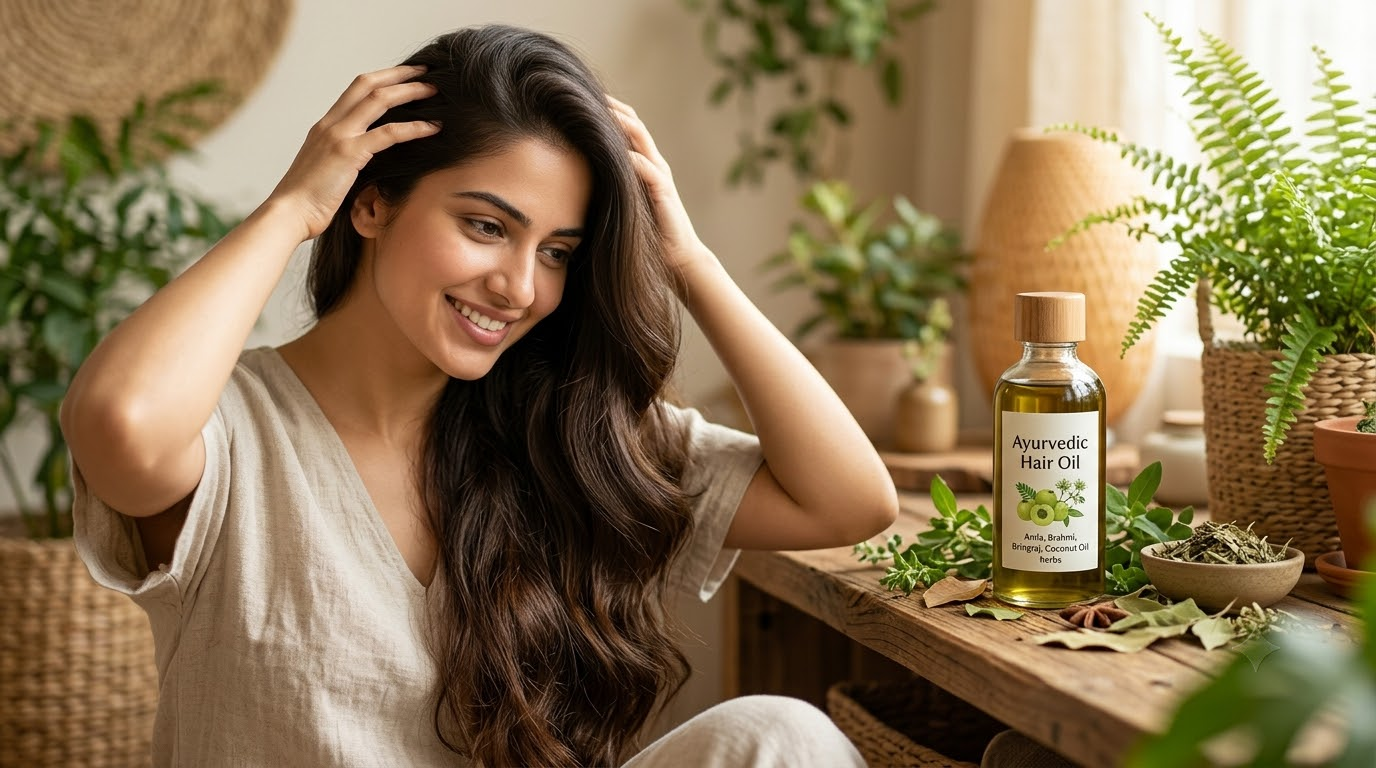
The best Ayurvedic hair oil for hair fall combines proven scalp-nourishing herbs — like Bhringraj, Brahmi, Amla, Neem, and Jatamansi — in a slow-infused base oil (usually sesame), applied 2–3 times a week with a warm scalp massage. These herbs are traditionally used to strengthen hair roots, improve scalp circulation, reduce dandruff-related shedding, and support thicker-looking hair over time. Results with Ayurvedic oils are gradual (typically 8–12 weeks of consistent use), not overnight — but they address the scalp environment, not just the strands, which is what makes them different from ordinary cosmetic hair oils.
Why Do Hair Fall Happen?
Before reaching for a bottle, it helps to understand what's actually going on. Hair fall is rarely caused by one thing. It's usually a combination of:
-
Poor scalp circulation, which starves follicles of nutrients
-
Stress and disturbed sleep (a major, underrated trigger)
-
Nutritional gaps — low iron, protein, or biotin
-
Excess heat styling and chemical treatments
-
Pollution and hard water buildup on the scalp
-
Seasonal shedding, which is normal and self-corrects
A good Ayurvedic hair oil doesn't "grow hair" in a lab sense — no oil can override genetics or a medical condition like thyroid imbalance or PCOS-related hair loss. What it can do is create a healthier scalp environment: better blood flow, reduced dryness and flaking, and stronger roots that shed less during the normal hair cycle. If hair fall is sudden, patchy, or accompanied by visible scalp changes, that's a conversation for a dermatologist first, oil second.
What Makes an Ayurvedic Hair Oil Genuinely Effective
Not all "Ayurvedic" oils are equal. A lot of what's sold as Ayurvedic hair oil today is mineral oil with a few herbal extracts added for fragrance. Here's what actually separates a classical formulation from a marketing label.
1. It's Made as a Tail, Not Just Infused
In classical Ayurveda, a Taila is prepared by slow-cooking herbs into a base oil (often sesame) over low heat for hours, allowing the oil-soluble compounds to actually transfer into the base. This is different from simply steeping herbs in oil at room temperature, which pulls far fewer active compounds through.
2. It Uses Multiple Herbs With Complementary Roles
Single-herb oils (just amla, or just coconut) are limited. A well-formulated blend typically layers herbs for different functions:
|
Herb |
Traditional Role |
|
Bhringraj |
Root strengthening, reduces premature greying |
|
Brahmi |
Scalp cooling, calms an irritated scalp |
|
Amla |
Antioxidant support, shine and strand strength |
|
Neem |
Anti-microbial, helps with dandruff and flakiness |
|
Jatamansi |
Calms the mind, indirectly reduces stress-linked shedding |
|
Shikakai |
Gentle cleansing support, scalp clarity |
|
Hibiscus |
Softness and texture improvement |
|
Tulsi |
Scalp hygiene and freshness |
3. It's Manufactured Under Proper Regulation
In India, genuine Ayurvedic products are manufactured under an AYUSH licence — this is the government body that regulates Ayurvedic, Unani, and Siddha medicine manufacturing. It's a simple but important trust signal: it means the product isn't just herbal-flavoured cosmetics, but formulated and produced under declared, licensed conditions.
4. It Declares Every Ingredient
If a brand won't tell you what's in the bottle beyond "herbal blend," that's a red flag. Full ingredient transparency is a basic marker of a trustworthy formulation — you should be able to see every botanical, oil, and preservative (or lack thereof) listed clearly.
How Roshni Botanicals' HerbOcean Hair Oil Fits This
HerbOcean Hair Oil by Roshni Botanicals is formulated on this classical logic rather than a modern cosmetic one. It's a slow-prepared Taila built on the forty-year formulation legacy of Vaidya Shri Ram Prakash Ji, the brand's master Ayurvedic formulator, and made in-house at their own Delhi facility under AYUSH Licence DL-474 A&U — not outsourced or white-labelled.
The oil combines sixteen botanicals in a sesame base, including Bhringraj, Brahmi, Amla, Shikakai, Jatamansi, Neem, Tulsi, and rose extracts, aimed at three things: strengthening hair roots, calming an irritated or flaky scalp, and supporting healthier texture over regular use. It's free from parabens, sulfates, silicones, mineral oil, and artificial fragrance — which matters, since several of these ingredients can actually aggravate an already sensitive or oily scalp.
It's positioned for regular use rather than a quick fix, which is consistent with how Ayurveda approaches hair care generally: as a routine, not a one-time treatment.
How to Use an Ayurvedic Hair Oil Correctly
The oil is only half the equation — application technique matters just as much.
-
Warm the oil slightly. Warmth improves absorption; don't apply it cold straight from the bottle.
-
Section the hair and apply at the roots first. Most people rub oil onto the lengths and forget the scalp is where the actual work happens.
-
Massage for 5–10 minutes using fingertips (not nails) in small circular motions — this is what stimulates blood flow, not the oil sitting there.
-
Leave it on for at least 1 hour, ideally overnight, covered with a towel or shower cap.
-
Wash with a mild, sulfate-free shampoo. Harsh shampoos strip the very benefits you just massaged in.
-
Repeat 2–3 times a week, consistently, for at least 8–12 weeks before judging results.
Expert tip: Pair the oil massage with a wooden or neem comb rather than plastic. Neem combs are traditionally used because they don't generate static, which reduces breakage during detangling — a small habit that compounds over months.
Ayurvedic Oil vs. Regular Cosmetic Hair Oil
|
Factor |
Ayurvedic Hair Oil |
Regular Cosmetic Oil |
|
Base preparation |
Slow-cooked herbal Taila |
Often mineral oil + fragrance |
|
Ingredient transparency |
Fully declared botanicals |
Often vague "herbal extract" blends |
|
Regulatory oversight |
AYUSH-licensed manufacturing |
Cosmetic-grade, less specific |
|
Goal |
Scalp health + root strength |
Shine and slip, mostly cosmetic |
|
Chemical additives |
Typically free of parabens/silicones |
Frequently contains both |
FAQs
1. What is the best Ayurvedic hair oil for hair fall?
The best option is a multi-herb Taila — one that combines Bhringraj, Brahmi, Amla, Neem, and Jatamansi in a slow-cooked sesame base, manufactured under a valid AYUSH licence with full ingredient disclosure. Formulas like HerbOcean Hair Oil follow this classical approach rather than using a single hero ingredient.
2. How long does it take for Ayurvedic hair oil to reduce hair fall?
Most people notice a difference in scalp comfort and reduced shedding within 4–6 weeks, with more visible improvement in hair strength and texture by 8–12 weeks of consistent, twice-or-thrice weekly use. Ayurvedic oils work gradually by improving the scalp environment, not overnight.
3. Can Ayurvedic hair oil regrow hair completely?
Ayurvedic hair oil can strengthen existing roots, reduce breakage, and support a healthier scalp, which helps minimize further hair fall. It's not a guaranteed cure for conditions like androgenetic alopecia or medically driven hair loss — those need a dermatologist's evaluation alongside any topical routine.
4. Is it safe to leave Ayurvedic hair oil overnight?
Yes, for most hair types, leaving a natural Ayurvedic oil overnight is safe and often recommended, since it gives the herbs more time to absorb into the scalp. Those with very oily scalps may prefer a 1–2 hour application instead to avoid excess buildup.
5. How often should I oil my hair for hair fall control?
Two to three times a week is the generally recommended frequency for Ayurvedic hair oiling. Oiling daily isn't necessary and can lead to product buildup on the scalp, which may actually clog follicles rather than help them.
Conclusion
Hair fall isn't solved by a single miracle bottle — but a properly formulated Ayurvedic hair oil, used consistently and applied correctly, genuinely supports stronger roots, a calmer scalp, and healthier-looking hair over time. The key is choosing a formula that's transparent about its ingredients, prepared using classical methods rather than shortcuts, and made under proper regulatory oversight.
If you're looking for a hair oil built on exactly this foundation, HerbOcean Ayurvedic Hair Fall Control Oil by Roshni Botanicals brings together sixteen classical herbs in a slow-prepared sesame Taila, formulated in-house in Delhi under AYUSH Licence DL-474 A&U. Start your scalp-care routine today — your roots will thank you in a few months, not a few days.
Address: Roshni Botanicals, 169 Pocket D, Sector 5, DSIIDC Industrial Area, Bawana, Delhi 110039
Call: +91 98111 13550
Visit: https://roshnibotanicals.com

 English
 Arabic
 French
 Spanish
 Portuguese
 Deutsch
 Turkish
 Dutch
Dutch
 Italiano
 Russian
 Portuguese (Brazil)
 Greek
Greek
