


Sustainable Apparel Market Forecast Signals Strong Demand Through 2036
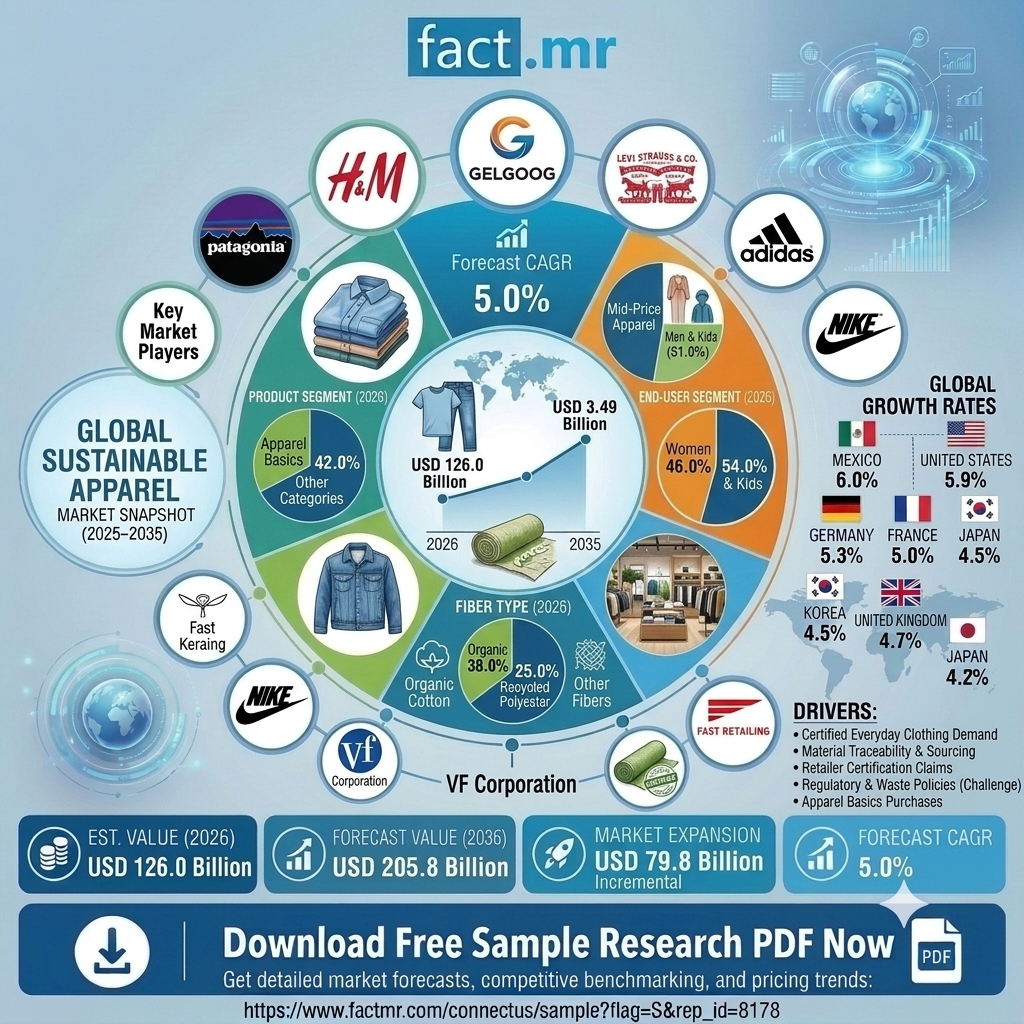
Fact.MR forecasts the sustainable apparel market to grow at 5.0% CAGR through 2036, supported by certified fibers, traceable sourcing, and demand for everyday clothing.
November 7, 2026 — The global sustainable apparel market is projected to reach USD 205.8 billion by 2036, increasing from USD 126.0 billion in 2026, according to Fact.MR. The market crossed USD 120.0 billion in 2025 and is expected to expand at a compound annual growth rate (CAGR) of 5.0% between 2026 and 2036. Growing adoption of organic cotton and recycled polyester in everyday clothing is supporting this expansion, while retailers are placing more certified products in regular apparel collections.
The market is expected to generate an incremental revenue opportunity of USD 79.8 billion over the forecast period. Apparel basics, particularly T-shirts and denim, are central to this development because retailers can introduce certified materials into frequently purchased products without changing established shopping habits.
Get detailed market forecasts, competitive benchmarking, and pricing trends: https://www.factmr.com/connectus/sample?flag=S&rep_id=8178
Sustainable Apparel Market Growth Driven by Certified Everyday Clothing
The shift toward sustainable apparel is becoming more visible in regular retail assortments. Brands are moving beyond limited sustainability collections and incorporating verified fibers into products designed for everyday use. Organic cotton remains an accessible option because consumers recognize the material and retailers can communicate certification claims through familiar product labels.
According to Textile Exchange's Materials Market Report 2025, 34% of global cotton production comes from certified sources. This provides apparel manufacturers with a wider sourcing base for cotton-based clothing. Recycled polyester is also gaining attention, particularly among sportswear manufacturers seeking recycled materials for activewear and performance clothing.
However, adoption is not uniform across price categories. Certified fibers and independent audits increase production expenses. Economy apparel manufacturers face tighter margins, making it harder to introduce verified materials without raising retail prices.
Apparel Basics and Organic Cotton Lead Segment Demand
Apparel basics are projected to account for 42.0% of the sustainable apparel market in 2026, making this the leading product category. T-shirts and denim support repeat purchases and provide brands with practical opportunities to introduce certified fibers into high-volume collections.
Organic cotton is expected to represent 38.0% of the market by fiber composition in 2026. Its familiar material profile and recognizable certification labels support consumer acceptance. Recycled polyester, meanwhile, is finding applications in performance wear and outerwear as textile mills improve material sourcing and yarn documentation.
Retail is forecast to hold 54.0% of market revenue in 2026. Physical stores remain important because shoppers can assess garment sizing, fabric texture, and product quality before purchasing certified clothing.
Women are estimated to account for 46.0% of demand by end user. Mid-price apparel is projected to capture 51.0% of the market, reflecting consumer willingness to pay a modest premium for verified material claims. Organic certified apparel is anticipated to hold 44.0% share by certification type.
Regional Outlook: Mexico Leads Country-Level Growth
Mexico is projected to record the highest country-level CAGR of 6.0% through 2036. Nearshore apparel sourcing and textile trade with the United States are supporting opportunities for manufacturers supplying certified clothing to North American retailers.
According to Cámara Nacional de la Industria Textil (CANAINTEX), Mexico recorded USD 7,307 million in textile and apparel exports between January and October 2024. This export base offers opportunities for suppliers capable of providing traceable fiber blends and reliable delivery schedules.
The United States is forecast to expand at 5.9% CAGR through 2036. Established retail networks and growing interest in traceable basics are supporting market development.
In Europe, Germany is expected to register 5.3% CAGR, followed by France at 5.0% and the United Kingdom at 4.7%. Textile waste regulations, collection programs, and repair initiatives are influencing apparel sourcing decisions across these markets.
South Korea is projected to grow at 4.5% CAGR, supported by recycled polyester adoption in sportswear exports. Japan is expected to record 4.2% growth as durable clothing and retailer collection programs support demand.
Policy Changes and Material Traceability Shape Industry Priorities
Regulatory developments are influencing how apparel manufacturers approach product durability and material sourcing. The European textile policy framework is encouraging businesses to consider garment longevity, textile collection, and recycling requirements during product planning.
The Waste and Resources Action Programme (WRAP) reported that UK Textiles Pact signatories reduced carbon emissions by 8% per tonne of product in its 2023–2024 progress report.
France is also introducing policy pressure on ultra-fast fashion practices. A French Senate legislative text established penalties of up to EUR 10 per product by 2030 for specified practices. These developments are increasing attention on longer-use clothing and responsible production models.
For manufacturers, maintaining reliable certification records is becoming a commercial consideration. Retailers increasingly need product-level evidence to support sustainability statements and sourcing decisions.
Competitive Landscape and Business Opportunities
The sustainable apparel market includes established international brands competing through material sourcing, product durability, and retail positioning.
Key companies profiled by Fact.MR include Patagonia, Inc., H & M Hennes & Mauritz AB, Levi Strauss & Co., Adidas AG, Nike, Inc., VF Corporation, Kering S.A., and Fast Retailing Co., Ltd.
These companies are pursuing different approaches to certified materials and longer garment use. Patagonia has established repair-focused initiatives, while Levi Strauss & Co. and Adidas AG are associated with material and circularity programs. H&M and Fast Retailing operate across large apparel retail networks, providing opportunities to incorporate certified materials into broader product assortments.
Shambhu Nath Jha, Principal Consultant at Fact.MR, comments, "CXOs will see sustainable apparel demand move toward certified everyday clothing. Verified fiber origin and affordable pricing are helping retailers and DTC brands expand sustainable apparel across regular product lines."
Fact.MR Research Identifies a USD 79.8 Billion Revenue Opportunity
The research examines market opportunities across apparel basics, performance wear, and outerwear. It also evaluates demand by organic cotton, recycled polyester, and novel biofibers, alongside retail, direct-to-consumer online, and wholesale distribution.
Sustainable apparel market research coverage: Fact.MR evaluates certified clothing made with organic, recycled, or audited materials, using a hybrid forecasting model combining apparel revenue estimates and bottom-up product volume projections.
The assessment covers more than 40 countries, with detailed country-level forecasts for Mexico, the United States, Germany, France, the United Kingdom, South Korea, and Japan. Research inputs include primary interviews with apparel brand managers, textile mill operators, certified fiber suppliers, and wholesale distributors.
Businesses seeking to understand sourcing opportunities, certification requirements, and regional demand patterns can access the [LINK: Fact.MR Sustainable Apparel Market Report] for detailed forecasts from 2026 to 2036.
About Fact.MR
Fact.MR is a market research and consulting firm providing industry analysis, market forecasts, and strategic insights across global business sectors. Its research combines primary interviews, secondary data analysis, and proprietary forecasting models to help businesses evaluate market opportunities and make informed decisions.

 English
 Arabic
 French
 Spanish
 Portuguese
 Deutsch
 Turkish
 Dutch
 Italiano
 Russian
 Romaian
 Portuguese (Brazil)
